





When the Boston Celtics won the 2024 NBA championship, they did so with three centers who thrived on the perimeter. Sure, Kristaps Porzingis was a nightmare on the high post, and Luke Kornet had a knack for coming up with clutch, timely passes out of the short roll, and Al Horford was the connective tissue at both ends.
Yet for the majority of the time, they operated as part of a five-out offense.
Both Horford and Porzingis were capable of (and sometimes did) spending some time at the four, too. That
trio of big men was ideal for what Joe Mazzulla’s system needed at the time. They spaced the floor, hit their threes, and even Kornet, who is a non-shooting big, found ways to excel in a five-out offense.
We saw that system continue into the 2024-25 season. Again, everything worked as intended, apart from Porzingis’ struggles with POTS, which unfortunately appears to be an ongoing issue for him.
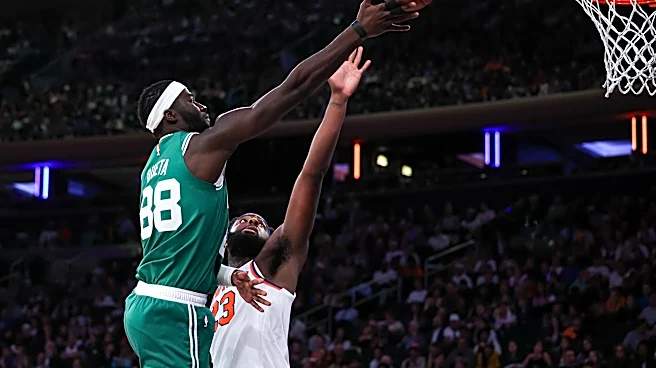
Yet, last summer, as Brad Stevens began to restructure the roster, the role of the big man position began to shift. With the elevation of Neemias Queta, Boston began asking different things of its bigs. Sure, Queta still spent a reasonable amount of time as a screener and dribble hand-off creator on the perimeter, but he also featured prominently as a roll-man (accounting for 24.3% of his offense, to be precise), while also being tasked with battling on the offensive glass.
Luka Garza, on the other hand, spent most of his time either spotting up around the perimeter or snagging offensive boards.
The roles of both bigs were well defined. They were put in positions to succeed based on their skill sets, while also being pushed to expand their game as the season went on. Yet, one core aspect of their role stood out above all others: their primary task was to get offensive boards and help the team maximize its possession game.
Now, it’s not like the Celtics didn’t ask their veteran trio of 2023-24 and 2024-25 to do this; they most certainly did, just not near the same level or frequency. In 23-24, the Celtics ranked 14th in offensive rebounding as a team. In 24-25, they jumped to 10th.
Last season, their climb continued as they finished the regular season ranked 7th in the NBA for offensive rebounding.
This summer, Boston doubled down on its quest to become one of the most possession-maximizing teams in the NBA by adding Mitchell Robinson.
Robinson, 28, is one of the best offensive board-getters in the NBA. For the past five seasons, his rebounding totals have been a near 50/50 split between offensive and defensive boards. Last season, he secured second-chance opportunities on 21.2% of his team’s missed shots while on the floor, placing him in the 100th percentile among bigs.
Suddenly, Boston’s new trio of big men all excel at one very specific thing, and that’s going to be their primary remit throughout the upcoming season, and likely the years to come. Sure, they’re going to go about their jobs in different ways. Garza, when on the court, will still lean into his perimeter shooting; he’s too good not to. Queta is the most mobile screener out of the trio. Robinson is a high-level roller who can space the floor vertically or provide physicality on the low block.
Optionality.
That appears to be the buzzword within the halls of the TD Garden these days, and that’s exactly what this trio will give you — options due to differing skill sets, but with one clear throughline.
However, there appears to be one big caveat to Boston’s plan. Robinson, for all of his floor-raising talents, joins the Celtics with legitimate injury concerns. He’s missed sizeable chunks of play in recent years. So much so that he spent last season on a sort of minutes management program.
“There was never a specific minutes limit, so to speak,” Jonathan Macri of Knicks Film School told me during a recent episode of the ’Celtics Chronicle’ podcast. “I think there were some games this year where he played in the high 20s, over 25. (But) You can probably count them on one hand…They basically treated him like a sub-20-minute-a-game player in the league…So your starting line is not 82 games, assuming the Celtics also continue with the plan, and they may not.
“If they don’t, that would actually worry me more as a Celtics fan if the Celtics were like, ‘You know what? We’re gonna run Mitchell Robinson out there on the second night back-to-backs. We’re gonna be fine with it.‘ If they continue treating him with kid gloves, your ceiling is probably 20 to 25 minutes per night over 65 games, and that’s not even factoring in other injuries.”
The Celtics are no strangers to dealing with players who require minutes management. They did so with Robert Williams and had great success while managing Malcolm Brogdon’s playing time during his Sixth Man of the Year tenure with the franchise.
Therefore, there’s no reason to believe Robinson won’t be a success or won’t be put in a position to succeed. However, what we should probably expect is a return to the ‘big man by committee’ approach that became commonplace during Brad Stevens’ tenure as head coach.
To me, the whole point of acquiring three high-level offensive rebounders is to ensure that when someone is out due to injury, rest, or management, the crux of the bigs’ offensive role remains intact. No Robinson? Cool, Queta and Garza can get the job done. No Queta? Well, you get the idea…
Regardless of whether Robinson starts games or comes off the bench, it’s likely he’s going to sit in the 18-minute to 22-minute per night range. That leaves 26 minutes to 30 minutes of playing time for Queta and/or Garza to fill.
The most likely outcome is that Mazzulla and his coaching staff will spend the opening weeks, or months, of the season figuring out how to best utilize the trio of bigs at their disposal. Could Garza slide to the four and provide spacing in a similar role to what we previously envisioned for Danilo Gallinari? Or will the coaching staff go for straight minutes splits between the three, something like 20/20/8 with Garza getting the smaller piece of the pie?
We won’t know until the season is underway.
Still, if there’s one thing Robinson’s addition has got me thinking, it’s that Boston is about to lean heavily into possession-maximization, with a premium placed on offensive rebounds, which is likely where a fair share of Boston’s two-point attempts will come from next season (Robinson ranked 12th in the NBA for putback attempts per game last season, shooting 54.9% on those possessions).
With a heavy three-point system, guards and wings will be tasked with “boarding up,” meaning they will cut from the corners, wing or baseline, toward the elbows/nail to snag long rebounds off of misses, while the bigs will eat in and around the paint.
Boston is heading back to its ‘big man by committee’ era, only this time, there’s a clear plan, and it’s one that perfectly fits the system Mazzulla loves.