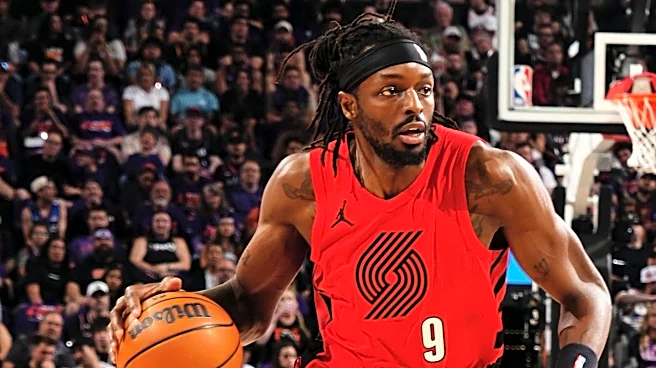




With the conclusion of the 2025-26 season for the Portland Trail Blazers, we’re running down the major players on the roster, recapping their year and asking what the future holds in store for each. Today we’re going to take a look at one of two prominent veterans on the squad, forward Jerami Grant. Brought to the team in what seems like another era—the heyday of Damian Lillard—Grant still serves as an important rotation member and occasional starter. How did he do this season? Let’s take a look.
Season Stats
Here is Grant’s basic stat block for the year:

OTHER STATS
Grant excelled in a couple of deeper stats this season. Though his field goal percentage and three-point percentage remained within his career bell curve, he registered a career-high True Shooting Percentage of .608. This happened, in part, because of his continued excellence in free-throw shooting and the highest rate of drawing free throws per field goal since he was 24.
This was counterbalanced somewhat by Grant being available for only 57 games. This marked the third straight season—five out of the last six—that he’s appeared in fewer than 60 outings. It seems pretty clear that the 30-year-old version of Jerami Grant is going to be good for about three-quarters of a season at best, not a full campaign.
Change Year-Over-Year
Grant rebounded this year from a disastrous 2024-25 campaign:
- His Field Goal Percentage rose from 37.3% to 45.3%.
- His Three-Point Percentage didn’t reach the 40% heights of his early tenure in Portland but 38.9% is pretty good, especially for a Blazer.
- 18.6 points per game this year is far better than the 14.4 he registered last season.
- Despite the earlier complaints, 57 games played is better than 47 too.
- Last year Grant averaged a horrific 38.1% on two-point shots. This year he shot 51.3% inside the arc. That’s a massive leap.
- Last season Grant drew 3.5 foul shots in 32.4 minutes of play per game. This year he earned 5.6 free throws in 29.7 minutes per game. That’s also a significant improvement.
If we have a quibble with Jerami, it’s that his turnover rate increased about 66% on a per-minute basis, 62% if you measure per possession. But he’s an endpoint for the offense, not a conduit. He generally stays under control. He doesn’t commit that many turnovers to begin with, so the real-life effect of him losing the ball more pales in comparison to his other, more turnover-prone teammates. He’s producing around 16% of the team’s points, only 12% of their turnovers.
Analysis
Blazers fans can be proud of Jerami Grant’s season the same way parents are proud of their student who utterly fails a math course, then takes it next year and gets a B. That’s great improvement. You’ll live with it and rejoice.
As he surged back, Grant filled useful roles for this team. He was their third-leading scorer. He remained their best three-point shooter outside of Matisse Thybulle, who only played 30 games. Grant often became the bail-out guy when Portland’s offense was stalling, one of the players who knew how and where to get his shot off even when put in poor positions. The Blazers don’t have a ton of alternatives in these departments. His contributions were welcome.
Grant also showed willingness (and flexibility) to play off-ball more this season, to come off the bench instead of starting, and to get to the rim a bit more instead of settling for threes. Within the space and roles open to him, he made a mark.
For those who would vilify Jerami, comparisons to teammates might help. Grant ended the season in a virtual tie with Shaedon Sharpe and Jrue Holiday in FG%. He was only a shade under Deni Avdija in that department too. He shot from the arc better than any of them. Sharpe produced more points per game, but his point-per-shot ratio was 1.2. Jerami’s was 1.45, significantly better. Basically, most of the things you like offensively about Sharpe, Holiday, and even Toumani Camara, you should also like about Grant. He was as useful as anybody.
Two matters bear further analysis, though.
First, Grant appears to be slowing down as he ages. It shows up on defense. The days of him darting and flying all over the court are gone. He’s a net-negative influence on defense now, not the multi-tool player who made the Olympics at the peak of his career. Nor has he ever been a help on the glass. If he’s not hitting threes or saving Portland’s bacon on offense, there just isn’t as much reason for him to be on the floor. It’s hard to criticize Grant too harshly for this, but it’s becoming harder to justify his value over the rest of the NBA’s power forwards either.
This is exacerbated by a salary of $34.2 million per year with $36.4 million on a player option following. This puts Jerami right alongside fellow veteran Holiday as the highest-paid players on the team. Nobody else is even close.
$34 million would be a cheap rate for a star, or even a 28-year-old version of Grant. For a decent-to-good power forward who isn’t changing the game on defense, doesn’t rebound, isn’t on the same timeline as his teammates, and is probably the fourth- or fifth-most valuable player in the rotation, it seems like a lot. It’s possible to be completely proud of your mathematician’s B- while still admitting that you kinda want more, especially for that investment.
The Future
Given the development of the players around Grant on the roster, it’s a virtual certainty that his name will be included in trade talks this summer.
His value on the market is uncertain, maybe questionable. Nobody is going to sneeze at 19 points per game, but there’s no longer much hope that those 19 will become 23 with the right opportunity. And even if they did, teams are cutting and trading players who score 20 but don’t play great defense. They’re not a hot commodity in a league where everyone scores. Fantastic three-point shooting might make up the difference, but Grant’s is on the high end of good, short of great.
The slightly-hefty contract Grant carries could become an asset if the Blazers need to match salaries in a trade for an established veteran. Honestly, though, it has one too many years (and twice as much real-life dollars) to be attractive. Portland would probably have an easier sell if it expired next year. As it is, potential trade partners might covet Holiday—a two-way player who’s still excellent as his position with many of the same assets as Grant—if they need to take on a vet.
If Portland really wants to move Grant, they might have an easier time at the 2027 NBA Trade Deadline—when half of the annual obligation for his salary would be paid already—than they would in the next few months.
Either way, it’s likely that Grant will settle into a utility role as his career progresses, dotted with bits of brilliance that hearken back to the time when he was a central figure for his franchises. The good news is, the Blazers can always use the utility and the dots. The bad news is, they probably need more at this juncture: more scoring, more shooting, more dependable and team-connected offense, more rebounding, and more defense.
Portland is looking for lightning in a bottle. Grant is a dependable double-A battery. The gap between team needs and actual, on-court production is likely to keep enthusiasm down for the remainder of Jerami Grant’s tenure in the Pacific Northwest. Trade, expansion draft, or running out the contract…the story will end one way or another. As much as Grant bounced back this year, as many good things as we can say, it’s still hard to avoid the impression that both he and the Blazers are running out the string.