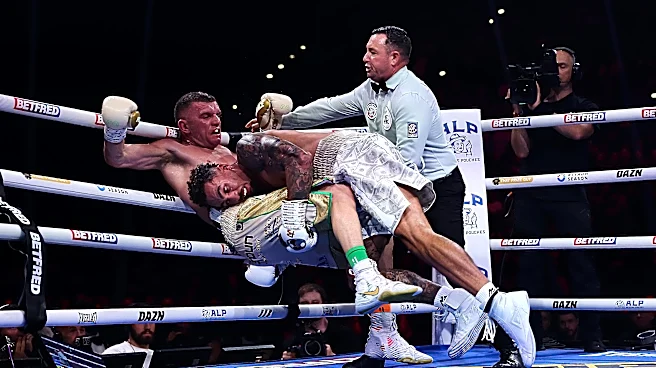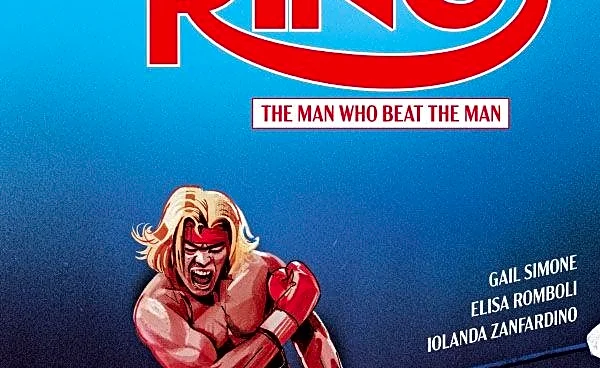








There are few more time-honored traditions among the societal elite than commissioning high art. Call it the Medici Method, though suspiciously wealthy furries with extremely niche interests tend to carry that torch these days. It should come as no surprise, then, that Turki Alalshikh’s attempted conquest of the sweet science includes an ongoing graphic novel series published by the venerable Dark Horse Comics.

This isn’t some United Passions-esque bit of hagiographic slop; Dark Horse enlisted legendary
comics scribe Gail Simone, author of highly regarded runs of series like Birds of Prey, Secret Six, Batgirl, and Deadpool, to pen it alongside capable and credentialed artist Elisa Romboli. There’s genuine talent and effort directed towards crafting a compelling narrative, one with a message beyond “big spinning hypno eyes implanting the phrase ‘read The Ring’ into your brain like a Manchurian candidate.”
Halfway through, I’m not sure they’re succeeding. Or, to be frank, if they even can.
Our story, helpfully spelled out in plain text by the third issue’s opening page, concerns “[s]easoned-but-never-jaded boxing journalist Cameron Duggan” having “brilliant social media maestro Lisa Wolfe” foisted upon him by his editor to jazz up their coverage. The two jet around seeking soundbites from a collection of eclectic heavyweights whose countries of origin account for 50-90% of their characterization
A writing snob though I may be, I’m not going to criticize a fighting-centric series with an international cast for playing into stereotypes. It’s practically an honored tradition; Street Fighter, Punch-Out, Baki, etc. If you like stories about people hitting each other really, really hard, you’ve just got to accept that:
- Your mob-affiliated Russian antagonist will be nicknamed “The Bear” and look like Ivan Drago ate Ivan Drago.
- Your giant friendly Chinese supporting character will bear a passing resemblance to Retsu Kaioh and sport the moniker “The Great Wall.”
- Your French representative will be a former ballerina with a passion for sculpting, red wine, and tiny cups of tea.
- Your British victim of the week will dye his hair into a Union Jack.
After a handful of somewhat disparate character studies, that third-issue recap suggests that the central conflict will concern “this year’s Ring Belt tournament,” which perked me up a bit. If there’s one thing I hope I’ve made clear over the years, it’s that I love tournaments. World Boxing Super Series, PRIDE Grand Prix, Maximum Tournament, Dark Tournament, Tenkaichi Budokai, Kengan Annihilation Tournament, you name it; put together a roster of colorful characters, give them something to compete over, and I’ll be a happy camper.
The end of the fourth issue, however, intimates that the second half will instead revolve around the fighters’ efforts to take down Victor Moretti, your corrupt, slick-haired, crisply suited scumbag promoter du jour.

When I read that, my misgivings boiled over.
I was already a bit skeptical of the setup I expected, because while I can keep my snobbery in check for some storytelling conventions, I take my tournaments very seriously. The clashes of styles have to be just as interesting as the clashes of personality; a fight is just as ripe a tool for exploring characterization as a conversation. I’ve made a whole-ass PowerPoint on the narrative potential inherent to fight scenes, which made it extra disappointing that “The Man Who Beat The Man” has no interest in exploring that avenue. Even when we see them in action, portrayed in a pleasingly loose and kinetic style courtesy of Romboli, there’s basically no indication of how these men fight outside of the occasional stray observation.

To be clear, I wasn’t expecting blow-by-blow minutiae on the level of Hajime no Ippo. This is a limited series with full color and shading, not a black-and-white weekly of indefinite length; they don’t exactly have the time or real estate to get into the weeds. Still, at least a token effort would have been appreciated, especially since the lack of one further highlights the creative team’s apparent lack of boxing knowledge.
Every once in a while, some weird detail will crop up that makes me question how much research Simone and co. did. You’ll note in that first image that despite the series taking place in the modern day, Marcus King’s fight is scheduled for 15 rounds. When King hits the deck in that same issue, the referee counts down from 10, and though the commentary duo highlights King’s signature “double left jab,” he goes southpaw when he stands up. Again, not expecting a painstakingly faithful labor of love on the level of Do a Powerbomb and I know I sound like a Genius at Work saying this, but it’s jarring to see basic aspects of the sport handled incorrectly.
While a devil’s advocate could point to the disclaimer that this is a “fictional, merciless landscape,” the aforementioned French dandy name-drops Marcel Cerdan, Ray Robinson, Muhammad Ali, and Manny Pacquiao. This is the world and sport we know, just filled with people we don’t.
But, you know, the mechanics aren’t the focus. Fine. I could live with that, provided everything else was handled well. We all know Moneyball wasn’t an accurate representation of the A’s season and that any professional musician would laugh Whiplash’s script out of the room, but they’re still classics for a reason.
Even taken in a vacuum, however, The Man Who Beat The Man’s narrative struggles.

Much is made by the surrounding cast of Wolfe’s journalism chops. We’re meant to see her as a relentless pursuer of truth, a razor concealed by doe eyes and an “aw, shucks, lil’ ol’ me?” affectation bolstered by her self-proclaimed lack of boxing knowledge. In practice, however, all she really does is ask the bluntest, most provocative questions with no preamble and then film the fighters’ reactions. Even for a hostile interview, that’s bad form. The entire crux of Frost/Nixon was Frost learning to manipulate Nixon into lowering his guard, yet Wolfe is presented as an ace reporter for the functional equivalent of heckling. Few things are more aggravating in a narrative than being told, not shown, that a character is a standout in their field.
Trust me, I get the appeal. When we watch promoters and politicians lie their way through press conferences, we all wish someone there would just stand up and put them on the spot. Hell, my Reddit username is a reference to Transmetropolitan’s Spider Jerusalem, a blatant power fantasy built around the idea that hard-hitting journalism can save the world. But there’s an art to it. I should know; I blew an interview with Mauricio Sulaiman a couple years back because I dove right into his preferential treatment of Jermall Charlo and he hung up on me.
So the whole “defeating corruption with the power of the truth” angle kinda falls flat on its own merits. Taken in the context of the comic’s real-world background, it’s egregious.
Turki Alalshikh’s name, preceded with a abbreviated “His Excellency,” appears at the start of every issue. It’s a story about the weight and power of unvarnished truth, bankrolled by someone who purchased and hollowed out the sport’s most prominent publication for his own benefit. Plus, while Duggan and Wolfe are never explicitly said to be working for the in-universe version of Ring Magazine, the implication is strong, particularly when Duggan waxes poetic about how the Ring title is “not mixed up in political horseshit” and “[t]he last pure title in the sport.”
Viewed from the macro level, we’re talking about a self-interested promoter who’s BFFs with arguably the most self-interested promoter in combat sports portraying his (now former, admittedly) media outlet as the bane of self-interested promoters. It’s a Joseph Heller bit writ large.
My feelings on separating art from the circumstances of its creation is a whole other mess that I’m not going to get into here. Bad people can make great art and, as when faceless megacorporation Disney gave us arguably the 2020s’ best piece of anti-authoritarian mass media, societal elites can and have bankrolled art whose message goes against their interests.
But here and now, too weak to stay afloat while inescapably weighed down with its progenitors’ baggage, The Man Who Beat the Man can’t justify its own existence.