





EDITOR: Click here for part 1 (Takes 1-5), which was published earlier today.
6. Setting the table for key roster battles on the defensive side of the ball.
Heading into the offseason, it was clear that the Chicago Bears’ defense needed some work. Following the exit of key veterans like Byard, Jaquan Brisker, Nahshon Wright, and Tremaine Edmunds, there’s still plenty to earn as the team heads into training camp. Let’s take a deeper look into the key roster battles that will be happening on the defensive
side of the ball.
- Defensive End
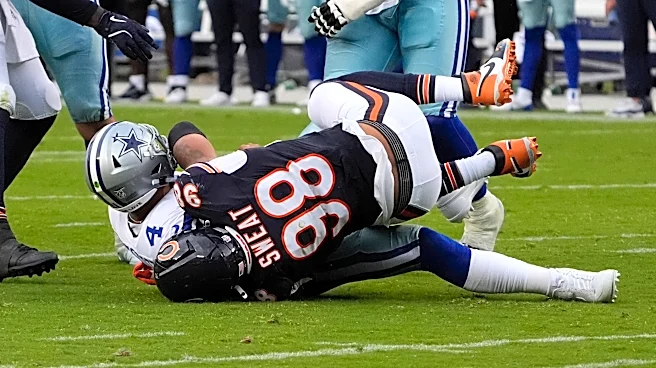
The top of the depth chart is set with Sweat and Booker as the two starters, but everything else behind them is unsettled. Maybe not from a “who makes the roster?” standpoint, but health and upside will play a role. While I’m still expecting them to add a name (impact TBA), it’s clear they are willing to play out the string with Odeyingbo, especially with his uncuttable contract. How the rotation unfolds behind the two starters will be fascinating to monitor.
- Defensive Tackle Depth
Assuming good health, the top three in the team’s rotation appear to be set with Dexter, Jarrett, and Gallimore. That said, there’s still some intrigue to see how that rotation plays out. Behind them are a group of veterans and their sixth-round pick that they traded up for in van den Berg. Kentavius Street was signed early in the offseason, and veteran James Lynch followed shortly behind. Although they could end up keeping five names, there’s also a strong likelihood that these three names, plus undrafted free agent Jayden Loving, could be fighting for one spot, and potentially two additional practice squad openings.
- Linebacker
As highlighted above, health and availability will play a key role in which depth pieces they keep. In addition, they have to figure out how to deploy their starting linebackers. Devin Bush is locked into a key spot, but how they handle the other primary opening will be interesting between T.J. Edwards and DeMarco Jackson. Physically, Jackson fits the scheme better, but the Bears’ insistence on extending Edwards last offseason causes a tough situation due to how much he’s being paid. Ultimately, all three players will “start” in some capacity, but as we learned last year, the “starting” SAM doesn’t see the field often. Behind them will be an interesting mix of veterans and younger players. Jack Sanborn is back in the mix, along with last year’s fourth-round pick Ruben Hyppolite, fifth-round rookie Keyshaun Elliott, the Sewell brothers, and a pair of undrafted free agents. The roster crunch at the back of the depth chart will be fascinating to follow.
- Cornerback Depth
Although the depth chart at cornerback isn’t as deep as linebacker, there are still plenty of fun battles to monitor over the summer. The health of Johnson and Gordon will be a focus, but the battle between Stevenson, Muhammad, and Smith for the starting spot opposite Johnson will be interesting. Behind them are Jaylon Jones and Dallis Flowers on the boundary, and Josh Blackwell, Lewis, and Dontae Manning at the nickel. This should be a good group, health willing, but there are multiple areas to watch throughout camp.
7. Assessing the deepest positions on the roster.
It’s been a while since fans could attend training camp without worrying about the roster. Even though last year went as well as it could have, the general preseason expectation was not to win 11 games or win the division. That said, we’re a year removed from some of those questions, and expectations following it are much higher. Here’s how I’d rank the three deepest positions on the roster heading into camp.
- Tight End
Since Johnson’s arrival last year as the team’s head coach, the focus on tight end has been obvious. It started with the selection of Loveland at No. 10 overall last year and continued in April with the selection of Sam Roush in the early third round. Combine that with Cole Kmet and all of a sudden, the Bears have one of the deeper groups in the entire league. We’ll see how quickly they get Roush involved as the TE3, but it’s clear that this offense will feature plenty of 12 and 13 personnel looks.
- Offensive Line
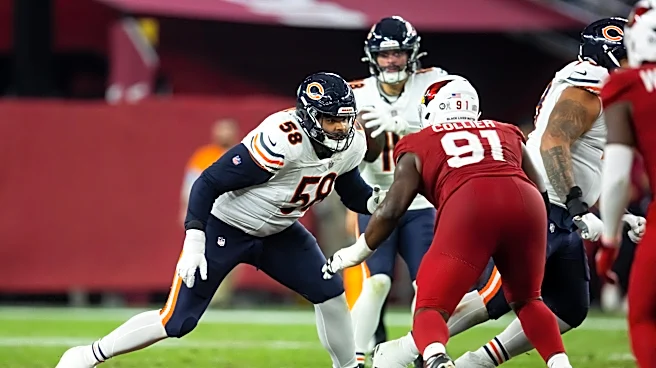
Losing your starting left tackle and center in the matter of two months is never ideal, yet the team has done a good job of not only providing quality replacement options but fortifying the depth around them. Joe Thuney remains one of the best interior linemen in the league, and Darnell Wright is firmly in the Top 5 conversation at right tackle. Assuming Jonah Jackson can stay healthy and neither of the two competition spots become problematic, the roster battles behind them should provide them with some of the best all-around depth in the league.
- Safety
Despite heading into free agency with no 2025 rostered player under contract, it’s easy to see what the Bears were looking to do this offseason. Replacing Kevin Byard won’t be easy, but the free agent addition of Coby Bryant could prove to be an upgrade over time. All things considered, Dillon Thieneman was a best-case scenario for the Bears at No. 25, and with depth players like Elijah Hicks and Cam Lewis behind them, this should be an athletic group with high takeaway potential.
8. Assessing the weakest positions on the roster.
Potential Super Bowl contender or not, every team will have its weak spots on the roster. For the Bears, much of that comes on the defensive side of the ball, after they took a conservative approach to their roster’s weakest spot. Only time will tell if the defensive trenches are Super Bowl-ready, but on paper, there are some concerns, and justifiably so.
- Defensive End
Last year, the front office went out and splurged along the defensive line with a combination of two big free agent contracts and a second-round pick. A year later, you’d be hard-pressed to find anyone who believes that any of the three acquisitions made were net positives. Despite that, Chicago held firm at edge rusher in hopes that a healthier year from Odeyingbo and Turner will be enough to get them by. While I remain skeptical of that approach, there’s still time before the start of the regular season for them to adjust, whether through a free-agent signing or a notable trade.
- Defensive Tackle
Last year’s big free agent addition was Grady Jarrett, who, in the nicest of terms, didn’t pan out as hoped in Year 1. Considering he’s now 33, their offseason approach of adding four new bodies made sense. The bigger issue is that the quality of names they added might not be difference-makers, which puts more pressure on a player like Gervon Dexter Sr. to make a big impact in a contract year. Neville Gallimore should see a quality share of snaps in 2026, but this group, without a break star, lacks a true difference-maker, which is a concern in today’s NFL.
- Specialists (Primarily Long Snapper)
Cairo Santos is about as reliable as they come within 50 yards. Still, the league is rapidly changing and having a kicker who can consistently push the boundaries of 55-plus is almost a must. All things considered, the Bears could do a lot worse there, and the same could be said about former fourth-round punter Tory Taylor. The bigger concern (or focus) is at long snapper. It was a curious decision to let Scott Daly walk in free agency, and now they’ll head into training camp with a pair of long snappers who have never played in an NFL regular-season game. It might be a position that many overlook, but the importance of repeatable consistency should not be overlooked. Until this spot is solved, there should be some concern.
9. Where the rookies start on the depth chart when the team opens camp versus where they end up heading into Week 1 will be worth monitoring.
Outside of the rare occurrence where teams simply hand rookies starting jobs out of the gate, there’s always an “acclimation period” where rookies must prove to their teammates and coaches that they belong in a bigger role. That’s exactly the approach that Johnson and his staff have taken the first two years in Chicago, but by the time the regular season rolls around, all the talk of trust fades.
Last year, we saw both Loveland and Burden brought along more slowly than expected. Still, injuries limited both players’ ability to see the field early in their rookie seasons. On the flip side, running back Kyle Monangai was quickly launched into a RB2 role, and most of that was thanks to a consistent camp performance. All in all, the Bears finished the season with one of the league’s most impactful rookie classes. While fans probably shouldn’t expect a one-for-one repeat this season, it’s fair to assume that there will be a handful of rookies that will see meaningful snaps early this year.
Barring an injury (or other unforeseen setback), Thieneman will be starting Week 1 opposite Bryant. In fact, because of the injury to Lewis, the 25th overall pick was already seeing time with the 1s in red zone drills near the end of the team’s mandatory mini camp. Jones’, the team’s second-round pick, path to a starting role is a little less clear. While there has been some speculation about a potential trade involving Bradbury, Johnson’s preference for a veteran center is notable and should not be overlooked. Similar to Trapilo’s path in 2025, don’t be surprised if Jones starts the regular season as a depth piece.
Roush and Thomas are two more names from this class that are highly unlikely to start in Week 1, but should have defined roles with some value early in the season. Assuming that all goes well in Roush’s development throughout camp, fans can expect him to start the season as the team’s third tight end and a valuable blocking option. For Thomas, his role might be slightly less defined in Week 1, but between his special teams value and game-breaking speed, it’s easy to feel comfortable about the coaching staff having a plan for him, even as a gadget piece early in the season.
Muhammad might be the most interesting player in this class (outside of the first round), simply because his path to a starting spot seems to be the most attainable. Veteran Tyrique Stevenson will receive the first crack at the job opposite Jaylon Johnson. Still, with ongoing soft tissue injuries to Kyler Gordon, the fourth-round pick could have a chance to show his versatility in the coming months. While it might feel “safe” to pencil in Stevenson as the second starting boundary corner, Muhammad will have a chance to steal the job heading into Week 1.
Finally, both Keyshaun Elliott and Jordan van den Berg are players that have little shot at a starting role early in their rookie seasons but could provide valuable depth in their own scenarios. Elliott likely slots in as the fourth or fifth linebacker, while van den Berg will have an outside shot to crack the early-season defensive tackle rotation. Both players, especially where they were taken, are more developmental, with some starting upside if all goes well.
Due to them picking later in April’s draft, fans shouldn’t expect the same immediate impact from this class as we’ve become accustomed to over the last few years. That said, good teams find talent no matter where they are slotted in the draft, which means, at least to a certain extent, contributions from the majority of this class should be expected. Much of their early-season expectations will be established from how they perform in camp and the preseason.
10. Contract happenings to anticipate heading into training camp.
This dead period leading into training camp is typically when general manager Ryan Poles and his front office strike deals with upcoming free agents. Unlike previous offseasons, there aren’t many impending free agents for 2027 that require urgency.
By my count, the team has roughly 17 players who are currently projected to make the 53-man roster who will be free agents in 2027. Among those are: RB D’Andre Swift, LT Braxton Jones, DT Gervon Dexter, CB Tyrique Stevenson, WR Kalif Raymond, C Garrett Bradbury, CB Terell Smith, S Elijah Hicks, LT Jedrick Wills, CB Josh Blackwell, and iOL Jordan McFadden. This, of course, doesn’t count players under contract who will need extensions soon, like RT Darnell Wright, and potentially others like CB Jaylon Johnson, DE Montez Sweat, or maybe even RG Jonah Jackson.
Financially, the Bears will have plenty more flexibility starting next season, but with plenty of key free agents set to hit the market in 2028, they could look to get a jump on players they wish to retain. The trouble is that, outside of Wright, there aren’t any clear candidates who fit the mold as in previous years. Swift could be someone they give a short extension to, but I expect both sides will want to play out the final year of his deal. Sweat and Johnson are two more interesting names, but considering their price tags and rising age, it might be smart to let things play out into the regular season.
Overall, Wright presents as the only “no-brainer” option for the team to extend, despite two more years of control (including his fifth-year option). The tackle market, much like every other position, has blown up. That makes a deal somewhat easier to accomplish, while also recognizing that Wright will be getting top-of-the-market money moving forward.
Looking at the market, the top of the position includes a pair of players who signed as right tackles but have recently switched sides: Tristan Wirfs (five years, $140.625 million, with $ 88.224 million guaranteed) and Penei Sewell (four years, $112 million, with $85 million guaranteed). With both players averaging $28 million per season, that seems like a fair endpoint in these negotiations. It’s worth noting that outside of Lane Johnson ($25 million per year), the next tier of players come in at an average of $22 million annually (Zach Tom, Taylor Moton, and Tytus Howard).
The Packers acted fast in securing Tom, and assuming he can get back to full health (and stay there), he’s one of the best value offensive linemen in the league. While it would be nice to get Wright under contract for that type of money, the expected cap rise is more likely to push him into the $28 million-per-year range. Considering Poles has stayed away from five-year commitments, something around Sewell’s deal makes the most sense for both sides. Wright will turn 25 at the start of August, which would mean a four-year deal (with the next two years added on) would afford him one last chance at a big contract. It would also allow the Bears to position his new money into this year and next year, helping cut down overall cap costs for the additional new years of his deal.
My guess on a projected deal: Four years, $112 million with $75 million guaranteed.
It’s the same overall money as Sewell with slightly less in guarantees (due to his minor injury history). A signing bonus in the range of $16 million would allow the team to prorate that cost through the first five years of his deal, ultimately lowering his cap hits when the deal officially starts in 2028. Although it would require an additional $3 million in cap space this season and next, it will allow the Bears to keep his cap hits lower for the first few years of his new deal, while slightly backloading the final year before a likely extension (if all goes well).
Although the Bears’ offensive line is one of the more expensive in the league right now, having Jones on a rookie deal at center and the eventual retirement of Joe Thuney will drastically help by keeping costs lower in future years. Again, the Bears could make a surprise move or two in the extension department in the coming months, but locking down Wright before another sizable jump in the cap makes all the sense in the world. Due to the expected extension and the team’s current cap situation, look for them to make one cap-clearing addition via a restructure.
What are your thoughts on these five takes?