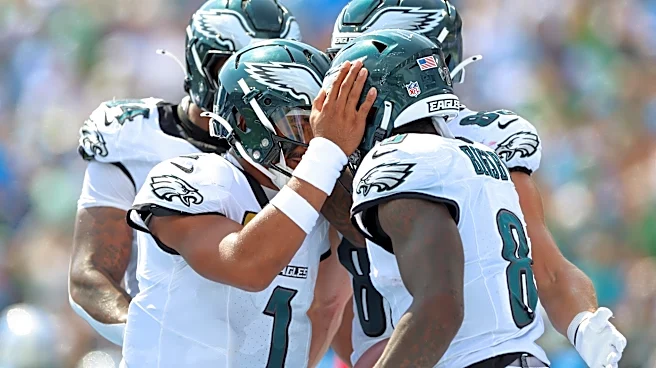



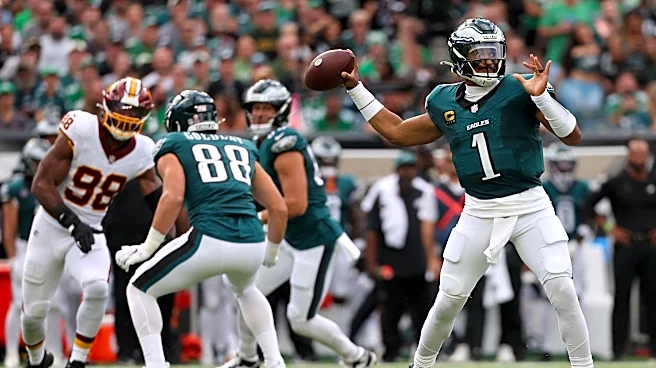
The Eagles won 24-20, and I came away feeling much better about the passing game than I did after Week 1. The Eagles found answers against the Titans’ coverage, attacked the weaknesses I flagged in my preview (which is always great to see), and repeatedly converted third-and-long.
However, the offense cannot keep making life this difficult for itself. The Eagles went 11-of-18 on third down, which is an absurd 61.1% conversion rate. That’s why they sustained drives despite averaging only 4.7 yards
per play, turning the ball over twice and rushing for 89 yards on 32 attempts. Winning on third down is obviously good. Needing Hurts to repeatedly deliver elite throws on third-and-long isn’t a sustainable offensive identity.
The early-down numbers are wild. I mean, come on…
The contrast between the pass and run games could not have been clearer. The Eagles produced +0.17 EPA per passing play but -0.20 EPA per rushing play.
This was not a perfect offensive performance. But the passing game looked excellent for long stretches. Jalen Hurts and DeVonta Smith were elite. Now Sean Mannion and the rest of the offensive staff must find a way to stop wasting early downs before asking them to rescue the offense.
Offense
This opening play might be the most Eagles run of all time. The offense comes out in 12 personnel, condenses the formation and invites the Titans to load the box. There is no numbers advantage, no misdirection and no obvious way to manipulate the second level. The Eagles simply run straight into it. What could possibly go wrong?
Pretty much everything. Johnny Mundt goes to the ground in hilarious fashion, Dallas Goedert is asked to climb to a linebacker he has little chance of reaching, and the combination between Tyler Steen and Drew Kendall is messy. Because the interior double-team never develops properly, Cam Jurgens cannot work up to the linebacker. Lane Johnson then runs into the traffic created inside and cannot generate movement on his block. It is a calamity of errors, but the design makes every error more likely because the defense can attack downhill immediately.
I refuse to post 20 versions of the same failed run, because you all watched the game. The more important question is why this keeps happening. The Eagles ran 79.2% of their offensive snaps from 11 personnel and only 19.4% from 12 personnel. I think that needs to change.
I am ready to set fire to the swing-pass section of the playbook. This is not just about one bad play. The whole operation looks slow. Hurts does not have the quickest release on these throws, and the ball often reaches the receiver when he is flat-footed or moving sideways rather than already attacking upfield. That delay gives zone defenders, who are facing the play, plenty of time to trigger and rally to the football. Most modern defenses are playing zone these days, so this look is common
Perimeter blocking doesn’t save the concept either. Dallas Goedert is blown up by a cornerback here, and the play has nowhere to go. The Eagles do not currently have a group of dominant perimeter blockers who can consistently turn these throws into efficient gains. They also lost five yards on the swing to Makai Lemon immediately before Hurts’ second interception, transforming second-and-7 into another third-and-12.
Screens and swings can be useful answers against pressure or aggressive fronts, but this version threatens no one. Burn it. At least until the Eagles can change the timing, blocking angles, or presentation enough to make it functional.
Now for the fun part. The Eagles loved dagger in this game, and it gave Hurts a clean answer against the Titans’ zone coverage. Marquise Brown runs the vertical clear-out with real intent, forcing the deep coverage to honor his speed, while Dontayvion Wicks pushes his intermediate route beyond the linebackers and settles in the void.
That route depth is really good. The linebackers sit around the sticks on third-and-12, so a shallow in-breaker runs directly into them and leaves Wicks short of the line to gain. By getting vertical first, he creates space behind the second level. The offensive line gives Hurts time, and he hits the top of his drop and layers a perfect throw into the middle of the field. The touch is outstanding.
Brown deserves credit too. He did not play in Week 1, but he ran these clear-out routes hard and looked fast. Very fast! He also carried the ball twice for 12 yards. I am not demanding he suddenly becomes a featured player, but speed changes the defense even when the ball doesn’t come his way. I would like to see more of him. Is that crazy to say?
The first interception is a mistake by Hurts, but it is also a fantastic play by Amani Hooker. Both things can be true. The Eagles are trying to isolate Smith by having Goedert pull the middle safety away, and Lemon occupy the flat defender. They create a window, but it never becomes as clean as Hurts appears to expect. Goedert does not remove the safety far enough with a pretty poor route, Smith’s route could be sharper, and Hooker recognizes the concept and drives on the throw brilliantly.
Hurts is slightly late and should turn it down. In the red zone, especially, he cannot give the safety this opportunity. It was an enormously costly decision, but I can somewhat understand why he made the throw based on the pre-snap look. What I loved was the response. Hurts did not become conservative or hesitant after the interception. He continued attacking tight windows, trusted what he saw, and played aggressively. Quarterbacks will make mistakes. The good ones don’t let one mistake ruin everything that follows.
Look at what happens when the Eagles spread the defense out and run away from the strength of the box. This outside zone rep is not revolutionary, but it gives the blockers a chance. The motion forces the Titans to flow in the opposite direction, and Goedert becomes eye candy rather than being asked to execute another difficult block. Steen and Kendall have room to work, create movement, and open the lane.
This is the wider issue with the run game. I understand that the Eagles are installing new ideas, and I understand why the Shanahan-style world of condensed formations, sift blocks and split-flow action is appealing. But you cannot copy another offense’s menu without having the same ingredients. If the Eagles don’t have tight ends and receivers who can dominate as blockers, stop building the run game around it. We have seen this story before.
The statistical profile reinforces that point. Inside zone accounted for 28.1% of the charted runs and produced -0.31 EPA per play. Outside zone accounted for 25% and was even worse at -0.44. The Eagles need better spacing, more favorable boxes and more ways to slow the second level before the ball is snapped. We have all the run game tracked over on Patreon here, and it’s pretty amazing that we didn’t see a single rep of Counter or Power all game.
This is beautiful quarterback and receiver play. Hurts hits his back foot and throws with anticipation before Smith comes out of the break. His ball placement was exceptional throughout this game, and this is exactly what high-level timing looks like.
Smith’s route is just as good. He straightens his stem to close the space between himself and the cornerback, waits until he reaches the defender’s blind spot, and then breaks outside. Smith then catches the ball cleanly away from his frame, as he did all game, as if it’s effortless. He finished with 117 yards despite only five yards after the catch. He won with route running, body control, and ball skills. He looked like a true WR1 because he is one!
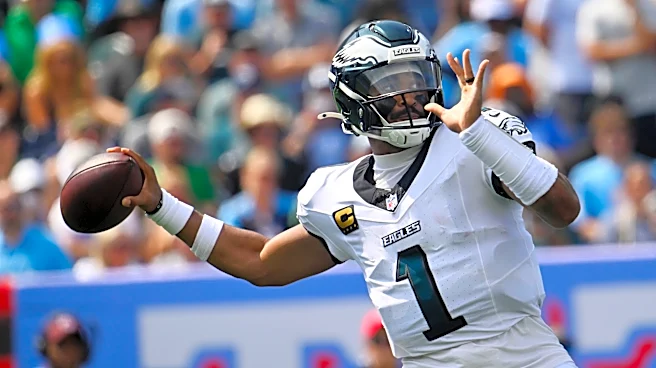
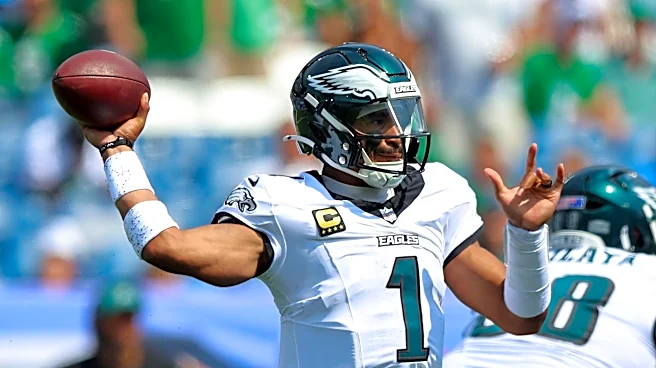
This might be the best Hurts game I have watched in a long time. A long time! Since the Vikings last year, or maybe even the Super Bowl?! The interceptions prevent it from being flawless, but the quality of the throws, the anticipation, and the willingness to stand in against pressure were elite. He did things I have never seen him do. That’s exciting!
This is how the Eagles should use Johnny Mundt. The perception of him as a massive inline mauler has never matched the player I watched on film. He is around 245 pounds and is far more impressive when he can move across the formation, get into space, and find a second-level defender. Asking him to repeatedly kick out defensive ends from a static alignment doesn’t play to his strengths. I made this point in my film review when we signed him.
Here, Mundt leads on the edge and executes his assignment well. Smith also blocks aggressively, and Hurts looks explosive as he follows them for a crucial third-down conversion. Hurts becoming a larger part of the designed running game is an obvious way to help this unit. I understand the concern about exposing the quarterback to hits, but his presence changes the math.
This is elite processing. Lemon’s pre-snap movement gives Hurts information about the coverage, and he checks to smash. The corner route creates the vertical element while the shorter route attacks the flat defender’s leverage. Hurts then adds a subtle pump fake to hold that defender, resets immediately, and delivers under pressure. Big time throw.
We have not consistently seen Hurts manipulate underneath defenders with his eyes and shoulders before resetting this quickly. Next Gen Stats credited the Titans with pressure on 17 Hurts dropbacks, including 14 against four-man rushes. Some of that number reflects the offense asking him to hold the football, but it also captures how well he operated under pressure. Really impressive stuff.
This might be my favorite development from the entire game. Hurts got to backside concepts more successfully than I can remember seeing from him. That is a credit to him and to the coaching staff.
The Eagles appear to pair a quick-game concept to the right with a longer-developing concept to the left. I like that structure because it allows Hurts to eliminate the first side quickly. If the Titans give him the immediate answer, take it. If they close it down, he can reset to the deeper concept without working through a slow, traditional full-field progression, which Hurts has struggled with.
Hurts looks slightly uncomfortable as he transitions because this is not something he has always done naturally, but his pocket movement is excellent. He buys the fraction of a second he needs and finds Smith on the deep over route. The Titans’ safety anticipates the ball coming out with the quick-game action and steps toward it, opening the space behind him.
I specifically called for the Eagles to use deep crossers and overload one side of the field in the preview because the Titans struggled with those concepts against the Jets. The Eagles found the same weakness and attacked it. This is exactly what weekly game planning should look like! It’s always nice when I get something right in the preview…
There were a few small signs that the run game can become more functional. On this outside zone rep, Kendall folds around Jurgens and effectively creates a pin-pull structure. Which I have always loved. Kendall is athletic in space and executes the block well. His movement also simplifies Jurgens’ assignment against Jeffery Simmons. Rather than asking Jurgens to reach or redirect an elite defensive tackle in space, he only has to pin him inside.
That is what good scheme should do. Jurgens did not play well overall, but the offense did him no favors. The Eagles moved him to left guard, a position he had barely practiced, and immediately asked him to deal with Simmons. Nick Sirianni acknowledged after the game that Jurgens had not taken much work at left guard, while Jordan Mailata said he had received one walkthrough there during the summer. Jurgens deserves credit for taking on the challenge, but he struggled.
Kendall looked pretty good, especially when blocking on the move. If the coaching staff believes Kendall is more comfortable pulling, this is a sensible adjustment to revisit. This pin/pull concept produced 16 yards on only three attempts and +0.45 EPA per play, comfortably the Eagles’ best rushing concept in the game.
Then the Eagles returned to the stuff I simply do not understand. Ugh. They use 12 personnel and bring Cooper tight to the formation, creating something close to a nine-man box. With only two legitimate vertical threats in the formation, the Titans do not have to respect play-action enough to create hesitation. The linebackers can attack downhill and meet the run in the backfield.
The Eagles are repeatedly asking the line to create movement against unfavorable numbers while giving the second level no reason to slow down. The design is contributing to the failures.
The Eagles ran 14 qualifying plays from under center and averaged 2.8 yards per carry with a 42.9% success rate. Their 10 shotgun carries also averaged 2.8 yards with a 40% success rate. Simply moving the quarterback under center is not the solution. The offense needs to change the picture for the defense through motion, formation width, play-action tendency, and different run plays. Right now, defenders often know where the ball is going and can play fast.
The Eagles return to dagger here, but the Titans defend it better. The backside safety provides more help on the in-breaking route, so the structure is not as clean as it was earlier. Hurts does not force it. He recognizes the isolation outside and gives Smith an opportunity on the comeback.
Once again, the throw is excellent, and Smith makes the difficult look routine. He works back toward his quarterback and catches the ball outside his frame, preventing the cornerback from playing through his hands. Hurts and Smith were completely in sync throughout the game.
I also liked the aggression of releasing all five eligible receivers. It forces every coverage defender to communicate and cover grass, which was exactly how to attack this Titans secondary. The trade-off is that the offensive line has to survive without extra protection. For the most part, the line held up well enough in pass protection for Hurts to exploit the matchups. I know the protection numbers look bad, but this lacks context.
This sift action (Shanahan guys call this split-zone type of block ’sift’) illustrates the schematic issue with the run game. The Eagles are asking Mundt to cross the formation and kick out the edge defender, creating a lane for Tank Bigsby. That block is fundamental to the concept. Mundt arrives, but he does not have the power to displace the defender, so the gap disappears before Bigsby can reach it.
The Eagles used sift action three times and averaged 1.3 yards per carry without producing a successful run. That is a tiny sample, but it matches the film. The concept is asking Mundt to do something different from the assignment he executed so well on Hurts’ earlier run. On that play, he was moving into space to block a second-level target. Here, he must kick out an edge defender at the line of scrimmage.
This is the downside of releasing five receivers. The Titans show pressure, forcing the Eagles to slide the protection to the right. That leaves Jurgens isolated against Simmons with a two-way go and no help. It is an extremely difficult assignment for an experienced left guard, never mind a center playing the position with almost no practice time.
The Eagles could keep a running back in to help, but that would remove one of the five eligible receivers stressing a secondary that had struggled to communicate all afternoon. I do not hate the decision to go to empty and trust Hurts. Smith destroys the cornerback outside and is breaking open for a touchdown. If Hurts gets another fraction of a second, this could be the play of the game.
The real frustration is how the Eagles arrived at third-and-12. On the previous snap, they ran the swing to Lemon that lost five yards. The passing design on third down is aggressive and excellent, but it is again being asked to repair damage created on an earlier down. Hurts cannot produce magic every time.
I still do not understand how Hurts gets this ball out with this much velocity. The Titans bring pressure, and Hurts does have a hot option, but he holds long enough to attack outside. He cannot fully follow through because the rush is arriving, yet the ball still explodes out of his hand and reaches the sideline on time. Smith’s body control is ridiculous. What a performance.
The Eagles come back to smash, and the Titans still cannot solve it. The cornerback drives on the short route once again, and leaves the deeper corner open. Hurts still has to make the throw, and the placement is perfect.
This is where I think the passing-game coaching deserves real praise. The Eagles didn’t win just because Smith is brilliant, although that helps. They found concepts that attacked Tennessee’s coverage errors from Week 1, repeated them with variations, and trusted Hurts to adjust when the defense changed the picture. It was really promising.
The winning touchdown brings the entire passing-game plan together. Before the game, I wrote that the Titans had repeatedly suffered communication errors against simple motion and late shifts in Week 1. The Eagles used Smith’s motion here, added the switch release, and watched the secondary lose Darius Cooper completely. This was not a miraculous individual play. The Eagles identified an opponent-specific weakness and forced the Titans to communicate with the game on the line. I love it.
Shipley deserves credit for the blitz pickup. He recognizes the pressure and gives Hurts the time required for the coverage bust to develop. Hurts stays composed and finds Cooper uncovered in the end zone.
The offense also used tempo effectively on the drive. That was another point from the preview. I called for the Eagles to get to the line quickly, prevent the Titans from settling, and test their communication. The Eagles did exactly that.
Final Thoughts
I loved the passing game. Hurts was elite outside of the two interceptions. The ball placement, anticipation, way he handled pressure, and willingness to work backside concepts were as good as I have seen from Hurts in a long time. The staff repeatedly attacked weaknesses that were visible on the Titans’ Week 1 film.
The two interceptions cannot be ignored, but I don’t want them to obscure the overall quality of the passing game. Hurts was asked to solve far too many difficult situations and kept doing it. However, the Eagles cannot live in third-and-long against better defenses. The run game lacks a coherent identity. The offensive line must play better, but the staff also has to make those assignments easier.
A very good offense is hiding in here because the most important pieces are playing at an elite level. Solve the early downs, and this performance becomes something the Eagles can actually sustain.
Thank you for reading! I’d love to hear your thoughts, so feel free to comment below and ask any questions. If you would like to support me further, please check out my Patreon here!