





It’s the first full week of the offseason here at BCB After Dark: the hippest hangout for night owls, early risers, new parents and Cubs fans abroad. Come on in and sit with us for a while. We’re so glad to see you. There’s no cover charge. We still have a few tables available. The hostess will seat you now. Bring your own beverage.
BCB After Dark is the place for you to talk baseball, music, movies, or anything else you need to get off your chest, as long as it is within the rules of the site. The
late-nighters are encouraged to get the party started, but everyone else is invited to join in as you wake up the next morning and into the afternoon.
Whatever I asked you before the playoffs started is irrelevant now. So I’m going to ignore it.
Here’s the part where we listen to jazz and talk about movies. You’re free to skip that. Or stick with it and skip the baseball stuff. Heck, do whatever you want. But I want it to be an informed decision.
It’s October, but I’m going to hold off on the Halloween jazz for now. There’s only so much of it that’s any good. It’s not like Christmas music where they are releasing tons of new stuff every year.
But we do have some new jazz released just in the past week. Here’s great contemporary saxophonist Joshua Redman paying tribute to the late, great Sonny Rollins by playing his tune “Grand Street” in studio. He’s joined by the equally-greats Christian McBride on bass and Marcus Gilmore on drums.
Since it’s October, it seemed appropriate that I write about horror films. As you know if you’ve been reading me for a while, I’m a bit squeamish about graphic on-screen violence, so this may be tough for me. I’m fine with older horror films, but there’s only so much I can write about the Universal monsters or even the Hammer Studios horror films. I will try to push my boundaries a little, but there’s only so far I will go. So don’t expect me to write about The Texas Chainsaw Massacre films or Cannibal Holocaust.
My first film of the month took me in a direction I didn’t expect.
I decided to watch the 1977 Japanese horror film House, directed by Nobuhiko Obayashi, because of one sentence in the Criterion Channel’s description of the film. Trying to summarize the film, the line compared it to an episode of Scooby-Doo directed by Italian giallo horror master Mario Bava.
Having now seen it, I can understand why Criterion had so much trouble summarizing it. House simply defies description. I could call it an episode of H.R. Pufnstuf directed by the bastard child of David Cronenberg and Ed Wood, but even that wouldn’t capture how crazy this is. It’s an ‘70s Afterschool Special (with similar budget restrictions) directed by Wes Craven. I read one description of it as Evil Dead meets Yellow Submarine. The film combines live-action with different kinds of animation and extensive use of chroma key effects. There’s a cat whose eyes flash green. The backdrops are often obviously painted screens in a studio. But even all that doesn’t capture just how insane this movie is. Calling it avant-garde is underestimating how “out there” this is. There’s no “guard” for this film to be ahead of. It has happily wandered into a small, unexplored corner of the universe.
Honestly, you’ve probably never seen anything like House before. It’s either brilliantly, fascinatingly different or simply unwatchable. Probably both. There is tons of blood, disembodied heads and other flying body parts as well as cannibalism, yet it’s all presented as far-too-silly to be in the least bit scary. One character is killed by being attacked by flying futons. Another is eaten by a piano. Afterwards, her disembodied fingers continue to play.
House is the story of seven schoolgirl friends. They are helpfully only called by their nicknames, which also describes their character: Gorgeous, Kung Fu, Fantasy, Prof, Melody, Sweet and Mac, which is short for “stomach” because she likes to eat. So they’re basically the Seven Dwarfs.
Anyway, Gorgeous is upset that her widowed father has re-married, so she decides to spend the summer with her late-mother’s sister. Her aunt has lived alone in an old house in the countryside ever since her fiancé never returned from the war. She invites her six friends to come and spend the summer with her at her aunt’s house.
Meanwhile, a white cat magically appears to make the long trip out to her aunt’s house with them. The cat belongs to the aunt and there are creepy pictures of it all over the house. The aunt greets them in a wheelchair. She explains that her fiancé is not dead because he promised to return to her.
One by one, the girls get killed by the house in increasingly weird and silly circumstances. As the girls disappear, the aunt gets stronger and stronger.
Meanwhile, the aunt’s fiancé tries to return from the war, but he is constantly foiled by getting struck in traffic, getting bad directions or just not being able to find the house. Where he came from, where he’s been or whether he’s just an illusion? No clue.
This plot description doesn’t do justice for how nutty this film is. I’m making it sound like a typical horror film where girls are trapping in an enclosed space and are murdered one by one. Superficially it is that, but really it’s . . . shrug? Surrealistic comedic nightmare fuel, I guess.
I’d say House is one of those things that is only comprehensible if you’re Japanese, but as far as I can tell most Japanese people didn’t get it either, at least not in 1977. It did develop a cult following over the years (and yes, it’s kind of perfect for midnight movie screenings) and when a restored version of the film came to North America in 2010, it got strong reviews from most critics. Whether they really appreciated this surreal film or they were just happy to see something original after sitting through endless horror films that change the names and the setting but little else, I couldn’t tell you.
I had to watch the supplemental videos to actually make some heads or tails out of House. The film makes more sense when you realize that Obayashi was a seven-year-old child in Hiroshima when the atomic bomb went off. In an instant, all of his friends were dead. With House, he wanted to portray the world that he knew as a child, where a group of young people could be senselessly slaughtered in an instant.
But Obayashi also wanted to contrast the world he knew as a child to the one that his daughter and her generation grew up in, where peace and prosperity is taken for granted. He wanted to emphasize that the younger generation should appreciate what they have, because it could all be gone in an instant.
Obayashi asked his pre-teen daughter what scared her, and she remembered the spooky old house that her grandmother lived in in the country. As a small child, the noisy grandfather clock scared her. She had to drag the futons outside for cleaning, but she was so young that they would sometimes fall on her. Most of the bizarre horror stories from House come from Obayashi’s daughter remembering what scared her as a small child.
This was Obayashi’s first feature film, but he had been a very successful commercial director for years before House. And much of the insanity of the way this film is shot comes from the sometimes strange world of Japanese television commercials. The schoolgirls are all played by girls who had appeared in his commercials and honestly, most of them aren’t great actresses. But their amateurishness just increases the film’s feel as an Afterschool Special on LSD.
I can’t tell you whether or not to watch House because honestly, the film defies criticism. I’m not sure myself whether I enjoyed the film, although I did grab my wife several times to say “Honey, you’ve got to see this.” I certainly laughed at it a lot. I’m not sure that’s what you should be going for in a horror film, but I doubt Obayashi cared.
Here’s a trailer for a 2018 Blu-Ray release of House. It kind of captures the insanity of the film. It certainly does a better job than I just did.
Welcome back to everyone who skips the music and movies.
Tonight we turn to off-season decisions. While there will be a lot of decisions about which players the Cubs will bring back and which ones will leave in free agency to another team, there are other decisions to be made before then. Specifically, which players should get a qualifying offer?
To be clear, the “qualifying offer” could go away in the upcoming collective bargaining agreement. But there seems little chance that it will go away this year. For one, the offers have to go out (and be accepted or rejected) before the current CBA ends.
This year’s qualifying offer hasn’t been calculated yet, but most estimates put it at around $23 million. Once a player is given a QO, they can either accept the one-year deal or they can reject it and enter free agency. If they reject a QO, then any team that signs them will lose a draft pick and the team that lost a player will gain a draft pick.
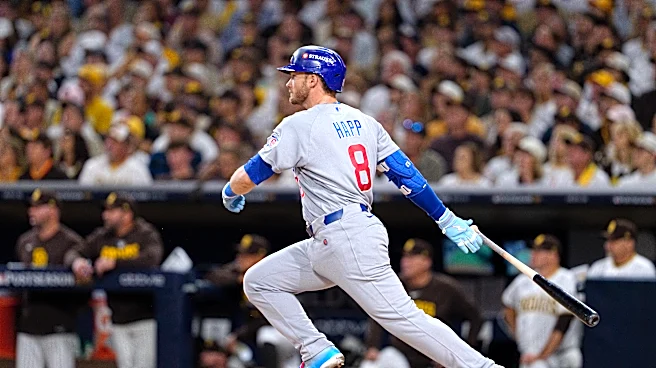
There are really two Cubs players that are candidates for a QO this winter and they’re the two corner outfielders: Seiya Suzuki and Ian Happ. Suzuki is almost certain to get the qualifying offer and is very likely to reject it and enter the open market.
Happ, on the other hand, is a tougher call. Happ is the Cubs longest-serving player, making his debut back in 2017. He’s been a solid left fielder for most of that time, winning four Gold Gloves and making one All-Star team. He’s also been an above-average hitter in every season he’s played in with a career RC+ of 115.
However, Happ turned 32 in August and had his worst season since 2021 this past year. To be clear, he was still good, with a fWAR of 2.6 and a bWAR of 2.9. That’s not easy production to replace. But his OPS+ of 103 was tied with 2021 for the second-lowest of his career, only better than his disappointing sophomore season that got him sent down to Iowa for over half of the next season. His weighted on-base-average was the lowest of his career. The switch-hitting Happ also was so poor against lefties that he was platooned with Tyrone Taylor after the trade deadline.
Like almost every hitter moving into his mid-thirties, Happ is on the downside of his career. But he’s still a pretty good hitter against right-handed pitchers and he’s still a good glove in left. But a $23 million deal for a platoon outfielder is a lot.
Still, there’s a saying that there’s no such thing as a bad one-year contract. Several of the Cubs top prospects are outfielders, including the very impressive Josiah Hartshorn but also Kane Kepley, Ethan Conrad and Caden Sorrell. But none of them are likely to be ready for the start of 2027. (Unless 2027 starts in August, god forbid.) A one-year deal for Happ would serve as a bridge to those players without a long-term commitment to someone else.
As far as Happ himself goes, he seems likely to accept a qualifying offer, although that’s not guaranteed. He’s been clear he wants to stay in Chicago and that’s a lot of money to let him play one more year with the Cubs. It’s not as much money as he’d get on the free agent market, but his market might be severely depressed because any team that signed him would lose a draft pick.
So should the Cubs offer Ian Happ a qualifying offer?
Thank you for stopping by tonight. We appreciate you hanging around after the season has ended. It’s good to stay in touch. Please get home safely. Recycle an cans and bottles. Tip your waitstaff. And join us again tomorrow night for more BCB After Dark.