





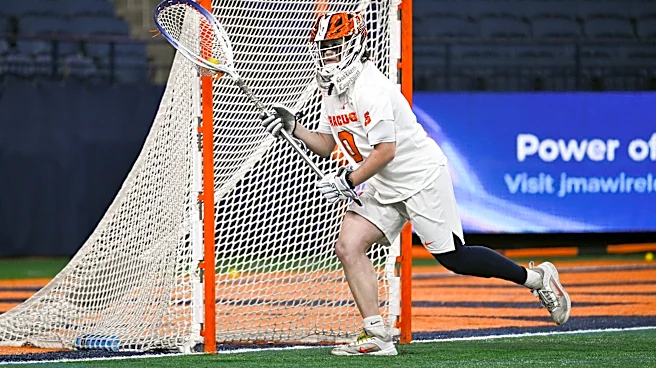
Coming off a 10-9 season in 2025, the very young Syracuse Orange had a lot of things to figure out to see if they could build off the experience they gained from their down year.
That’s where Regy Thorpe came in. The first year head coach, returning to his alma mater and the program he helped build for a decade, and his staff were coming into a very malleable situation. They were working with a largely inexperienced group that had shown flashes of their talent, if not their consistency, during the previous
spring.
And there was plenty to work with. The Orange were returning 70 percent of their points, 78 percent of their goals, 79 percent of their shots, 82 percent of their ground balls and 80 percent of their caused turnovers. But now there was the matter of organizing that production; of figuring out what needed to be kept the same and what needed to be changed in order to optimize the roster.
There’s been plenty of trials and tribulations in that pursuit, some of which we’ve seen play out in front of us as the season has progressed. It hasn’t all gone perfectly all the time, but it’s pretty tough to argue with the results. Especially on defense.
The construction of this year’s elite defense began late last year when the staff started giving more playing time to certain players to try and shake things up for a struggling team. One of those players was Izzy Lahah, who didn’t play at all in the first 13 games of last season, did play in the final six, and started in the two playoff games.
That momentum has obviously carried over to this year as Izzy is in the midst of one of the best defensive seasons in program history, currently leading the team with 38 caused turnovers and 42 ground balls, after spending the bulk of her first two years on the scout team.
It continued with the offseason addition of Mackenzie Salentre, who arrived to add a veteran presence as a graduate transfer from UAlbany. Inserting her into the starting lineup has paid big dividends for this defense as Mackenzie’s proven quite the disruptive force playing just above Izzy on the right side, currently third on the team with 28 ground balls and fourth with 15 caused turnovers.
Combining Izzy and Mackenzie with the mainstays in Coco Vandiver and Kaci Benoit, as well as a group of midfielders returning largely in tact from last season, has turned out to be the perfect combination of veteran leadership, returning players with another year of experience under their belts and new contributors that have come together to make this one of the best ‘Cuse zones we’ve ever seen.
While the defense has fallen into place beautifully, the offense has required more tinkering to find the right combinations, and one could argue they’re still searching in some respects with a team that’s just barely averaging over 10 goals per game.
Regardless, the personnel moves on offense have impressively deviated from what we saw last year, and it starts right at the top with Molly Guzik.
Molly, you might recall, spent her true freshman season as a backup midfielder on the second line. She would come in every now and again and show off her tantalizing outside shot, but largely her runs on offense were limited, and she actually got less productive as the season wore on. She didn’t score a single point in the last five games, finishing her rookie year with 14 goals, 19 points and 34 shots taken.
But the move into the starting lineup and to attack has been a brilliant one, as she’s been the Orange’s most dangerous offensive weapon all season, leading the team with 36 goals and 46 points. If you take another look at those numbers, you’ll see she already has more goals this year than she took total shots last year. She earned more playing time with the work she put in in the offseason, and she’s proven herself worthy with the way she’s produced on game day. And she’s done it all while simultaneously taking on the vast majority of draw taking responsibilities, as well. Talk about an uptick in workload, and no one’s experienced that more than Guzik.
Another fascinating move has been with Mackenzie Rich. Unlike with Molly, Mackenzie didn’t begin the year in a fancy new role. After only appearing in five games all of last season, she began this season by not playing in the Maryland game. But then, against North Carolina, Regy put her in midway through the game, and she ended up scoring a third-quarter goal that tied the score at the time.
She impressed against her former team, and during the next game against Stanford, she earned more playing time and came away with two assists in a game ‘Cuse only mustered six goals. When the Orange returned home for their next game against Loyola, Mackenzie had been inserted into the starting lineup, where she has remained ever since.
The results have been great, as she is second on the team with 30 points and, most importantly, leads the team with 19 assists. She’s become someone the offense likes to lean on to provide incisive passes to inside cutters that help fuel scoring, and she’s reliably taken on the role on the right side, both below GLE and above on the low wing.
Mackenzie has proven herself to be the most productive passer on the team, and she’s kind of come out of nowhere to do it. Before this season, she was a career backup who had produced rather lightly. She scored 13 points in her one year of playing at UNC. And then, in her first two years at SU, she scored a single point in each season for a grand total of two points in two years in an Orange uniform. But that’s all changed as she’s quickly transformed from bench in game one, to starter in game four, to one of the team’s most important contributors who has already scored twice as many points this year as she had in her first three years combined.
One of the most interesting lineup shuffles Regy’s made has been at the left side of attack, where Ashlee Volpe and Annie Parker have made for a fascinating tag team. The pair have split the starts evenly, seven each, and have done so in a back and forth manner. Ashlee started the first three games. Annie started the next two. Ashlee started the next four, and Annie has started the last five.
When Annie starts, Ashlee plays on the power play unit and sometimes comes in later in the game if she’s being productive. When Ashlee starts, Annie tends not to play as much. The results have actually been pretty striking. Annie is, unsurprisingly, more productive when she starts. But what’s interesting is, Ashlee is also more productive when Annie starts. Ashlee has thrived picking out passes on the power play this year, and its helped fuel her in games when she begins the game concentrating only on woman-up scenarios.
When Annie doesn’t start, she’s averaging only 0.25 points per game. When she does start, she averages 1.29 points per game. For Ashlee, it’s the opposite. When Ashlee starts, she’s averaging 1.14 points per game. But when she doesn’t start, she’s actually averaging 1.86 points per game.
It looks like Regy’s caught on to this trend, since the past five games have had Annie starting with Ashlee coming off the bench. That might be the most interesting example of the staff figuring things out on the fly and adjusting as the results show themselves as the season progresses. And, apparently, both Annie and Ashlee are better for the same lineup adjustment.
Bri Peters followed a similar path to Izzy, making three appearances late last year after not playing the bulk of the season. She played in both playoff games and ended up scoring three points in the first meaningful action of her college career. Like Izzy, that late-season playing time has translated to 2026, as Bri has played in every game as a second-line midfielder.
She’s contributed nicely on defense, and has played a big role as a circle player on draw controls, as her 13 draw wins are second on the team behind Molly. She’s also been the most productive member of the second line with eight goals and nine points.
Of course, Regy and the staff’s decisions surrounding these players have required corresponding moves in the opposite direction to make space.
The most notable of those moves has been that of Gracie Britton, who last year was a 20-goal scorer and finished fourth on the team with 30 points. After starting the first three games of this season, Gracie was moved to the bench in favor of Mackenzie Rich. Gracie has two goals and four assists this year in playing time that’s primarily been confined to the power play unit since her removal from the starting lineup.
There are also some other players whose playing time hasn’t diminished but whose production is down from last year as a result of a big uptick from the likes of Guzik and Rich.
Alexa Vogelman and Mileena Cotter both scored 21 goals last year in their first years of action, but Cotter has eight goals right now and Vogelman has six goals and two assists.
Caroline Trinkaus and Emma Muchnick, who came into the season as the expected leaders of the offense, have both been somewhat down after having huge years last year. They’re both possibly starting to surge at the right time, though, as Trinkaus has recently scored four points three games in a row and Muchnick recorded a season-high with four points and a second hat trick of the year against Duke.
There’s been a lot of roster shuffling in the first year of the Regy Thorpe era, as both staff and players learn who they are as individuals and as a team. After a rough start against a really difficult schedule, Regy and his staff have done an amazing job of adjusting on the fly with some creative, outside-the-box thinking.
The results, of course, speak for themselves.