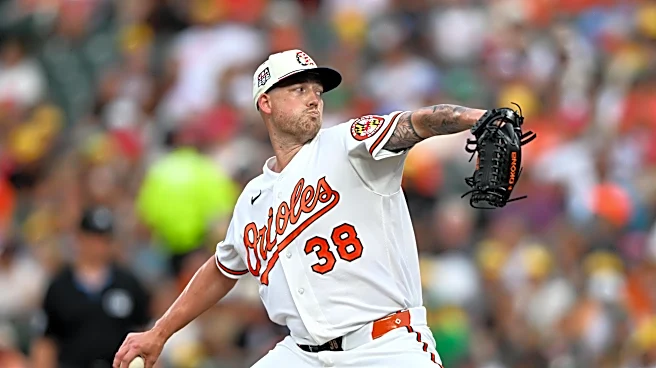



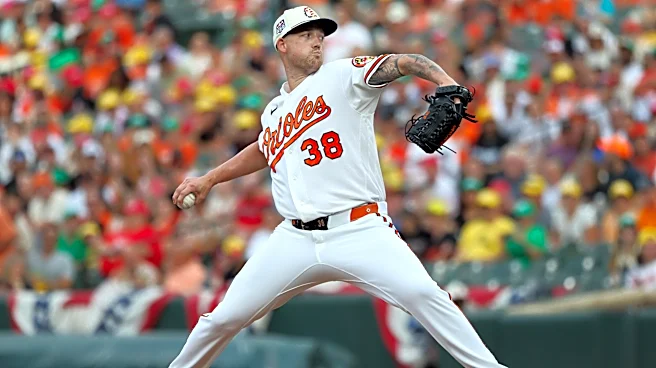


When Kyle Bradish takes the mound tonight in Boston, he’ll make the first start of the next era of his career. I have often referred to Bradish as the “Orioles’ former ace”—having been dethroned by the acquisition of Corbin Burnes and his subsequent UCL injury that required Tommy John surgery. However, after the recent announcement of Bradish’s five-year, $90M extension, the Orioles’ 29-year-old right-hander is squarely perched atop Baltimore’s rotation for the foreseeable future.
Bradish has certainly
earned his new contract, one that represents the biggest commitment to a pitcher in Orioles history. Since coming back from Tommy John surgery at the end of last season, Bradish has a 3.35 ERA across 139.1 innings with 153 strikeouts and a .229 batting average against.
And while he had some rough edges to sand off to begin the 2026 campaign, he’s rounded into form along with the O’s. Over his last nine starts, Bradish has a 3.11 ERA while averaging 6+ innings per start and holding opposing batters to a .218 average. During that same stretch, the O’s are 6-3 with Bradish on the bump, and his hot streak has coincided with the O’s definitive return to playoff contention.
Baltimore now has two starters in Bradish and Shane Baz signed through the 2030 season, with Bradish’s deal taking him until the end of 2031 campaign. Add in that breakout star Brandon Young is under team control through 2028, and the O’s finally have a solid foundation for their rotation after years of struggling to cobble together five decent starters.
However, that doesn’t mean the Orioles can rely on the current quintet of Bradish, Baz, Young, Trevor Rogers and Dean Kremer forever. Rogers is a free agent after this season. Kremer’s team control runs out after the 2027 season. And let’s face it, if the Orioles want to be consistent contenders with their current core, the front office should be chasing better starters the same way they chase reclamation project relievers.
The timing of Bradish’s new deal and the Average Annual Value may shed light on how the Orioles continue to approach their rotation moving forward. Mike Elias & Co. bought out two years of arbitration for Bradish, with the right-hander previouisly scheduled to become a free agent at the end of the 2028 season. The former New Mexico State Aggie will instead be tied to the O’s through his age-34 season.
The $18M/year AAV certainly represents a big step up from Bradish’s current salary of $3.6M. But that number only puts him tied for 37th among all major league starters, and just under the $18.5M the front office gave Chris Bassitt for this season. And so, while Bradish’s $18M/year is the most the O’s have ever given a pitcher on a multi-year deal, it’s far from top of the market.
After not giving any pitcher a multi-year deal for the first seven years of his tenure, Elias has now dished out two five-year extensions in the last five months. Theoretically, this is good news for the pending free agent Rogers. After acquiring the southpaw at the 2024 trade deadline, the Orioles have helped craft 28-year-old into an upper echelon starter. In the past, Rogers would have been destined to hit free agency, with the O’s only attempting to bring him back via the Qualifying Offer.
The Bradish deal offers hope that the front office will work out a deal with Rogers prior to him hitting free agency. It also means that $18M/year is likely the starting point for the negotiation with the Orioles’ top lefty. Spotrac ranks Rogers as the third best starter (by projected AAV) scheduled to be an unrestricted free-agent. Last offseason, Ranger Suarez got the third-highest AAV of any starter at $26M/year. Five other pitchers got less than Suarez but still $20M+, though only two (Michael King and Merrill Kelly) received multi-year deals.
Given that the Orioles aren’t buying out any arbitration years with Rogers (which often drives down the AAV), it wouldn’t be surprising to see an extension cost somewhere in the $20-25M/year range for the 28-year-old southpaw. Even at $25M/year, the O’s would hardly be adding any salary to the total cost of their rotation, as Bassitt and Zach Eflin’s combined $28.5M salary comes off the books. What’s uncertain is whether Elias & Co. would be willing to hand out such a contract, even in this new, extension-tolerant era.
The success of Bradish, and subsequent pay day, may also drive the front office’s approach at this year’s trade deadline. When Mike Elias acquired him as part of the trade that sent Dylan Bundy to the Angels, Bradish was seen as a pitcher unlikely to even make a major league rotation—let alone headline one. In his first 10 starts in the big leagues, he pitched to a 7.38 ERA while getting destroyed by walks and homers.
But clearly, the front office saw something in Bradish that they thought could be honed into a real contributor at the major league level. And they backed him through his awful start to his big league career, the grind of coming back from Tommy John and the early-season struggles this year. Now, he gets to continue rewarding the franchise well into his 30s.
The acquisition of Rogers and Baz followed similar blueprints. When they acquired Rogers in 2024, he was an oft-injured starter with an ERA consistenly in the high 4’s, who ultimately needed some time back in the minors before finding his current form. Baz pitched to 4.87 ERA last year with the Rays as he struggled through his first full season after Tommy John surgery. Both pitchers are now noticably better than when the O’s acquired them.
And so while many in Birdland will want the front office to trade for an extend Tarik Skubal, or pluck Joe Ryan out of Minnesota, the success of Bradish means Elias will likely look in a different direction. The O’s will continue to look to find vaue beyond the top of the market. Then hopefully, like Bradish, the next wave of pitching reinforcements will earn the same type of long-term committment.