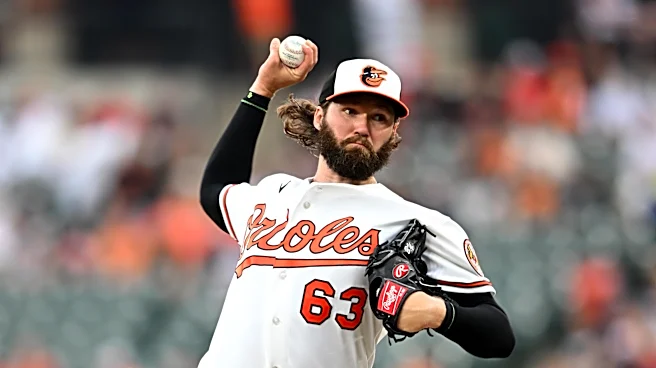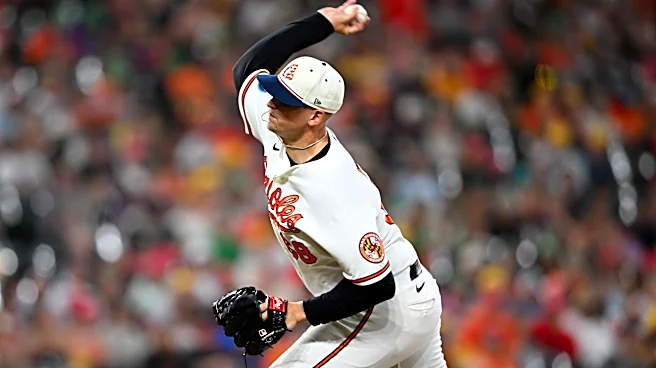



Tyler Wells wasn’t supposed to be here. By here, I mean, in the Majors at all, and certainly not taking the mound in the ninth inning with a lead to protect for this Orioles team. But injury luck has a way of rewriting careers, and Wells’s is one of the stranger paths in today’s game.
We can start with how he arrived into the Orioles org. Wells was a selection of the Minnesota Twins in the 15th round of the 2016 draft out of Cal State San Bernardino, #453 overall—this is hardly a pedigree that promises
a big-league career. Wells reached Double-A in 2018 with a 2.49 ERA and 121 strikeouts in 119⅓ innings—so far, so good. But then he blew out his elbow, had Tommy John surgery in May 2019, then the pandemic wiped out the 2020 minor league season. That is how Tyler Wells ended up never throwing another competitive pitch for the Twins. Minnesota left him unprotected in the Rule 5 draft, and the Orioles snatched him up that December.
The 6-foot-8 prospect seemed a long shot, indeed, with his rebuilt elbow and pedestrian fastball. This is true of Rule 5 picks generally, who have to stick on their new team’s active roster for the entire following season or get offered back to their old club, not to mention pitching fifteenth-rounders. Most don’t make it. Over the 2018 and 2019 drafts combined, only seven of 25 picks (28%) met that bar.
Well, Tyler Wells has beaten those odds by a wide margin: not only did he stick with Baltimore in 2021, he made 44 appearances and pitched to decent numbers: 4.11 ERA, .192 average against and a 0.91 WHIP. This was a 52-win team only, but Wells was already showing his value.
Wells moved into Baltimore’s rotation in 2022, his rise mirroring that of the team—at 83-79, they finished just outside of the playoffs—and in 2023, the Orioles’ fourth best season in team history, Wells emerged as one of the team’s best starters. Well, he had a tale of two halves: through his first 18 starts of 2023, Wells posted a 3.18 ERA and an MLB-best 0.93 WHIP, one of the biggest surprises in the American League. But the innings caught up with him. By late July, Wells had thrown 113⅔ innings, a career high, and it showed: an 11.00 ERA over his next nine innings, three ugly starts in a row, resulted in a demotion to Double-A Bowie.
Wells clawed his way back to Baltimore that fall, finishing the year with eight scoreless outings between the regular season and the playoffs, but questions had been raised about his fragility, despite his undeniable talent. The next few seasons only reinforced that reputation. Elbow inflammation sent Wells to the injured list again in 2024, and after only three starts it was announced he’d have to right elbow UCL surgery. He’d make just four starts in 2025.
Heading into 2026, nobody was quite sure where, or how much, Tyler Wells would pitch. President of baseball operations Mike Elias had said back in the fall that the plan was for Wells to start, but with Shane Baz, Zach Eflin, Chris Bassitt, Kyle Bradish, Trevor Rogers, Dean Kremer fighting for rotation spots, Wells was far from a lock. And in the end, the big righty opened the season in the bullpen as Baltimore’s top right-handed setup man in front of new closer Ryan Helsley.
In some ways, 2026 was already a success for Wells before the whole closer thing began. Between March 26, his season debut, and July 1, Wells made 30 appearances—he was finally healthy! And, even more happy news, he was good! Wells pitched to a 3.18 ERA in 39.2 innings as a setup man, making the majority of his appearances in the sixth or seventh innings. Then a “break” of sorts: in early July, Helsley felt discomfort warming up against the White Sox and landed on the 15-day injured list with right elbow discomfort. Thankfully, the veteran righty managed to avoid structural UCL damage, but Wells got the call anyway.
Wells has more than delivered in his new high-leverage role: in nine games, he has a 1.93 ERA, and just one run allowed in his last five appearances. He was scoreless in six of seven outings that month. Manager Craig Albernaz has stopped short of naming him the permanent closer, noting that Andrew Kittredge and Yennier Cano remain in the mix and that “everything is on the table.” But for now, the job is Wells’s to lose.
It is a strange but fitting turn for a pitcher whose entire career has been defined by other people’s plans falling apart around him. Perhaps more than ever, it’s a triumph that Wells has been healthy. Wells is a setup man promoted by his closer’s bad elbow: Baltimore never drew this plan up. But this season he’s been there when his team needs him.