



Welcome to the 2026 edition of Ranking the Rockies, where we take a look back at every player to log playing time for the Rockies in 2026. The purpose of this list is to provide a snapshot of the player in context. The “Ranking” is an organizing principle that’s drawn from Baseball Reference’s WAR (rWAR). It’s not something the staff debated. We’ll begin with the player with the lowest rWAR and end up with the player with the highest.
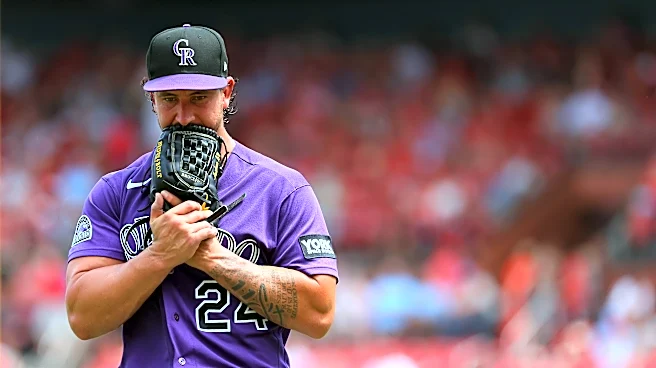
No. 53, Michael Lorenzen (-1.7 rWAR)
I was genuinely intrigued when the Rockies signed Michael Lorenzen
last winter.
The expectation was never that Lorenzen would suddenly become an ace — or even necessarily a No. 2 or No. 3 starter. The hope was that an established veteran could give the Rockies rotation plenty of reasonably league-average work.
There was some track record behind that hope. Lorenzen had spent most of his career around league average, and he wasn’t far removed from a strong 2024 season in which he posted a 3.31 ERA and 117 ERA+ over 130.1 innings between Texas and Kansas City.
He brought experience starting and relieving, a seven-pitch arsenal, a willingness to experiment and a preexisting relationship with new Rockies pitching coach Alon Leichman, his longtime friend and workout partner.
Then came the World Baseball Classic.
Pitching for Team Italy, Lorenzen looked sharp against a loaded United States lineup shortly before the regular season began. It provided one more reason to be curious about how Lorenzen might fit in Colorado.
The Rockies didn’t need greatness. They needed innings, stability and something close to average.
Instead, Lorenzen’s season unraveled almost immediately.
The numbers
The traditional numbers are every bit as ugly as the season felt.
Colorado gave Lorenzen 25 starts and 115.2 innings to find something that worked. He finished his Rockies tenure with a 7.08 ERA and 1.88 WHIP, allowing 168 hits while striking out only 82 before being designated for assignment on August 17. 10 days later, Lorenzen signed with the Toronto Blue Jays.
The move to Toronto didn’t provide a reset. Used exclusively out of the bullpen, Lorenzen allowed 11 earned runs in 11.2 innings, including four home runs, for an 8.49 ERA and 1.97 WHIP before being DFA’d again on September 18.
The lack of length was also a problem. 19 of Lorenzen’s 25 Rockies starts lasted 5.0 innings or fewer, repeatedly leaving the bullpen to cover four or more innings. He recorded only two quality starts all season.
What actually happened
The Rockies showed their faith in Lorenzen immediately.
After making his Colorado debut on the road in Miami, Lorenzen was given the ball for the home opener against the Philadelphia Phillies on April 3.
It went about as badly as possible.
Philadelphia scored seven runs in the first inning, and Lorenzen was gone after 3.0 innings having allowed nine runs on 12 hits. Brandon Marsh and Bryce Harper both homered as the Phillies turned the afternoon into a rout before the Rockies ever really had a chance to settle into their home opener.
Five days later, Lorenzen held the Houston Astros to one run over 5.2 innings.
On April 24 against the Mets, he was even better, working 7.0 innings while allowing one run without issuing a walk.
That became the frustrating rhythm of Lorenzen’s season. He could produce a respectable start, sometimes two, only for another blowup to follow.
He allowed seven runs over 5.0 innings against the Mets on May 6. Less than a week later, he held Pittsburgh to two runs over 5.0 innings. Five days after that, Arizona tagged him for six earned runs in 4.2 innings.
June offered an even starker example.
The Angels battered Lorenzen for eight runs in 3.1 innings on June 3, collecting eight singles, a double and a home run against him.
A week later, Lorenzen looked like a different pitcher.
He held the Cubs to one run over 5.0 innings on June 10, striking out seven while allowing just two hits. He generated a whiff on 25% of Chicago’s swings and produced some of the weakest contact against him all season.
Five days later in Chicago, he again allowed one run over 5.0 innings, this time striking out five.
For a moment, that looked like the kind of stretch Lorenzen had spent the first two months searching for.
But even his better stretches require some perspective.
June was one of Lorenzen’s two best months of the season. He still posted a 5.92 ERA.
July was technically better. His 5.48 ERA was his lowest monthly mark of the year.
That was as good as it got.
By August, whatever hope remained was gone. Lorenzen allowed 16 earned runs in 13.0 innings during the month, while opponents hit .393/.471/.607 against him and his WHIP climbed to 2.46.
His final five Rockies starts lasted 3.2, 4.0, 3.0, 4.1 and 3.2 innings.
His final start came August 15 in San Francisco, when Lorenzen allowed six runs over 3.2 innings.
Two days later, his Rockies tenure ended.
Searching for an answer
Lorenzen did not spend the season repeating the same approach.
Early in the year, he spread his workload fairly evenly across a seven-pitch arsenal. As the season progressed, the sinker and changeup became more prominent, while his curveball and slider usage fell. His first-pitch sequencing changed as well, with heavier doses of sinkers and cutters later in the year.
There were a few pieces that worked better than others, and the changeup stands out.
Lorenzen threw it 20.8% of the time with Colorado and generated a whiff on 28.4% of swings against it. When hitters put it in play, they averaged 85.5 mph in exit velocity, with a 30.3% hard-hit rate.
His four-seam fastball was almost the opposite.
Hitters whiffed on only 8.5% of their swings against the pitch. When they put it in play, the average exit velocity was 94.9 mph and 58.2% of those balls were hit at least 95 mph.
That is a brutal combination for any fastball: very little swing-and-miss and extremely loud contact.
The broader Statcast picture was just as ugly.

Lorenzen finished near the bottom of baseball in Pitching Run Value, expected ERA, expected batting average, average exit velocity, chase rate, strikeout rate and hard-hit rate.
The individual pitches reflected that same problem. None of Lorenzen’s seven pitches finished with a positive Pitch Run Value overall. There were a couple of matchup-specific exceptions: against right-handed hitters, his cutter produced a plus-five Pitch Run Value and his four-seamer finished at plus-two. But neither carried that success across platoons.
Against left-handed hitters, the cutter finished at minus-eight and the four-seamer at minus-15. In fact, none of Lorenzen’s seven pitches produced a positive Pitch Run Value against left-handed hitters.
Lorenzen changed his pitch mix and sequencing throughout the season, but none of those changes produced sustained improvement.
Where things stand
Lorenzen’s time with the Rockies is over, and his $9 million club option for 2027 is no longer part of the picture.
There was plenty of logic behind the original signing. Lorenzen had recent starting experience, a broad arsenal and an existing relationship with Leichman. The Rockies were looking for innings and stability, and neither materialized.
Off the field, Lorenzen appeared to embrace the veteran role. Ahead of the club’s trip to Las Vegas, he bought suits for the team’s minimum-service-time players.
On the mound, though, the innings and stability the Rockies signed him to provide never came.
Signing Lorenzen was a worthy risk. It just didn’t work out.
Join the conversation!
Sign up for a user account and get:
- Fewer ads
- Create community posts
- Comment on articles, community posts
- Rec comments, community posts
- New, improved notifications system!
Download the SB Nation app on iOS or Android.
Please keep in mind ourPurple Row Community Guidelines when you’re commenting. Thanks!