

I’ve written about former Royal pitcher Roger Nelson on several occasions. For some reason, I’ve been fascinated with his career arc.
He was originally signed by the Chicago White Sox in 1963. His minor league career with the Sox gave no clue to the magic hidden in his right arm. After five seasons moving through the Sox system, Nelson sported a 25-28 record with a cumulative ERA of 4.04, a record that hardly made him out to be a top prospect.
He made his debut on September 9, 1967, against the Detroit
Tigers. He hit the first batter he faced, Bill Freehan, then retired Hall of Famer Eddie Matthews on an infield popup.
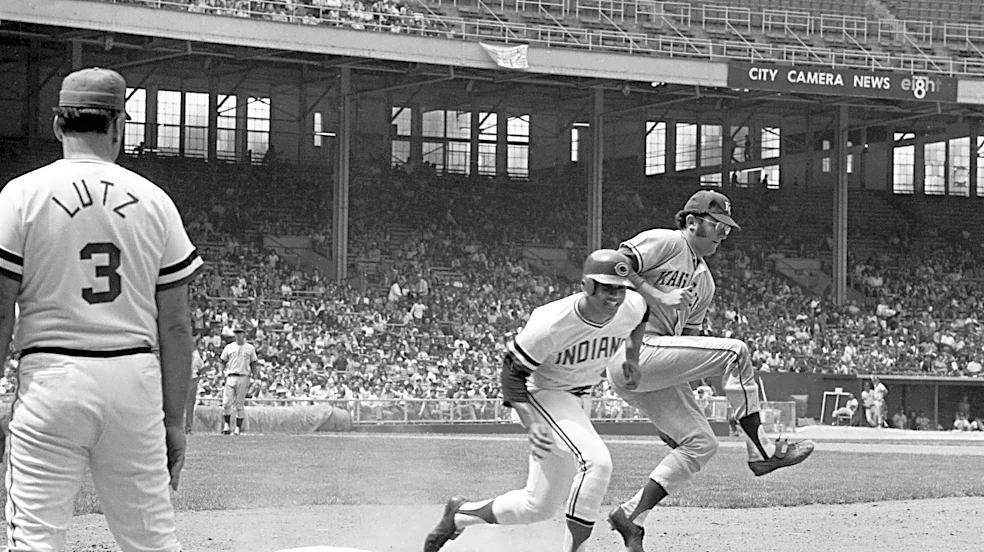
He made four more appearances that summer, the last coming on September 27 against the Kansas City Athletics in a game at Municipal Stadium. Once again, he hit the first batter he faced, pitcher Chuck Dobson, before retiring Ted Kubiak on a groundout to first.
In the offseason, Nelson was part of a six-player blockbuster trade with Baltimore, with the principals being Don Buford and Luis Aparicio. Future Royal John Matias went to the White Sox, while Bruce Howard, father of future Royal David, moved to Baltimore with Nelson.
Nelson got into 19 games with the 1968 Birds, throwing 71 innings, including six starts. He put up a sparkling 2.41 ERA, which was enough to catch the eye of Cedric Tallis. When Baltimore left him off its protected list, Tallis made Nelson the No. 1 overall pick in the 1968 expansion draft.
Nelson made the second start in Royals history, going five innings on April 9, 1969, against the Twins in what became a 4-3 Royals win in 17 innings.
Nelson was much better than his won-loss record indicated in 1969. Even though his record was only 7-13, he made 29 starts, throwing 193 innings to the tune of a 3.31 ERA.
Unfortunately, arm troubles beset Nelson, and he was only able to throw 43 combined innings in 1970 and 1971.
Nelson wasn’t even in the Royals’ plans for 1972 and had to make the team out of spring training. How long ago was 1972? Fifty-four years, if you’re counting.
Fifty-four years before 1972 would have been 1918, which marked the end of World War I. That makes me feel old.
The hit movies in 1972 were The Godfather and Jeremiah Johnson. The radio was playing “American Pie,” “Lean on Me,” “Candy Man,” and “Baby Don’t Get Hooked on Me.” Richard Nixon was president, and the U.S. still had troops in Vietnam.
Nelson had a strong spring training and made the team as a bullpen arm. He was outstanding, making 15 appearances and throwing 25 innings while striking out 23 batters with a terrific 1.44 ERA.
Manager Bob Lemon finally gave Nelson a start on July 4 in a game against Detroit at Municipal Stadium, and he responded by throwing a complete-game, four-hit shutout. Somehow, someway, Nelson’s arm healed enough for him to harness his enormous potential.
The Detroit win kicked off a pitching run as good as any in Royals history.
Nelson made 18 more starts in that magical summer and finished with 10 complete games and six shutouts. Nelson blanked the White Sox on July 27 and the Angels on July 31 with a three-hitter. This gave him three shutouts in July alone. He threw a three-hitter against Texas on August 11 and a masterful one-hitter against the Red Sox on August 23. The Red Sox game scored a 93, which remains one of the top-scoring games in Royals history.
He closed out his tour de force with a two-hit amputation of the Rangers on October 4 in a game that was notable for being the last ever played at Municipal Stadium and the last game for Ted Williams, who was manager of the Rangers.
Nelson lost eight games in that stretch, with four of the losses coming by one run and two coming by two runs. The Royals scored only 20 runs in those eight losses, despite Nelson pitching brilliantly.
Nelson set four single-season pitching records that summer that still stand today. His record of six shutouts in one season will probably never be broken. He’s also in the top 10 in several other single-season categories.
It remains, arguably, one of the best pitching seasons by any Royal, ever, which is saying something when you look at some of the guys who have pitched for Kansas City. Drago. Busby. Splittorff. Leonard. Saberhagen. Cone. Appier. Greinke. Big names, all.
In the summer of 1972, Roger Nelson, a guy who looked like your high school science teacher, was as good as or better than all of them.
In the offseason, Cedric Tallis shocked everyone by trading Nelson and one of his best hitters, Richie Scheinblum, to Cincinnati for Wayne Simpson, a pitcher with enormous potential but a bum arm, and Hal McRae, a utility player who was still recovering from a gruesome broken leg.
Thank God the internet didn’t exist in 1972, because Tallis would have gotten roasted. Like most of his trades, this one worked out just fine. Nelson’s arm problems resurfaced, and Scheinblum lost his hitting stroke. Simpson had a couple of good starts in Kansas City, but his Royals career lasted only 16 games. The real prize was McRae, who not only developed into one of the game’s best hitters but also infused the Royals with some much-needed toughness. McRae, of course, was one of the Royals’ all-time greats and ended up in the Royals Hall of Fame.
Nelson appeared in 28 games for the Big Red Machine between 1973 and 1974, toggling between starting and relieving.
He even threw 2 1/3 hitless innings against the New York Mets in Game 3 of the National League Championship Series in 1973.
Nelson had another excellent but short run of success in 1974. On May 15, he held the Giants hitless for seven innings. He ended up going 8 2/3 innings and giving up only two hits. In his very next start, six days later, he gave up only three hits in seven innings of work against the Dodgers. He closed out that stretch on May 26 with a complete-game, six-hit win against the Padres. Alas, the arm woes returned, and Nelson was only able to throw 21 more innings before the season ended.
In October 1974, the Reds sold Nelson back to the White Sox, who released him in March 1975 before he ever appeared in a game. He hooked on with the Oakland Athletics but spent the summer with their Triple-A team in Tucson before being released.
He was out of baseball and driving a truck for UPS when the Royals called in March 1976 and gave him another shot. He started the 1976 campaign in Omaha, appearing in 52 games and racking up 16 saves before the Royals called him back to the big league club.
After all he had been through, it was a heartwarming reunion. The Royals were on their way to their first Western Division crown, and Nelson made three September appearances. The best came on September 19 at Royals Stadium, when Nelson threw 5 2/3 innings against the White Sox, allowing only three hits and one run. At one point, Nelson turned back the clock and retired 14 consecutive hitters. After the game, Nelson told Kansas City Times sportswriter Sid Boardman, “I ain’t that old. I can still throw it. When you’re 32, you’re not ready for the grave. I’m just glad I was able to contribute to a club going for the pennant. I felt I could pitch longer today, but why try to be a hero? My longest outing before was four innings in Omaha in May. I could feel myself losing something. Why mess around when you got guys like we have in the pen?”
Unfortunately, that game was the high point of Nelson’s reunion with the Royals. A few days later, his car caught fire in the Truman Sports Center parking lot. Then, on Sunday evening, September 26, the Royals flew to Oakland for a critical series against the A’s.
Nelson was mugged outside the team hotel, thankfully losing only his watch to the miscreants. Nelson did take a spill and sprained both wrists during the attack.
The injury ended Nelson’s 1976 comeback, as the Royals left him off their playoff roster.
Nelson returned in 1977 but spent the season in Omaha, making 58 appearances and recording 16 more saves. He never made it back to the majors.
After being released by the Royals, he signed with Pittsburgh and pitched for its Triple-A team in 1978 and 1979.
He called it a career after the 1979 season at the age of 35.
It’s easy to wonder what the Royals’ past might have looked like had today’s surgical techniques and rehab been available. What would the careers of guys like Nelson and Steve Busby, possessor of another electric arm, have looked like? Would Busby have thrown a couple more no-hitters? Would Nelson have remained a Royal for life, which would have meant no Hal McRae as a Royal?
With a healthy Busby and Nelson, would the Royals have displaced the Yankees in 1976, 1977, and 1978? Life is always a series of what-ifs.
There’s an old saying that goes: Life gives us children so death won’t be such a disappointment. I’m not sure I agree with that sentiment, but I do wonder what someone like Nelson feels about being so close to stardom, only to have it dashed by an injury. He’ll always have the summer of 1972, though.