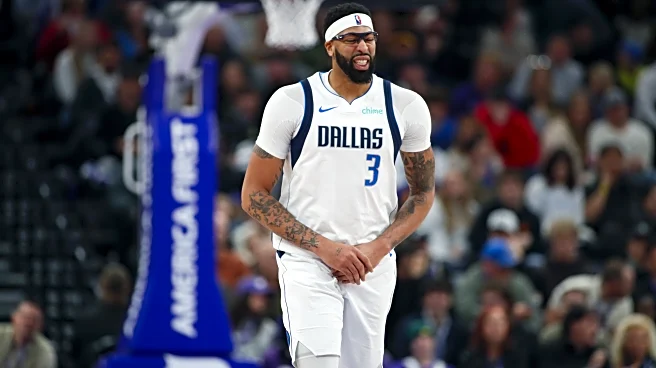
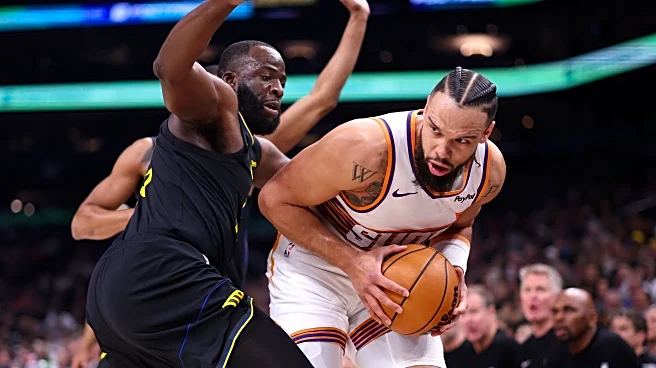
The second-greatest shooter in basketball history is averaging 11.1 points per game on 35.3% shooting from three-point range. Let that sink in for a moment. Klay Thompson, the man who once scored 37 points in a quarter,
who dropped 60 points in 29 minutes, who hit 14 threes in a single game, is now struggling to crack double figures on a Dallas team that’s trying to stay afloat without the traded Luka Doncic and the injured Kyrie Irving.
On Christmas Day, Captain Klay comes home.
Not for nostalgia. Nor for tribute videos or standing ovations. He’s coming to compete, to prove something to the organization that let him walk and to himself. And waiting for him at Chase Center will be Moses Moody and Brandin Podziemski, two young guards trying to fill the role Klay held for 13 championship-caliber seasons.
The Warriors haven’t quite filled the hole left behind by the younger Splash Bro after he went to Dallas. Buddy Hield gave a great impression during Game 7 on the Rockets series last year. But ultimately Steph Curry has never won a title without his former backcourt mate Klay; their twin shooting powers ripped up convential basketball strategy and forged a dynasty.
Here’s the thing about replacing a legend: you can’t do it alone, and maybe you can’t do it at all. But what you can do is learn from what made them great and find your own way to honor those principles. Klay’s former understudy Moody has figured out part of the equation. Moody’s 24.9 minutes per game represent a career-high. His 11.4 points and 38.1% three-point shooting are career-highs. He’s starting to look like a legitimate rotation piece on a contending team, which is exactly what the Warriors need him to be.
Through 28 games this season, he’s attempted 152 catch-and-shoot field goals, converting at 40.8% overall and 41.2% from three. When he catches the ball and releases it within two seconds, that three-point percentage holds at 40.1%. This is Warriors basketball distilled to its essence: move without the ball, trust the system, fire when ready.
That says a lot about what Moody’s becoming. He doesn’t need space as much as he needs rhythm. When the defense closes out and he’s forced to shoot on pure instinct, that’s when the months of practice and the years of watching Klay operate crystallize into something beautiful. And on the defensive end Moody is tasked with guarding the other team’s primary guard, much like Klay used to in order to take the pressure off Steph. Hounding guards in today’s NBA is not an easy task, but it’s necessary in order to cut off the head of the snake. Remember how Klay used to body the likes of Chris Paul and Kyrie Irving?
Meanwhile Podziemski’s forging his own path out of Klay’s shadow. He’s learning how to keep the offense moving, not letting the ball stick, and finding ways to get into to the paint. Per my GSOM colleague Joe Viray:
For Brandin Podziemski, a demotion from being a starter to virtually the first or second man off the bench was warranted. In trying to do too much as a featured player, he ended up with contributions that were either too little or too deviating from the collective intention of the team, which ended up doing more harm than good.
The Warriors outscored the Magic by 36 points in Podziemski’s 27 minutes and 30 seconds of time on the floor. It was one of the third-year guard’s better games this season, one where his impact was fully felt and where he seemed to be fully comfortable in the role that was given him.
When he’s not attacking the middle of the floor, collapsing defenses, making quick decisions out of traffic, he becomes just another perimeter player trying to figure out what to do with the ball. But in that dominant performance against Orlando (16 points, 6-10 shooting, 5 assists, plus-36 in 28 minutes), you saw what happens when he rediscovers his identity as a connective playmaker.
He’s not replacing Klay’s shooting. He’s replacing Klay’s understanding: when to attack, when to swing it, when the possession needs your aggression versus when it needs your discipline.
And speaking of discipline, Podziemski is establishing himself as quite the pesky defender. Since entering the league, he’s has established charge-drawing as a core part of his NBA identity, not a situational quirk. As a rookie, he drew 41 charges—one of the highest totals in the league—immediately signaling anticipation, fearlessness, and organizational trust uncommon for a first-year guard. He followed that with 34 charges in his sophomore season, confirming the behavior wasn’t a spike but a sustainable skill as his role and offensive responsibilities expanded. Right now he’s in the top 15 in the league in charges drawn with 14, using his quickness to offset the relative size difference with his 6-foot-4 frame. Klay knows how Podz gets it on the defensive end!
The Warriors are 15-15 trying to convince themselves the Two Timeline strategy wasn’t organizational cope for letting a champion like Klay walk. The Mavericks are 12-19 trying to stay competitive without their superstar. Nobody’s winning the breakup right now, which makes this Christmas matchup feel less like celebration and more like mutual evaluation. What could Klay have been if he’d stayed? What could Moody and Podziemski become if they keep developing? These questions don’t have clean answers yet.
Klay spent 13 years in Golden State mastering the art of playing off the greatest shooter who ever lived. He learned when to defer, when to attack, how to move without the ball, how to punish defenses for even thinking about leaving him open. He sacrificed his body in the Finals, tore his ACL, tore his Achilles in recovery, and still came back to help win another championship.
Now he’s in Dallas averaging career-lows across the board while young players back in the Bay try to prove they absorbed the lessons he didn’t even know he was teaching.
Podziemski’s path feels rockier. The early-season demotion stung, but it also forced him to reassess what makes him effective. Getting to the paint isn’t optional for him, it’s fundamental. When he rediscovers that aggression, when he starts touching the paint two or three times per game again, the rest of his game flows naturally.
Christmas basketball has always carried extra weight. The national spotlight, the family gatherings paused so everyone can watch, the symbolic meaning of reunion and reflection. Klay Thompson returning to Chase Center in different colors feels like all of that compressed into 48 minutes of actual competition.The kids he mentored will try to show him they’ve been paying attention. The organization that let him go will try to prove the decision made sense. And Klay will try to prove he’s still that guy, even if the statistics suggest otherwise.
Maybe that’s enough. Maybe watching the next generation start to understand what you built is its own kind of validation, even when it hurts.
On Christmas, the legend comes home. And the protégés he left behind get one more chance to learn.