



NBA history spans 80 seasons, and as CelticsBlog readers well know, the Boston Celtics have won a league-high 18 championships. This month, we are recapping each of those title years.
After Bob Cousy’s retirement, the Boston Celtics entered the 1963-64 season with a new point guard for the first time in 13 years. K.C. Jones, with five years of experience as Cousy’s backup, was more than ready to take the reins. The Celtics were going after their sixth straight NBA title, which would set a record for longest
championship run in U.S. professional sports history.
If you think that was the buzz about the team, you would be wrong, because the questions being asked by fans and media were: “Can the Celtics win again without Cousy?” “Is the dynasty over?”
That’s right, hot takes and narratives existed in the Sixties. It’s true that losing the great Cousy, who was one of the few “small men” ever to win MVP, would be an adjustment. But wasn’t it obvious that the championships began to come when Bill Russell arrived? Russell changed the league, and five straight titles should have removed all doubts. And the big man was still wearing green and white.
The Celtics players reacted to all this talk as champions should. They had won in 1963 so that Cousy could go out on top, and now they were determined to prove they could win without him. So, despite all their success, “Nobody believed in us!” essentially became their motivation for the season.

The regular season
The Celtics wasted no time in staking their claim. They began the season by winning 15 of their first 16 games, the one loss being by a single point on the road to the Cincinnati Royals. The Cs also ended the season on a 14-2 run to finish with a league-best 59-21 record.
As it turned out, Boston won the season series against every team except Cincinnati, going 5-7. This reflected how well Oscar Robertson performed throughout the 80-game schedule. The Big O averaged 31.4 points, 9.9 rebounds and a league-high 11.0 assists per game for the Royals, who finished second-best in the league at 55-25.
Robertson won the vote for MVP, ending Russell’s three-year streak. Russell did lead the league in rebounding with a career-high 24.7 average.
Celtics beef: rare. but spicy
An unusual rift occurred in January 1964 between Celtics founder/owner Walter Brown and his star power forward, Tommy Heinsohn, in his role as president of the NBA Players Association. The players union was founded in 1954 mainly through the efforts of Bob Cousy. Heinsohn succeeded him in 1958.

The owners had promised to consider starting a pension fund for union members, but had for a long period been dragging their feet on following through. With the 1964 All-Star game scheduled for Boston Garden, Heinsohn persuaded his fellow stars to threaten a strike unless the owners took action that night. The union was leveraging that the owners would not jeopardize the national television broadcast of the game.
After some tense back-and-forth, the owners and commissioner Walter Kennedy agreed to move forward on their promises. The game went on as scheduled.
Heinsohn was no rookie at business negotiations. His other job (because players didn’t make enough money to live on from basketball) was as a successful manager in insurance sales. Heinsohn had also studied labor relations at Holy Cross and was especially knowledgeable about pensions.
Brown, perhaps the best and most player-friendly owner in the league, was livid and embarrassed that one of his Celtics instigated the episode. He called Heinsohn “the number one heel” in sports, which was a major insult in those days. The two didn’t speak again until after the season, when they put disagreements aside and buddied up again.
Two players on the roster were new to Boston. Rookie Larry Siegfried, a teammate of John Havlicek at Ohio State, was signed as a free agent. He was a Celtic for seven seasons as an all-purpose guard who could defend and shoot from outside. “Siggy” played 10 seasons in the NBA and was a double-figures scorer.
The other new Celtic was Willie Naulls, a seven-year veteran and four-time All-Star who had played with the Knicks, Hawks and Warriors. With those teams, the 6-foot-6 forward had appeared in just two playoff games. He was in Boston for three seasons and won three rings, contributing hard-nosed defense and rebounding with double-digits scoring.

The quota system
Black players had been competing in the NBA since 1950, when forward Chuck Cooper was drafted by Boston with the first pick of the second round (13th overall). During the Fifties and Sixties, amidst Jim Crow laws and the Civil Rights movement, it was an open secret that NBA teams followed a quota system, always having at least one white player on the floor. The fear was that using five black players at once risked alienating white ticket-buyers.
The interesting thing about the 1963-64 Celtics roster was that Naulls was now Tommy Heinsohn’s backup. Sometimes, when Red Auerbach made that substitution, Naulls was on the court with Russell, Sam Jones, K.C. Jones and Tom “Satch” Sanders. Five blacks. Because all Red wanted to do was win a basketball game. He couldn’t have cared less about unwritten rules.
(More on this topic in the next installment of this series.)
Eastern playoffs
With their league-best record, the Celtics once again received a bye to the Eastern finals. And their opponent was the Cincinnati Royals, who went the distance to win a best-of-five against the Philadelphia 76ers (the former Syracuse Nationals had relocated).
The Royals had won the head-to-head duel in the regular season, and they had a strong team that now included Rookie of the Year and future Hall of Famer Jerry Lucas, who played with Havlicek and Siegfried in college. Lucas was a tough power forward who averaged 17 and 17 in his first season.
The Celtics, however, had an equally good starting five, a much deeper bench, and far more postseason experience. With top defensive guard K.C. Jones now playing in place of offense-minded Cousy, Boston was in better position to hold down the Royals and their star Robertson.
This Boston squad posted a defensive rating of 83.8, which was more than five points better than the nearest challenger. They also grabbed the most rebounds (71.7) and held opponents to the lowest shooting percentage (.413) in the league.
Russell called this group “easily the best defensive team we ever had – and maybe the best of all time.”
The Celtics validated Russell’s observation by winning the series 4-1 and holding the Royals to 93.2 points per game. Cincinnati fell behind 3-0 and scored no more than 95 points in any of their losses. They had averaged 114.7 in the regular season.
NBA Finals

Out West, the San Francisco Warriors defeated the St. Louis Hawks, 4-3, advancing to their first Finals since the Warriors moved from Philadelphia. This meant another battle with Wilt Chamberlain, who was already 0-2 in series versus the Celtics and Bill Russell. Would the third time be the charm for Wilt?
Nope, not even close.
The matchup
Boston’s defense allowed just 105.1 points per game in the regular season, but San Francisco had the edge by allowing just 102.6. Two big reasons were Chamberlain at center and rookie Nate Thurmond at power forward. Thurman was 6-foot-11 with a physique like a body builder. He would go on to a 14-year career in which he had 14,437 points and 14,464 rebounds.
San Francisco was directed by guards Guy Rodgers, who led the league in assists, and Al Attles, a future Warriors coach and pound-for-pound one of the toughest players the NBA had ever seen.
Games 1 and 2 were in Boston, with the Celtics winning by 12 thanks to a 32-15 second quarter, and by 23, with a 30-point lead after three quarters.
In San Francisco for Game 3, the Warriors opened with a 40-21 first quarter and never looked back – final score 115-91.
Turning point
The Warriors led 44-40 at halftime of Game 4, then the Celtics seized control with a 36-20 third quarter. Boston withstood a fourth-quarter rally by San Francisco to win, 98-95. Heinsohn and Sam Jones combined for 48 points as Boston took the commanding 3-1 lead.
It wasn’t over until…
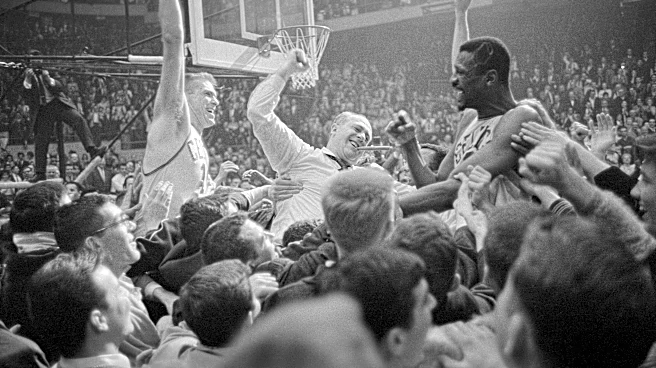
Up 3-1 for the second year in a row, the Celtics were determined not to repeat last year’s mistake where they let Game 5 slip away and needed another trip to California to end it. This time, it was close for most of the 48 minutes, but a Russell putback dunk stopped a Warriors comeback bid and put Boston up four with about 10 seconds left. In the pre-three-point-shot era, that was a safe lead.
Notable facts and stats
- In 10 playoff games, Boston’s defense allowed 100 points or more just three times.
- Sam Jones led the Celtics in scoring for the series with 21.2 points per game.
- Chamberlain averaged 29.2 points; he was at 36.9 in the regular season.
- John Havlicek scored 18.4 points per game in the Finals, taking over the Sixth Man role from Frank Ramsey. In the closeout game, Ramsey scored 18 points off the bench.
- Clyde Lovellette, Jim Loscutoff and Frank Ramsey all retired after the season.
Banner Years continues tomorrow with a review of the 1964-65 season and the road to winning Banner #8.