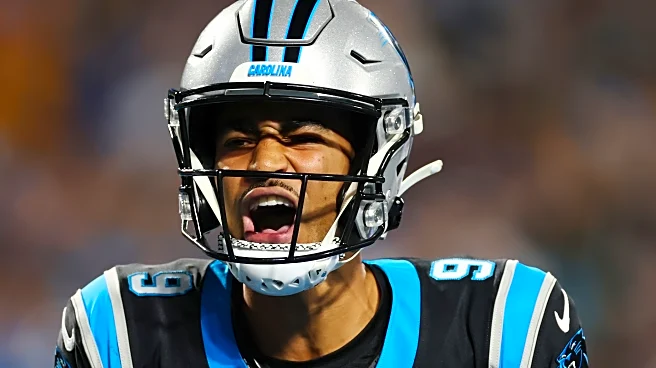




Carolina Panthers general manager Dan Morgan confirmed the team’s long rumored plan to exercise Bryce Young’s fifth year option in a press conference this morning. Young, who has generated considerably mixed opinions from fans due to his low production and inconsistent play, will be under contract for the Carolina Panthers through the 2027 season.
When does this take effect?
Filing the paperwork at this point is a formality. The fifth year option will not affect cap space for the 2026 season unless the team decides to build
upon the option and sign Young to a long term extension. An extension seems unlikely based on Morgan’s language this morning. The team has until May 1st of this year to formally exercise the option.
What will the option cost?
The fifth year option price tag is calculated according to a scale set forth in the 2020 Collective Bargaining Agreement between the NFL and the NFL Players Association. The tiers and their payment requirements are as follows, per overthecap.com:
- Basic: $22,936,000
- Playtime: $26,530,000
- One Pro Bowl: $39,723,000
- Multiple Pro Bowls: $46.073,000
Young qualifies for the playtime tier as he has played in both 50% or greater of all Panthers snaps over his past three seasons and 75% or greater of the same across two of his three seasons. As you can see, this could have been a much harder decision if Young had earned a Pro Bowl nod.
Is this the right call?
Simply put, yes, exercising Young’s fifth year option is the right call. That’s probably true even if the Panthers aren’t hopeful that he will keep improving year over year. The $26M cap figure he will carry into the 2027 season would be good for the 15th highest cap hit for a quarterback in 2026 and the 18th (so far) for the 2027 season. That gets bumped down further by any number of potential events, such as anybody signing a long term extension, Bo Nix making a Pro Bowl, or Philip Rivers returning from retirement.
The fact of the matter is that the Panthers are not upgrading from Young for less money. Add on to that the fact that he is heading into year three under Canales, he just posted a career year in most statistics, and he just completed that career year behind an offensive line that was constantly in flux due to injury. From the team’s perspective, they are keeping a guy under contract at a reasonable rate who they are high on and have some reason to believe has not yet his his ceiling. That $26M cap figure is also not so much that they can’t keep Young and draft his replacement in 2027 in the event that the wheels fall spectacularly off his wagon.
Let’s take a look at the other directions they could have pursued with Young:
Declining the fifth year option
The team could have chosen to decline Young’s fifth year option, citing a lack of significant progress between years two and three. That would make year four of his rookie deal a true contract year and given the team the room to publicly scout, pursue, and woo high level free agents, higher end draft picks, and otherwise really hold Young’s heels to the fire to get him to produce this season.
The reward here is that, if he doesn’t step up his game, they can walk away free and clear in 2027 and start fresh at the quarterback position. That is, to be clear, they would walk away into a low supply, high demand market that they have struggled with before.
The risk is that Young does step up, regain his Alabama form, and demand a real contract. The Multiple Pro Bowl tier of the fifth year option compensation list above is pegged to the franchise tag price. Young would cost double to hold in Carolina if they had to go that route, and probably more in a long term extension if he played well enough to have that kind of negotiating power in the first place.
Releasing Young
An acrimonious split between Young and the Panthers based on the quality of Young’s play would be unlikely to be quiet or interesting enough to generate a competitive trade market for Young’s future services. If the team was as ready to move on from Young as some of the more vocal Panthers fans are then they would likely have to simply release him, either by cutting him this season or letting him walk at the end of his contract after next. That again, thrusts the Panthers into the quarterback market, and not at the front of the line.
Their 19th overall draft pick and recent reputation handling first overall pick quarterbacks would have rookies and veteran free agents alike looking twice at any offer from Carolina.
Extending Young
Their other option for keeping Young in the fold for the long haul is to go ahead and sign him to a long term extension. The problem with that is that Young has underwhelmed, statistically and often actually, in his first three seasons. The Panthers know this and Young knows this.
The Panthers should not be willing to sign Young to a big $40M+ average annual value contract extension without evidence that he is worth it. Young, meanwhile, probably believes he is worth that level of contract and won’t want to settle for less without another chance, or two, to prove himself worthy.
This is an option in name only, because neither side should be willing to even discuss the numbers that the other side of the negotiating table would want to open with. That leaves them with exercising Young’s fifth year option as their only real route for the time being. Which, surprise, leaves Panthers fans in nearly the same position they were in last offseason: wondering if what they saw in the last game of the season represented a level of play that Young can put on the field consistently in the future.