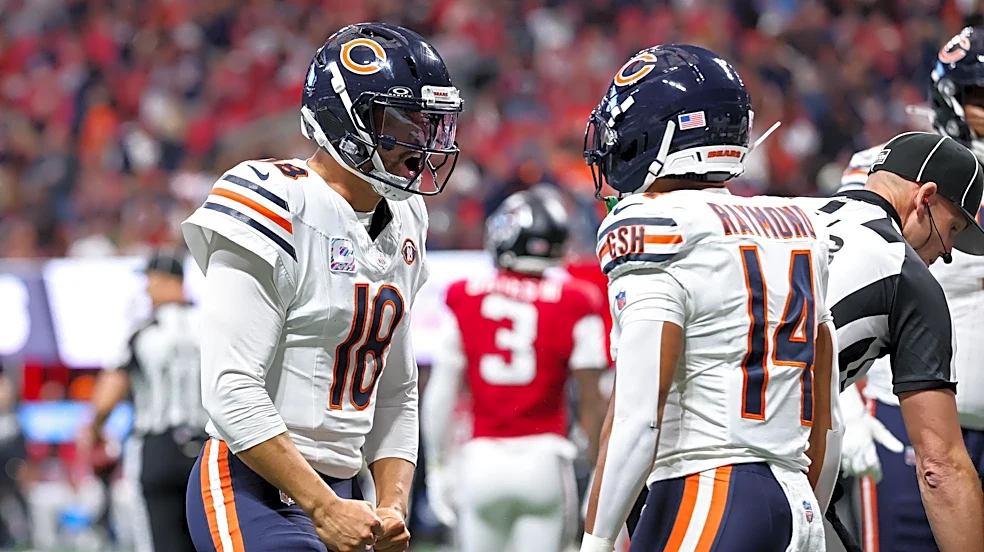






Well, that was a pretty nice way to welcome Caleb Williams back.
After missing three games with the hamstring injury he suffered against Minnesota, Williams returned to the lineup Sunday in Atlanta and looked about as sharp as you could reasonably ask for in his first live action in nearly a month.
Chicago jumped out to a 14-0 lead on its first two possessions, with Williams completing all 10 of his passes for 122 yards and a touchdown on those drives. He eventually connected on his first 12 attempts,
the longest streak of his career, and the Bears never trailed in a 31-23 win that moved them to 4-2.
Williams finished 30-of-36 for 305 yards, one touchdown and no interceptions, good for a 111.2 passer rating.
That 83.3% completion rate wasn’t just a career high. It was the highest completion percentage by a Bears quarterback in franchise history on 30 or more attempts, breaking a record previously shared by Mitchell Trubisky, Shane Matthews and Steve Walsh.
And the accuracy gets even more ridiculous when you dig a little deeper.
ESPN Insights charted Williams at 26-of-26 for 255 yards when Atlanta failed to pressure him, the most unpressured attempts without an incompletion since ESPN began tracking pressure in 2009. Next Gen Stats came to a similar conclusion using its clean-pocket definition, tracking him at 24-of-24 for 248 yards, the most clean-pocket attempts without an incompletion in a game since at least 2018.
Pretty good for a guy coming off a hamstring injury.
What I liked most, though, was how Williams got to those numbers.
His 3.6-yard average depth of target was the second-lowest of his career, so this wasn’t Williams spending the afternoon bombing the ball downfield. Instead, he consistently took what Atlanta gave him when they committed to playing two high safeties most of the afternoon. Williams responded by getting the football into the hands of his playmakers and trusting them to create after the catch.
Press Taylor summed it up nicely afterward, saying Williams did a good job taking what the defense gave him and avoiding forced throws. That’s an important part of the growth we’ve been looking for. Williams has always possessed the ability to turn chaos into something spectacular, but sometimes the best answer is simply taking the completion and moving on to the next snap.
But all that doesn’t mean the aggressive throws disappeared either.
When Atlanta presented opportunities downfield, Williams still took them. There was a 22-yard strike to Luther Burden III, and one of his best throws of the afternoon came on a 23-yard completion to Rome Odunze, where Williams worked through the coverage and ripped the dig route to move the chains on 3rd and 17. And not to mention his touchdown to Colston Loveland, a throw that maybe your only comfortable seeing 3 or 4 other QB’s in the league try.
In other words, the lower aDOT wasn’t Williams refusing to push the football downfield. It was Williams choosing when to. He said essentially the same thing afterward: almost every pass concept has a shot available somewhere, but if the defense takes it away, get the ball to the underneath option and let your guys go make a play. That’s the balance you want to see.
The performance also put Williams into some pretty elite company.
His opening-drive touchdown to Colston Loveland gave him 50 career touchdown passes before throwing his 15th interception. Williams became just the third quarterback in NFL history to accomplish that, joining Patrick Mahomes and Lamar Jackson. Both, of course, former MVP’s.
Sunday was also Williams’ fifth career game with at least 300 passing yards and no interceptions, breaking Brian Hoyer’s Bears franchise record.
And apparently the NFL thought the afternoon was pretty good too.
Williams was named NFC Offensive Player of the Week, the second time he’s earned the award in his career. That ties Jay Cutler for the most Player of the Week awards by a Bears quarterback in team history.
Caleb wasn’t the only Bear making his return felt, either.
Kyler Gordon made his season debut after missing the first five games and somehow managed to record three sacks and two forced fumbles despite playing a limited defensive role on 16 total snaps. According to Novig, Gordon became the first defensive back in the last 40 seasons to record at least three sacks and multiple forced fumbles in the same game.
His final sack couldn’t have come at a better time.
After Chicago built a 31-7 lead, Atlanta scored 16 unanswered points to suddenly make things far more interesting than they had any business being. Gordon ended the threat with a strip-sack of Michael Penix Jr. with 2:54 remaining, allowing Devin Bush to recover the football and the Bears to finally put the game away.
It wasn’t a completely flawless afternoon. Williams took four sacks, the Bears committed 12 penalties for 133 yards and what looked like a blowout became uncomfortable late.
But after watching the offense completely unravel at Lambeau one week earlier, Williams’ return was a pretty emphatic reminder of the difference he makes.
The explosive, off-script plays will always be part of what makes Caleb special. Sunday showed that he doesn’t necessarily need them to dominate a football game.
Now let’s get into the numbers.
Benchmarks
(Season totals are underlined, Season Averages in Italics, and this week’s stats appear in regular text.)
C/A: 36/55 (65.5%) | 18/27.5 (65.5%) | 30/36 83.3%
Yards: 407 | 203.5 | 305
Touchdowns: 4 | 2 | 1
Turnovers: 1 | 0.5 | 0
QB at Fault Sacks: 0 | 0 | 1
aDOT: 7.7 | 3.6
Passer Rating: 92.0 | 111.2
True Passer Rating: 113.4 | 106.5
Time to Throw: 3.34s | 3.08s
Time to Pressure: 2.75s | 2.25s
Pressure Rate: 41.57% | 33.33%
On-Target Rate: 83.3% | 88.9%
Poor Play Rate / Big Play Rate: 7.5% PPR / 5.0% BRP | 2.1% PPR / 6.3% BRP
EPA per dropback: +0.31 | +0.25
ANY/A: 6.2 | 7.3
Game Scorecard

The full grading sheet for each play can be foundhere.
Game Notes
Note: Last year, I included PFF grades in these breakdowns. With PFF continuing to expand its use of AI across its platform, and with my confidence in how accurately its grades reflect quarterback performance declining, I’ve decided to move away from them this season. In their place, I’ll be using PFN’s Impact Score, which will be notated as PFN on grading sheets moving forward.
NFL Passer Rating / True Passer Rating / PFN Impact Score: 111.2 / 106.5 / 80.5
- The NFL’s average passer rating through Week 6 sits at 91.0, making Williams’ 111.2 against Atlanta a very good mark that pushes toward elite territory.
- A 106.5 TPR lands slightly above the 100-point baseline for “Average.”
- TPR’s aDOT component works as a sliding scale around 7.0 yards, with very conservative passing pulling the score down and more aggressive depth creating additional value. Williams’ low aDOT cost him some points here, while his accuracy and overall efficiency were enough to keep the final score comfortably above average.
- His 106.5 TPR finished 6.5 points above the model’s average baseline and 12.5 points above the 2025 league-average TPR of 94.0.
- On the PFN scale, where 75 represents an average qualifying starter and 90 is elite territory, Williams finished Week 6 with an 80.5 Impact Score, good for 4th best in week 6 behind just C.J. Stroud (82.6), J.J. McCarthy (82.3), and Trevor Lawrence (81.1).
On-Target Throws: 2026 Average: 83.3% | Week 6: 88.9%
- Reminder: Completion percentage ≠ On-Target Percentage. I only chart aimed passes, meaning throwaways, spikes and passes deflected at the line are excluded. Drops can still be credited as on-target.
- Short-Level Passing (Behind LOS–9 yards): 27/28 | 96.4% On-Target
- Deep-Level Passing (10+ Yards Downfield): 5/8 | 62.5% On-Target
- Three games played, three On-Target rates north of 80%. Williams accomplished that just once over the entirety of the 2025 season.
- While most of his game took place under 10 yards, he still hit on a respectable rate beyond 10-yards, with nice completions to Rome Odunze, Colston Loveland, and Luther Burden.
- It might go without saying but his 96.4% on target % in the short-level set a career high mark.
Poor Play Rate / Big Play Rate: 2.1% PPR / 6.3% BPR
- On the season, Williams now sits at a 3.9% Poor Play Rate and 7.0% Big Play Rate.
- His BPR is right around his 2025 season average of 7.6%.
- The much bigger development has been the reduction in poorly graded plays. Williams finished 2025 at 9.0% and currently sits at 3.9%, a decrease of 5.1 percentage points.
- His lone poorly graded play against Atlanta came on a pass intended for D’Andre Swift that was nearly intercepted.
- The play still receives a grade despite the penalty because it was committed by the offense. Had the defender secured the interception, Atlanta could have declined the penalty and taken possession.
EPA per Dropback: 2026 Average: +0.29 | Week 6: +0.25
- Williams landed almost directly on his season average in EPA/dropback.
- For some added context, a +0.25 mark would have been his fourth-best single-game result of 2025, trailing only Dallas (+0.80), San Francisco (+0.39) and Cincinnati (+0.38).
What’s the deal with aDOT?
- In Williams’ last two starts, his aDOT has hovered around four yards or lower. Naturally, some people have grabbed onto that and labeled him a “checkdown merchant,” despite many of those same people spending much of 2025 arguing that he needed to operate within structure and take what the defense gave him more often.
- Two games is an incredibly small sample in the context of an NFL season. More importantly, it doesn’t really match Williams’ established profile. His aDOT sat at 8.1 yards in 2024 and climbed to 8.9 in 2025, clearly establishing him as a quarterback willing to attack downfield.
- The recent context matters too. One of those games came in miserable weather against Brian Flores and an historically aggressive Minnesota defense. The other ended with Williams throwing for 305 yards at 8.5 yards per attempt while completing 83.3% of his passes.
- A two-game stretch of shorter throws doesn’t suddenly erase two full seasons showing a willingness to push the football downfield.
The Irony of Context:
- The funny part of the entire aDOT conversation is that short-area accuracy was actually one of Williams’ weaknesses in 2025. He finished that season with just a 73.5% On-Target rate on throws between 1 and 9 yards.
- The sample is obviously smaller this year, but the early returns have been dramatically better. Williams currently sits at 92.5% On-Target on short-level throws, connecting accurately on 37 of 40 attempts.
- Among the six quarterbacks I’m grading this season, Williams currently leads the group in play-action On-Target rate (87.0%), Behind-LOS On-Target rate (100.0%), short-level On-Target rate (92.5%), mid-level On-Target rate (72.7%) and overall On-Target rate (85.4%).
- The only level where he doesn’t rank first is deep passing, where his 42.9% On-Target rate currently ranks second.
Understated and Underrated: Pre-snap Processing
- The film was littered with examples of Williams making calls at the line, adjusting protections, killing plays and generally commanding the pre-snap chess match based on what Atlanta presented. This is an important developmental step, and one where plenty of young quarterbacks can get stonewalled. More often than not, though, Williams is identifying the look correctly, getting the offense into the right play and shifting protections where they need to go. We’re starting to see him move beyond simply executing the offense and toward actually commanding it. When Ben Johnson said Williams was well ahead of everyone when it comes to the terms of this offense back in spring, that sentiment shows up between the downs on film.
Play Reviews
The plays we’ll be reviewing are presented in the order they occurred in the game.
Situation: 1st Quarter, 2nd and 13 ATL13 08:25
Play Grade: Elite
Result: 14-yard touchdown to Colston Loveland
Notes: (+) Positive Play Extension (+) Touch/Layering (++) Difficulty of Throw (+++) Mid-Level Accuracy/Ball Placement
Analysis: We start with the first touchdown of the game, where Caleb found Loveland with a exceptional ball after extending the play.
The Bears threaten the middle here with Loveland releasing up the inside seam and Raymond running a post outside him, while Kmet works toward the flat underneath. The initial routes don’t give the quarterback an immediate completion, mainly due to the pocket compressing before they are finished.
The escape to his right keeps the play alive. He maintains his eyes downfield and stays in position to throw, giving Loveland time to adjust and work across toward the goal line, flowing with his Quarterback. That movement creates a new opportunity after the original timing of the play has passed.
Delivering the ball while moving makes this difficult enough, but the placement is what elevates it. The quarterback has to clear the underneath defender without carrying the pass into the coverage beyond Loveland. He drops it into that narrow space, reaching Loveland’s extended hands near the goal line before the closing defender can break it up.
Loveland secures the pass through contact and finishes into the end zone for the fourteen-yard touchdown. The extension creates the chance, and an exceptionally difficult, precise throw finishes it. This play showcases exactly why Caleb is a high ceiling quarterback.
Situation: 1st Quarter, 3rd and 17 CHI34 05:15
Play Grade: Great
Result: 23-yard completion to Rome Odunze
Notes: (+) Anticipation (+) Explosive Play (+) Mid-Level Accuracy/Completion (+) Long 3rd Down Conversion
Analysis: Our next play the Bears are facing a 3rd and 17, for most quarterbacks and offenses this is a death sentence to a drive.
Not the Bears.
In what has become a staple of the Ben Johnson and Caleb Williams led offense, Odunze runs a deep dig from the bottom of the screen, while the trips side sends routes vertically and across the field. The post paired with Rome’s dig gives this a Mills-style relationship across the formation, stretching the deep coverage while Rome breaks underneath it.
Caleb begins his delivery before Odunze has fully turned across the field. Rome still has a defender close behind him, so waiting for obvious separation would give that defender more time to recognize the break. Instead, the ball is already traveling as Rome works into the window of the throw.
For the depth of the throw, the ball placement is acceptable but is worth noting it causes Rome to leave his feet, which muddies up any potential huge gain involving YAC since it allows the trailing defender to close.
However it’s a chunk play that turns a difficult third-and-long into a twenty-three-yard completion and a fresh set of downs. The anticipation creates the opportunity, and the accuracy allows Rome to finish with coverage still close enough to contest the catch.
Situation: 1st Quarter, 1st and 10 ATL43 04:28
Play Grade: Good
Result: 25-yard completion to Luther Burden III
Notes: (+) Anticipation (+) Mid-Level Accuracy/Completion (+) Explosive Play
Analysis: Play 3 (and 3rd throw in a row) showcases a nice anticipation ball from Caleb setting up a YAC opportunity for Luther Burden.
Burden does a great job creating this opportunity by selling the go route at the bottom of the screen. The corner retreats to protect against the deep ball, Burden then throttles down and works back toward the quarterback. On the opposite side, Odunze pushes vertically running a mirrored route while Kmet releases underneath toward the flat, giving the offense options at different depths.
Williams starts his delivery before Burden had fully throttled down. He recognizes the cushion and throws into the space underneath the corner, trusting Burden to come back to the ball. That anticipation helps preserve the separation Burden creates with his change of direction.
The pass reaches Burden in that window perfectly. He turns up field before the corner can close, then breaks a tackle from the corner immediately after. It’s an accurate intermediate completion made possible by Williams trusting his timing with his WR. Burden’s elite YAC ability turns it into an explosive twenty-five-yard thanks to this mutual trust.
Situation: 3rd Quarter, 1st and 10 CHI48 04:28
Play Grade: Great
Result: 22-yard completion to Luther Burden III
Notes: (+) Anticipation (+) Explosive Play (+) Touch/Layering (+) Mid-Level Accuracy/Completion
Analysis: We skip to the 3rd quarter, after the Falcons adjusted early to the Bears attacking deep, Williams and company were more than happy to take what the Falcons were leaving underneath, but that doesn’t mean when an opportunity hit’s the pass it up.
This completion is a perfect example of that.
The Bears run a flood switch concept here, attacking the right side of the field at three depths. The outside route stretches the coverage downfield, Burden breaks toward the sideline on the intermediate corner route, and Raymond works into the flat underneath. That spacing puts the underneath defender in conflict while creating a window behind him for Burden.
The quarterback commits to the throw before Burden reaches that window, showing good anticipation once more. With the underneath defender dropping into the throwing lane and deeper coverage closing from outside, waiting for obvious separation would give the defense time to squeeze the route, putting the ball in a potentially dangerous position.
The pass clears the underneath defender and drops toward Burden before the deeper defender can get across to break it up. That’s where the touch and layering show up. Burden extends vertically to secure the ball, then holds on through the arriving contact for a twenty-two-yard completion. This play just misses out on being an Elite level throw due to it Caleb being just a tick late and high.
This throw would ultimately led to a Roshon Johnson 4-yard touchdown run, and a 28-7 Bears lead.
Summary
Caleb Williams finishes Week 6 with final grades of 1st Half (2.50) / 2nd Half (1.60) / Game (4.10), which is a few points into a “Good” start.
This gives Williams 2 Good or better starts in his three starts this year, the only outlier being the Week 2 Vikings game where he scored an “Average” grade of 1.55, an extremely solid start to the season thus far for the third year QB looking to take the next leap as this franchises’ Quarterback.
After missing three weeks with a hamstring injury, it would’ve been understandable if Williams needed some time to knock off the rust.
Instead, he came back and delivered one of the cleanest performances we’ve seen from him.
The 83.3% completion percentage speaks for itself, but I think the more encouraging part was how he got there. Williams wasn’t constantly hunting for the spectacular play. He took what Atlanta gave him, consistently put the football where it needed to be and trusted his playmakers to create after the catch. When opportunities opened farther downfield, he still showed the willingness and arm talent to take advantage of them.
That’s the balance a lot of us have wanted to see.
The low aDOT will understandably stand out, especially after a similar number against Minnesota, but two games don’t suddenly redefine the type of quarterback Williams has been throughout his career. If anything, Sunday showed another way he can successfully attack a defense.
He finished with just one poorly graded play, maintained an 88.9% On-Target rate and still generated enough high-end throws to finish with a positive Big Play Rate. Coming off an injury and three weeks without game action, that’s a pretty encouraging way to return.
Of the six quarterbacks I’m grading this season, you can see where Williams’ Week 6 performance landed among the group here. For a look at how the entire group stacks up through six weeks, along with some notes on the other quarterbacks from this week’s slate, you can find that here.
And there won’t be much time to enjoy this one.
The Bears return home on a short week to host the New England Patriots just a handful of hours from now on Thursday Night Football. After three weeks wondering when QB1 would return, it’s nice to finally get back to evaluating Caleb Williams every week.
Until next week, Bear Down!
Gary Baugher Jr. is a second year contributor to WCG, bringing football insight backed by over 16 years of experience in organized football and more than 30 years as a passionate fan of the game. You can follow him on Twitter at @iamcogs.