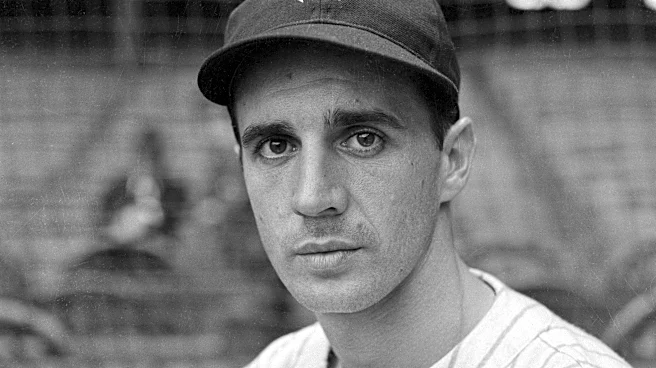



There is probably no one in baseball history more decorated than Frankie Crosetti. Across his years as a player and then as a coach, he was part of 17 World Series championship teams, all of which were as a Yankee. While he wasn’t a bad player — 27.8 career fWAR — he was hardly ever the star of the championship teams he played on, nor was he the manager of the teams he coached on. However, he was quite clearly helpful to have around in several capacities.
On this, “Crow’s” 116th birthday, let’s look
back at the life and times of the serial winner.
Frank Peter Joseph “Frankie” Crosetti
Born: October 4, 1910 (San Francisco, CA)
Died: February 11, 2002 (Stockton, CA)
Yankees Tenure: 1932-48
Crosetti was born in San Francisco, the son of an Italian immigrant father and a mother whose parents were immigrants themselves. He would end up being one of a couple Italian-American Yankees from the Bay Area, as future teammates Joe DiMaggio and Tony Lazzeri were San Francisco-born children of immigrants themselves.
As a child, Crosetti learned baseball with his brother, using a whittled down board as a bat and the end of a corncob as a ball. He never much loved school and eventually dropped out when he was 16. He started playing semi-pro baseball out on the west coast and soon caught the attention of the Pacific Coast League’s San Francisco Seals. While the Seals appreciated his talent, they thought he was a bit too small and began sending deliveries of milk to his house every morning. He soon packed on 10 pounds and began playing for the Seals in 1928.
Over the next couple seasons, Crosetti became a very good player in San Francisco. In 1930, he hit .334 with 27 home runs, while also being regarded as a very good fielding shortstop. That caught the eye of Yankees’ scout Bill Essick, who was credited with signing DiMaggio, Lefty Gomez, and others for the team. Essick convinced the Yankees to sign Crosetti.
Even after the signing, Crosetti spent 1931 with the Seals, but reported to the Yankees for 1932. Early in the season, manager Joe McCarthy stuck with the veteran Lyn Lary at short with Crosetti at third, but by midseason Crosetti was starting at short and would hold onto that spot for much of the next decade.
The Yankees won the 1932 World Series, but Crosetti got his career off to a bit of a slow start in that season and over the next two, as the Yankees fell back to the pack in the standings. Ahead of the 1935 season, Crosetti worked with the University of California track coach and came into the season bigger, faster, and stronger than he ever had been. While he played well the following year, Crosetti went down with an injury during the season, requiring surgery on his knee.
Crosetti was seemingly running out of chances going into 1936, but he managed to keep hold of his spot in spring training. In the regular season, he then turned in probably the best year of his career. In addition to his always reliable defense, he hit .288/.387/.437 with a career-high 15 home runs. He was named an All-Star for the first of two times in his career. With that, plus Lou Gehrig, Bill Dickey, and a rookie DiMaggio, the Yankees returned to the World Series, winning the AL pennant and then beating the Giants in six games for Crosetti’s second championship.
Crosetti would never match those offensive exploits again, but he remained a reliable part of the Yankees’ roster for years to come. Besides his defense, he also became known as the most vocal Yankee in the field, with his “Crow” nickname being more than just a play on his last name. In addition to ‘36, he was part of the Yankees four-peat from 1936-39. In 1938, he would’ve had an argument for World Series MVP had it existed, as he OPSed 1.056 in the series, made a couple crucial defensive plays, and hit an eighth inning home run in Game 2 that gave the Yankees the lead for good as they eventually swept the Cubs.
As the calendar turned into the 1940s, Crosetti would start to lose some playing time, as a young shortstop named Phil Rizzuto arrived on the scene. He did get his spot back for a little bit while Rizzuto was serving in the military during World War II, but was never a regular again after that. The Yankees kept him around as a bench player and then a player-coach as the mid to late 40s came along. He would add three more championships to his collection as part of the Yankees 1941, ‘43, and ‘47 teams.
Crosetti gave up playing after 1948 and became a full-time coach, holding a role with the Yankees through 1968. He became the team’s third base coach and won another nine World Series titles over there. He was valued not only for helping younger players along, but also because he never held any ambitions to manage himself. He turned down managerial opportunities from other teams and kept with the Yankees through several managers.
After 1968, the Yankees were mired in what would become arguably the worst period in franchise history. Crosetti resigned from the team desiring to spend more time with his family on the west coast. He joined the Seattle Pilots coaching staff in their one year of existence, and then spent two seasons as a coach for the Twins. He left the MLB ranks after 1971, settling back down in California. He still stayed in the game though, and even did some high school coaching. Crosetti remained in California until he passed away at age 91 in 2002.
There have been many Yankees who have been better players than Crosetti, but based on the way baseball works nowadays, I don’t think anyone will ever become more decorated than Crosetti.
See more of the “Yankees Birthday of the Day” series here.