
The NFC Wildcard game between the Chicago Bears and the Green Bay Packers evolved into a true coaching clinic, a legendary chess match orchestrated by Bears offensive coordinator Ben Johnson. His layered
play-calling and masterful conditioning of the Packers’ defense ultimately led to the game-winning touchdown.
Johnson’s first move was a calculated test of the Packers’ defensive philosophy. In the first quarter, he unveiled a specific “wide bunch” formation positioned to the field side—the wider portion of the field.
The formation inherently threatened the flat and stressed the two deepest defensive backs on that side. Crucially, the Packers’ defense responded with only two defensive backs covering that area.
Recognizing the numerical advantage and the Packers’ soft coverage, the Bears exploited it immediately. Johnson called for a quick screen pass out to wide receiver Luther Burden.
The play was executed flawlessly, resulting in a 12-yard gain and a first down.
This early success gave Johnson a crucial insight: the Bears were content to accept “what the defense gave them.” More significantly, it instilled apprehension regarding the quick screen pass in the minds of the Packers’ defensive backs and coaches.
Having successfully conditioned the defense, Johnson moved to the next phase of his attack in the second quarter. The Bears came out in a formation that was visually and structurally similar to the earlier successful bunch look, motioning tight end Colston Loveland into the formation to recreate the potential threat of the screen pass.
This time, the Packers’ defensive response was entirely different. Still smarting from the earlier 12-yard conversion, the Packers prioritized matching the numbers on the outside, specifically calling for man coverage against the wide receivers when the Bears motioned into a bunch.
This hyper-focus on stopping the short, quick throw played directly into Johnson’s hands. As the play unfolded, the Packers’ defenders, anticipating the screen, sat down on the shorter, shallower route.
This commitment to the flat and intermediate zone created a massive vulnerability downfield. Quay Walker should have stayed in coverage on DJ Moore underneath the crosser. Moore was able to execute a clean release, break free from the coverage, and get wide open for a first down further down the field. Johnson had successfully manipulated the defense: the threat of the screen had now opened up the deeper passing game.
With the game on the line and the clock ticking down in the biggest moment of the contest, Ben Johnson returned to his well-crafted progression, calling a look that was a near-mirror image of the earlier formations—but with a subtle, yet important, twist.
He brought in Luther Burden to reinforce the bunch look, but he also utilized an “tackle eligible” formation, known as a tackle-over. Offensive tackle Darnell Wright was positioned on the left side and declared an eligible receiver, adding another layer of complexity.
At the snap, the execution was designed to sell the screen-pass deception perfectly. Darnell Wright would sprint out to the flat, simulating the lead blocker on a screen. Colston Loveland and DJ Moore overtly sold run or screen blocks, reinforcing the idea that this was another attempt at the quick throw. Luther Burden sold his block and circled back, exactly as he did on the successful first-quarter screen.
The conditioning was complete. Having been burned once by the screen and once by an intermediate route when they overreacted to the screen, the Packers’ defensive backs completely triggered downhill. All three immediate defenders committed fully to stopping the short screen/run action.
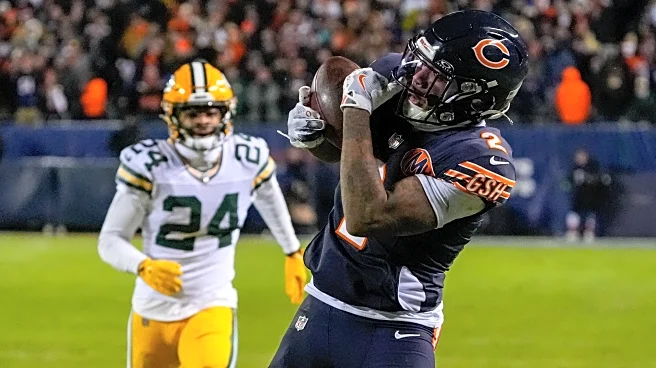
At that exact moment, DJ Moore abandoned his simulated block and executed a clean vertical release downfield. With the entire defense committed to the line of scrimmage, Moore found himself completely wide open deep down the field. The quarterback delivered the pass, resulting in the game-winning touchdown.
It was a brilliant sequence of play calls. Johnson used the simple, short screen to create fear, used that fear to open up the intermediate routes, and then used the ultimate threat of the screen to isolate and free his best receiver deep for the decisive score.