







Sometimes it can be really, really baffling to try and figure out what NHL teams see in certain players, and what they don’t see in others.
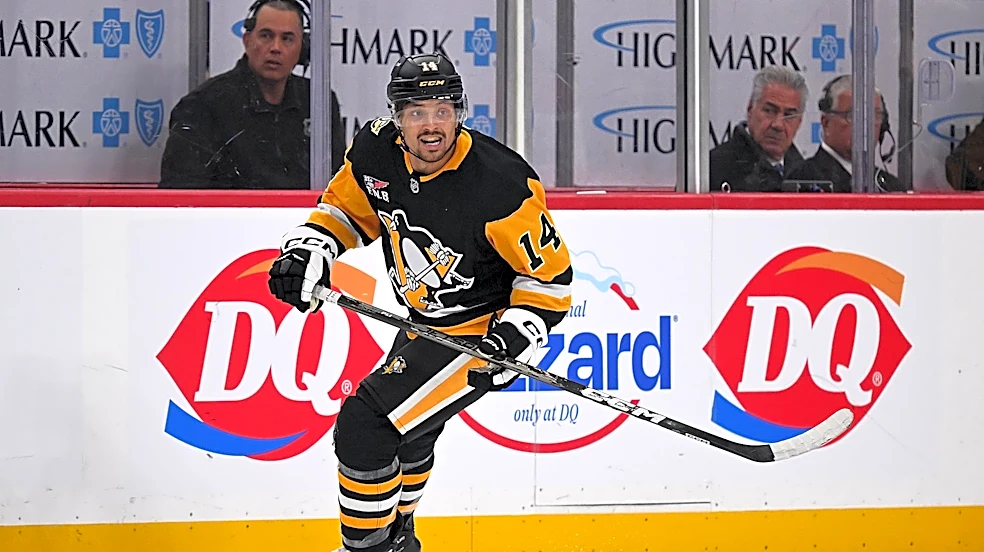
Let’s take Pittsburgh Penguins Nicholas Robertson, for example.
He’s 25 years old, played over 240 games in the NHL, and always posted strong numbers whenever he’s been on the ice. Relative to his ice time, he’s always been an extremely productive player.
Over his final three years with the Toronto Maple Leafs, his 1.09 goals per 60 minutes ranked 28th out of 414
forwards that logged at least 1,000 minutes of 5-on-5 ice-time during that stretch. That number placed him ahead of players like Brandon Hagel, Jake Guentzel, Kirill Marchenko, Nikolaj Ehlers, Alex DeBrincat, Jack Hughes, Sidney Crosby, and Leon Draisaitl just to name a few. Doesn’t mean he’s a better player than them. It just means he scored goals at a higher rate per minute.
That’s not everything, but it’s also not nothing.
It’s something.
But how much?
The only way to really find that out is to give an expanded role and see what happens. It never really happened much in Toronto. He never averaged more than 12 minutes of ice-time per game over a full season, and over the previous three years only had two individual months where his ice-time went above that.
When the Penguins acquired him this summer I thought it was an intriguing move because he checked a lot of the boxes they have been searching for in trying to find some overlooked gems. Early-to-mid-20s player, some success, not a lot of opportunity, and maybe some untapped potential that still needed a way to come out.
Through seven games with the Penguins, he’s doing exactly what he’s always done — score a lot of goals in not a lot of minutes.
His ice-time per game? Still around 12 minutes.
After starting the season on the first line, he was quickly demoted down the lineup to the fourth line, where he continued to contribute.
Each line he has been on has immediately (and significantly improved) when he has been on it.
In his 80 minutes of 5-on-5 ice-time, the Penguins are outscoring teams 7-1. They have a 61.8 percent expected goal share. He has had 38 defensive zone starts to only 14 offensive zone starts. Between a drop to the fourth line and heavy defensive starts he isn’t exactly being put into great offensive positions. Despite all of that, he has still been one of the Penguins’ most dangerous offensive players. He already has four goals, is one of their top players in terms of generating shots, scoring chances and expected goals per minute, and always seems to be around the puck.
It’s only seven games, but it has been pretty close to what he has done prior to this season, and if anything, he’s been even better this season.
Do you know what you should do when you have a player that seems to be overqualified for the role they are in and is outperforming it?
Give them a bigger role with more responsibility and see how they handle it.
Maybe it doesn’t work. Maybe you have to eventually slide them back into the smaller role.
But it might work. And you might have a player that can be a key contributor not just this season, but also beyond.
The Penguins had Robertson skating on the third line on Thursday with Ben Kindel and Andrei Kuzmenko, so maybe he is going to get some increased minutes and a chance to play with better playmakers. It would be deserved, even if his line with Blake Lizotte and Connor Dewar was rolling. Lizotte and Dewar can still handle those minutes and have played well together regardless of who their third linemate is. And it’s not like Elmer Soderblom would be an issue there (he’s also played well). He has simply played too well to still only be getting limited minutes. Expand his role a little and see what he can really do for you.