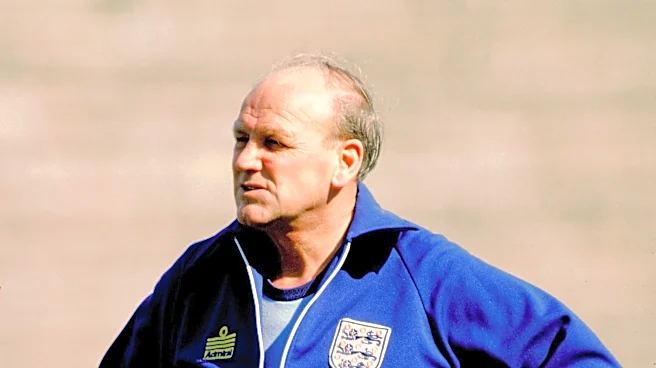



Ron Greenwood was the assistant manager of Arsenal from 1957 until 1961, when he took the job as West Ham manager. During his time at Highbury, he was a key member of the England coaching team and had direct responsibility for the Under-23 team.
Greenwood famously instituted what became known as the “Academy of Football” philosophy at West Ham and developed 1966 World Cup heroes Bobby Moore, Martin Peters and Geoff Hurst. From a very early stage in his coaching career, he was a teacher rather than
a dictator, striving to produce open, attacking football and always liking to win beautifully.
The forthcoming 1962 World Cup tournament in Chile was occupying the minds of the England coaching team as they laid their plans in 1959. The Under-23 games were a key plank of the strategy as England manager Walter Winterbottom, along with Greenwood, attempted to mastermind the World Cup campaign.
Greenwood had selected a young squad, with a couple of surprise inclusions, for the game against France (whom they had never defeated at this level) at Roker Park.

The French team were a reasonably established squad and contained two players who would go on to grace the French international game for many years: Lucien Cossou, the Monaco centre-forward, and René Ferrier, the St Etienne midfielder/right-winger.
England’s team contained Fulham goalkeeper Tony Macedo (a great favourite of Greenwood’s), who would go on to compete with Jimmy Montgomery within the international set-up. George Cohen, the Fulham full-back, would cement his place in the 1966 World Cup-winning team. Peter Swan of Sheffield Wednesday was the centre-half and was seen as a shoo-in for the 1962 World Cup squad, even at this stage of his career. (Swan would miss the 1962 tournament through illness and, in 1964, was banned from football for life for his part in an illegal betting scandal.)
There was local interest in George Eastham of Newcastle at inside-forward and Middlesbrough full-back Mick McNeil.
Also in the team, making his third appearance at this level, was centre-forward Joe Baker, who was the very first player to be selected for England at any level from outside the English League.
Baker played for Hibernian in Scotland and was on his way to scoring a record 42 goals in 33 league games for “The Hibees” that season.
Even though he had been raised in Scotland by his Scottish mother, the strict qualifying criteria of the era meant he had to play for England, having been born in Liverpool to an English father.
The 19-year-old Baker’s inclusion in this squad was seen as putting pressure on all the existing strikers in the England set-up, but in particular, 24-year-old Brian Clough, who was a Middlesbrough player at this time.

On a cold, wet night in Sunderland, a very credible crowd of more than 26,000 gathered at Roker Park to get a first-hand look at some of the best young players in the country.
On the night, this game was something of a disappointment. The assembled England squad was reported by the local press to have been guilty of over-elaboration and playing for themselves rather than as a team. Only two English players escaped criticism: Wolves right-winger Chris Crowe and Joe Baker, both of whom scored in the second half to give England a two-goal victory.
Baker, in particular, was lauded in match reports. Argus, writing in the Sunderland Echo, reported: “With the right support Baker could be a sensation.” The Journal’s headline read: “Bright Promise of Baker on a Cold Night”.
Baker and Crowe showed signs during the game of a good playing relationship on the pitch.
As early as the second minute, Baker had exchanged two passes with Eastham to create a good shooting opportunity for the Newcastle forward. In keeping with his game on the night, Eastham dallied in front of goal and his eventual shot was well blocked.
Crowe then found Baker with a very good cross, which was powerfully headed just wide of the post.
Captain Maurice Setters (who would go on to become Jackie Charlton’s assistant with Ireland from 1986-1995) then pinged a 30-yard cross-field pass to winger Jim Sydenham, whose cross was only just missed by Baker.
Baker then teed up Crowe for a 35-yard shot that just skimmed the bar.
Crowe then scorched an indirect free-kick into the back of the French goal, but without any touch to the shot, the goal was disallowed.
Just after half-time, a Setters free-kick saw Baker ghost in at the near post and head powerfully home for the first goal of the game.
Just after the hour, Crowe turned a Cohen cross-shot into the France net to complete the scoring.
Baker had backed up his first two caps at this level with another good performance and his first international goal. He was rewarded a week later with his first full England cap, as he replaced Brian Clough in the starting XI. Clough never got another chance to build upon the two caps he gained in October 1959.
Clough would join Sunderland in July 1961 and set a phenomenal record of 63 goals in 74 appearances before his premature retirement due to injury.
Joe Baker joined Sunderland from Nottingham Forest in June 1969. He had scored goals and been a fan favourite at every club he had played for up to this point in his career. He was 29 when he joined Sunderland, who were relegated in his first season. His 12 league goals in 39 league appearances were the least prolific return of his professional career, but he was still a very popular member of the team. He left Sunderland to return to Hibs in January 1971 and finished his professional career at Raith Rovers, for whom he scored 34 goals in 49 appearances. He is one of two Sunderland forwards to score over 100 goals in the English and Scottish leagues (Neil Martin is the other).
Joe Baker went on to earn eight full England caps, scoring three goals (as well as six U23 caps), between 1959 and 1966.
Alf Ramsey selected Baker for the initial 40-man squad for the 1966 World Cup tournament but trimmed him from the 28-man squad and placed him on standby for the tournament, along with other forwards, including Chelsea’s Peter Osgood and Barry Bridges, Everton’s Fred Pickering and Derek Temple, and West Brom’s John Kaye.
[Link to OTD 17th July 1940: Remembering Former Sunderland Forward Joe Baker]
The Sunderland Echo on this day was able to report international activity involving some Sunderland players, with Ian Lawther and winger John Fraser back from Ireland ‘B’ duty and in the squad for the forthcoming league game against Bristol City.
Martin Harvey had also played extremely well in the ‘B’ game, but would be turning out against Stockport in the North Regional League in a strong-looking reserve team that contained Johnny Bollands, Cec Irwin, Dickie Rooks, Ralphy Goodchild and Alan O’Neil.
The Youth Team and its de facto second team, Silksworth Juniors, also announced squads containing Nick Sharkey and Willie McPheat, as well as Jimmy Montgomery, Mel Slack and John Dillon.
Under-23 International
Date: 11 November 1959
Venue: Roker Park
Attendance: 26,495England U23 2-0 France U23
Goalscorers: Baker 47 mins; Crowe 63 mins
England: Macedo (Fulham); Cohen (Fulham); McNeil (Middlesbrough); Setters (Man Utd); Swan (Sheff Wed); Smith (West Ham); Crowe (Wolves); [player name unclear in original] (Blackburn Rovers); Baker (Hibs); Eastham (Newcastle); Sydenham (Chelsea).