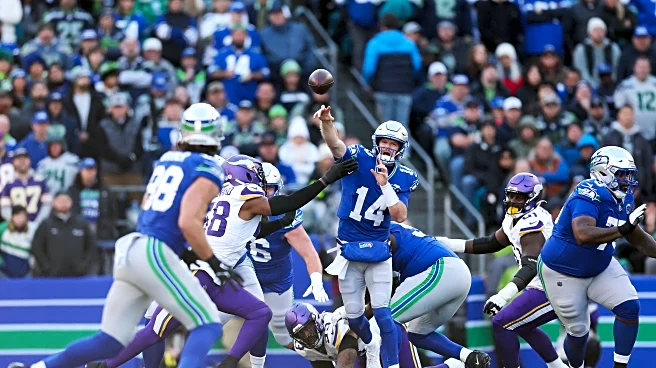

It’s the postseason and the Seattle Seahawks are scheduled to take to the field against the San Francisco 49ers in a matchup of NFC West foes with a trip to the NFC Championship Game on the line.
For whichever
of the two teams loses the game Saturday night at Lumen Field, it will mark an end to the 2025 NFL season that started in the exact same place in Week 1. In the meantime both teams earned the right to play in the postseason, with the Seahawks earning a first round bye the 49ers upsetting the defending champion Philadelphia Eagles in the Wild Card round.
All of that sets up a matchup between two teams who have already played a pair of very close games this season.
The season opened for the teams with the Niners holding off Seattle 17-13, with the game effectively ending with a late Sam Darnold fumble.
Then, in Week 18, the Seahawks prevailed when Christian McCaffrey was unable to haul in a pass that had been ever-so-slightly tipped, gifting Drake Thomas his first career interception.
Now, in the divisional round the two teams once again face off. This time, though, the stakes are as high as they can be, with the loser’s season ending.
That brings things to the important question about which version of Sam Darnold the Seahawks will get on Saturday. Specifically, will they get first half of the season Sam Darnold who lit opposing defenses up, or will fans watch second half Sam Darnold, who helped the team to a franchise-best 14-3 finish, albeit with glimpses of Jets- and Panthers-era Darnold showing through.
As Field Gulls Managing Editor Mookie Alexander chronicled, the Seahawks offense has been inconsistent during the second half of the, and in particular the way opponents defended the Seattle offense changed midseason.
As the data, shows, though, the Niners laid out how to slow down the Seattle offense in Week 1, other defensive coordinators simply aren’t as good at their jobs as Robert Saleh. Saleh’s 49ers defense finished near the top of the league in percentage of plays on which five or more defensive backs were on the field.
That is, of course, relevant to the matchup this weekend because the answer to the question about what happened to the Seahawks offense midseason that caused Sam Darnold to go from Superman to seeing ghosts is rather simple. Sure, fans have debated non-stop about what changed, but the answer is that, as noted above, how opponents defended the Seattle offense changed, which changed what was asked of Darnold.
That chart is a whole lot of numbers without a ton of explanation, so to break it down for those who have questions, the five columns of the table are as follows:
- Team
- Expectated pass rate based on situation
- EPA per play on pass attempts in expected rushing situations
- EPA per play on pass attempts in expected passing situations
- difference between EPA per play between expected rushing and expected passing situations.
It’s not hard to see that Seattle is at the very bottom of the table, and the reason is because the Seahawks’ success through the air early in the season was largely a product of Klint Kubiak’s scheming and game planning. His extensive usage of 12 and 13 personnel tricked defenses into heavy boxes, stymying the Seattle run game, but opening things up for Air Darnold to light up undermanned secondaries.
Basically, Darnold’s success early in the season came by throwing when opponents were in base defense personnel packages and expecting the Seahawks to run the ball, and Seattle was the most efficient team in the league throwing the ball in expected rushing situations through the first seven weeks of the season, to the tune of 0.427 Expected Points Added per dropback.
However, in expected passing situations, they were not nearly as efficient. In fact, in expected passing situations, the Seahawks were closer to the bottom of the league, with ten teams worse than the -0.0401 EPA per dropback. Particularly noteworthy is that the reason the Seahawks are in the bottom spot on the table is because the difference between their EPA per dropback in expected passing and expected rushing situations was the largest in the entire NFL over the first seven weeks of the season.
In short, much of the success of the Seattle offense during Darnold’s insanely hot first half of the season was the direct result of Klint Kubiak’s scheming and the use of smoke and mirrors to get opponents into easy to take advantage of personnel packages.
Opponents, of course, eventually wised up to this around midseason, sometime around the Seahawks acquisition of Rashid Shaheed at the trade deadline and sometime around when former Seahawks tight end Greg Olsen was busy rambling on about how easily Kubiak was tricking defensive coordinators into the personnel groupings he wanted to face.
Whether this was a change defensive coordinators made after the Rams picked off Darnold four times in the Week 11 victory over the Seahawks, or whether it was a natural change after Seattle acquired a deep threat that opponents feared at the trade deadline in Rashid Shaheed, fans can go ahead and take their pick.
Regardless of which option one chooses to believe, the simple fact is that the Seahawks offense was far less explosive when throwing in expected rushing situations during much of the second half of the season, though they did see improvement in EPA per dropback in expected passing situations.
With that all said, for those who have called for Kubiak to be fired or otherwise replaced, and who wondered why the Seahawks didn’t take advantage of more play action during the first half of games, the answer appears simple. Seattle appears to have been using the first half of most games as practice for Darnold, as the team needed, and needs, improvement from him in pure passing situations. In the absence of improvement in pure passing situations, the team committed $100M to a quarterback who isn’t very good at quarterbacking in pure dropback situations, which is the time when the most is being asked of a quarterback.
Just as the Let Russ Cook season of 2020 showed, a quarterback can excel when opponents are stacking the box and making it easy to attack downfield, but it’s the ability to execute against defenses that want eliminate explosive plays that separates quarterback tiers. The difference between a mediocre, middle of the pack quarterback and the likes of a Brady or Manning or whoever is the ability to produce when the opponent demands consistent execution and eliminates the big strike abilities of explosives.
That’s exactly what opponents did to the Seahawks offense over the second half of the season, and it’s the area of quarterbacking which is the greatest area of opportunity for Darnold to improve.
Putting it all together, it’s simple. The Seahawks rode Klint Kubiak’s version of the dumbed-down-for-Jared-Goff McVay offense through the first half of the season, and that worked until it didn’t.
The offensive slowdown didn’t impact the ability of the team to compete or to seize the top seed in the NFC, but if they are going to advance to the Super Bowl they will likely need Darnold to avoid a repeat of his Week 11 performance, something that could be a big ask with all three remaining NFC teams among the top ten in the league in the usage of nickel and dime personnel usage.