
Leslie LaFronz still remembers her first exposure to international field hockey. LaFronz, a Northwestern alum who played from 1981 to 1984, faced a 1981 San Jose State squad led by a standout player from the Netherlands. That player, whom LaFronz says was nicknamed “Peaches” and describes as “outstanding,” withdrew after competing just one season.
“At the time, our coach Nancy Stevens said, ‘It’s just not right. She’s not going to classes. She’s just playing field hockey,” LaFronz said. “‘How do you
compete against somebody that’s been playing since they’re three, four years old?”
During LaFronz’s time, Northwestern only rostered Americans. The pool of international NCAA student-athletes was smaller than it is now, and it was more common for players to compete for just one year. They often hailed from countries with more established field hockey scenes than the United States.
Over time, coaches began to recruit more international students seeking a four-year education, while the quality of play and facilities at American universities got better. North Carolina won three consecutive national championships without any international students from 1995 to 1997, but an All-American team hasn’t won a title since.
572 international athletes, or 29.1% of all players, played Division I field hockey during the 2025 season, according to data from The Field Hockey Analyst. Each DI team has at least one international student. One-and-dones still exist, but most recruits now come to the U.S. and stay for all four years.
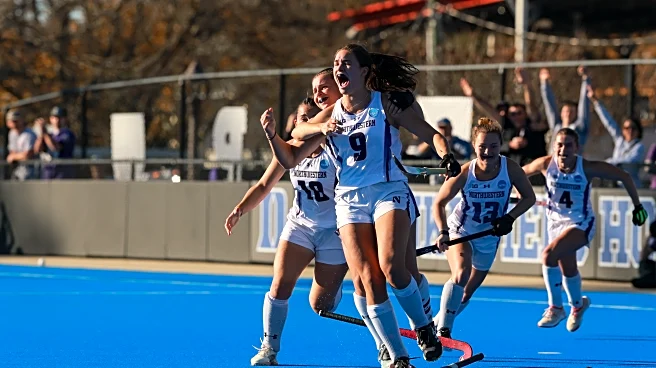
Northwestern fielded five internationally recruited players on its 2025 roster compared to just two during head coach Tracey Fuchs’s first season in 2009. The Wildcats remain a predominantly American team, with top players like Ashley Sessa and Maddie Zimmer competing for the U.S. National Team. But it was two Dutch players, Kate Janssen and Ilse Tromp, who scored Northwestern’s two goals in its 2025 NCAA title game victory.

Field hockey is a predominantly global game. The U.S. women’s national team is ranked No. 12 in the world and hasn’t medalled at an Olympic Games since 1984. Women’s field hockey is dominated by nations like the Netherlands and Argentina, which have postgrad club opportunities and astroturf facilities that are sparse in the United States. On the American stage, international influence is essential to bettering the sport.
“We definitely could not do it without our international players. In Division I hockey, you realistically can’t compete without them,” Zimmer said. “We just have so many great players that bring in their own playing philosophies and styles, and it really helps us rethink our game and elevate the way that we play.”
Field hockey’s international background opens a whole new Pandora’s box for NCAA players and coaches. This includes following an entirely separate timeline from domestic recruiting, finding the right fits among players from different cultures and then integrating them onto American college teams.
In turn, Northwestern’s navigation of this recruiting process helped propel its rise to the top of college field hockey. Every single successful NU team in the Fuchs era — from the head coach’s first B1G title team in 2014 to the 2021, 2024 and 2025 national championship teams — rostered All-Big Ten caliber international athletes who meshed with star Americans. Many of those international players, from Northwestern’s all-time points leader Chelsea Armstrong to 2025 NCAA title game golden goal scorer Tromp, are etched in Wildcat lore.
“We’re developing great and attracting great Americans, and then also adding diversity with our internationals,” Fuchs said. “So I couldn’t be more proud of the way we handle our business when it comes to recruiting.”
Northwestern’s first Fuchs-era international recruit was Australian Chelsea Armstrong, who in 2009 brought a fast, risky playstyle from her home country to Evanston.
Armstrong made an immediate impact as a first-year, leading the ’Cats to their first winning season since 2003. The Aussie eventually became Northwestern’s all-time goals and points leader, a player who Fuchs credits as the one who kick-started the team’s 21st-century success and established a blueprint for international recruits.

“Each year she got so much better and was able to lead,” Fuchs said of Armstrong. “She set the tone with the culture, fitting in.”
Following Armstrong, the ‘Cats brought in international recruits almost every year. In 2012, Fuchs signed Irishwoman Lisa McCarthy, an eventual two-time All-American and a leader of Northwestern’s 2014 squad that broke a 20-season NCAA Tournament drought. McCarthy briefly lived in Ann Arbor as a child and grew up knowing she’d want to play in America. When the time came, Fuchs was the first coach she emailed — McCarthy didn’t even know Fuchs led Northwestern at the time, only recognizing her as the former U.S. Junior National team head coach.
Fuchs gave McCarthy the rundown on the American college system and suggested a few schools. Naturally, one of them was Northwestern, and McCarthy eventually visited. Immediately, she bought in.
“[When I] saw the campus, [I] was absolutely blown away by it,” McCarthy said. “And then you get to meet Tracey, and then at the time [assistant coaches] Zoe Armquist and Ali Johnstone, and I was just like, ‘geez, this feels like home.’”
Northwestern’s Fuchs-era international player count peaked at nine in 2015 and 2016 and has since declined, remaining at four to six every season since 2020. Nowadays, the Wildcat coaching staff first finds Americans, who usually commit during their junior year of high school. Internationals are on a more flexible timeline, so most are recruited as seniors to fill gaps that Americans couldn’t cover.
Some recruits, like McCarthy, Dutch senior Maja Zivojnovic and Chilean sophomore Laura Salamanca, reach Northwestern via email. Agencies also help prospective international student-athletes with recruiting — two Dutch agencies brought Northwestern first-year Annika de Haan and sophomore Kate Janssen to the States. Sometimes, Fuchs and her staff travel overseas, like when they recruited 2022 NFHCA West Region Player of the Year Bente Baekers while on a cross-country team trip to the Netherlands in 2018.

Word also spreads within Northwestern’s network. Fuchs connected 2025 graduate and fellow Irishwoman Sophie Dix with McCarthy during Dix’s recruiting process. Dutch junior Ilse Tromp, arguably Northwestern’s top defender in 2024 and 2025, first wanted to compete at Northwestern because of her friendship with Zivojnovic.
In high school, Tromp knew she wouldn’t make the Dutch national team and wasn’t sure if she’d play after graduation. A recruiting agency approached her during her junior year about college in the U.S., but she wasn’t sold. Then she learned how much Zivojnovic, her former club teammate, loved playing for Northwestern, and she changed her mind.
“I didn’t look at any other schools, if I’m being honest,” Tromp said. “I trusted that [Zivojnovic] did the research and made a good decision, and I knew she was having a lot of fun.”
Another standout in Tromp’s recruiting experience was American Northwestern assistant Will Byrne, who visited Tromp’s Rotterdam home several times to sell NU. Although she didn’t know English well at the time, Byrne instantly seemed like someone she could trust.
Others feel the same about Byrne. He’s often the first Northwestern coach that international recruits meet, usually over Zoom. Marle van Dessel, who runs the field hockey department at Dutch recruiting agency Slamstox (which recruited de Haan), said that Byrne was one of the first coaches she connected with “on a deeper level.” When Salamanca first visited Northwestern, Bryne oversaw her tour.
“He senses if you’re going to be a good fit culture-wise, but he’s also really honest about everything, like game time,” Salamanca said of Byrne. “He won’t promise something that won’t actually be true.”

Northwestern prioritizes cultural fit while recruiting both international and American athletes. But it’s harder to evaluate fit with the former group because the coaching staff can see them play less frequently than American recruits, whom they may watch several times throughout high school. It’s why Fuchs values the intangibles she sees on overseas trips, such as a player’s communication style on the field, halftime behavior, confidence or demeanor.
Fuchs says Northwestern has a recruiting budget used both for international and domestic travel, and that her staff goes overseas once or twice a year. NU takes advantage of European flight and hotel prices during the holidays, which Fuchs says are often cheaper than domestic ones then. But resource management can be difficult. LaFronz, who used to coach DIII Kean University, said she struggled to attract international recruits because her school doesn’t award athletic scholarships. Former Delaware coach Rolf van de Kerkhof, a Dutchman who coached Janssen with the Blue Hens before she transferred to NU, exclusively travels to Europe for recruiting.
“I’ve never gone to Australia [or] New Zealand. Why? Because a trip to those countries from the U.S. is at least twice as expensive as it is to go to Europe,” Van de Kerkhof said. “If you have no money in your budget, you just pick and choose.”
Fuchs doesn’t believe there’s an ideal international-American ratio for Northwestern. Other coaches, such as Van de Kerkhof, are more precise. He believes that teams should have a maximum 35% international roster, or what he calls “an American identity with international flavor,” to maintain strong team chemistry. Northwestern’s 2025 and 2024 title-winning rosters were about 21 and 23% international, respectively.
However, recruiting is just the beginning. Next, international student-athletes must acclimate to a whole new world, facing all the adjustments that come with living in another country.
Ilse Tromp was the hero of the 2025 Final Four, tying the game up with 1:10 left in the semifinals against No. 1 North Carolina before scoring the golden goal in the title game against No. 2 Princeton. She’s loved her time at Northwestern and has seen exorbitant success with the Wildcats. And yet, during her most recent flight from Rotterdam to Evanston, she found herself questioning everything.
“It’s the logical thought of, ‘Why am I doing this again?’” Tromp said. “I’m making it so hard for myself, I’m separating my life while I could have everything, everyone close together.”
International students who come to Northwestern must leave parts of their lives thousands of miles away. Neither Tromp nor Salamanca’s families could make the 2025 Final Four alongside the families of Northwestern’s American players. The Big Ten Network isn’t available overseas, so both players taught their parents how to install VPNs to watch their games.

Then there’s language. Though Tromp and Salamanca were both taught English at home, it was still jarring at first to suddenly speak it all the time.
“You just get there, and you have to start speaking English to everyone,” Salamanca said. “And then you don’t speak your own language again until you talk on the phone with your parents.”
Still, Northwestern’s environment made transitioning easier for many international students. Due to the quarter system, players have a month to train with their teammates before classes begin in late September. Then the season occupies them all fall — McCarthy remembers being so excited and fascinated by NCAA field hockey during her first season that it took her months to fully grasp that she had moved across the Atlantic.
Fuchs and her players praise Northwestern’s team atmosphere, driven by unity. But international students also found community among themselves. They bonded over things unique to them, like setting up a new phone number, occasional homesickness and that nagging question of what life would be like if they stayed home — no matter how much they liked it in Evanston.
Then there are field hockey-related transitions. When every major city in the Netherlands is a few hours away at most, Tromp had to adjust to longer-distance travel in the U.S. Her Dutch club separated teams into different levels to give everyone playing time, so she also wasn’t used to the concept of starters and role players at Northwestern.
U.S. college sports culture was another big learning curve. Most international players eventually grow to understand the importance of a Big Ten or national championship, but living in a world beyond the NCAA can also help make big postseason games feel less nerve-racking.
“Not growing up watching those types of games on TV releases a little bit of the pressure in a good way,” Salamanca said of the Final Four. “Being there and playing, it’s so fun to be a part of, but at the same time, you step back, and it’s still field hockey. It’s the sport I like to play, and in the end, I just go there and have fun with my teammates.”
International students have plenty to offer Americans in return. Because they have greater access to smoother, faster astroturf fields growing up and tend to start playing earlier, Europeans typically come into college more technically sound. This includes the ability to hit the coveted dragflick shot — the shot Tromp took in both of her signature Final Four goals.
Cultural differences can also add to NU’s own culture. Salamanca recalls Northwestern captain Aerin Krys telling her that she helped the team become more comfortable with physical affection like hugging, something Salamanca says Chileans do more often than Americans. And while not every Dutch player fits the stereotype of being super upfront, those who do use the quality to help their team environment. Van de Kerkhof noted how communicative Janssen was relative to her Delaware teammates, while former goalie Annabel Skubisz saw that trait in her Dutch-born successor, Juliana Boon.
“I think it’s something American, especially female American sports culture, can take from a Dutch culture,” Skubisz said. “They’re very good about having those uncomfortable, upfront conversations.”
On the flip side, the American game offers more pace and physicality, as well as greater volume of weight-room training that many international athletes don’t usually see at home. Van Dessel says Division I gyms are on par with those of the five-time Olympic champion Dutch women’s national team.
There’s also the professionalism of NCAA sports, from announcing starting lineups before games to teams building a large social media presence. For instance, Northwestern field hockey has more Instagram followers than Den Bosch, the reigning champions of the top women’s league in the Netherlands. Even though the game is more popular participation-wise in the Netherlands, Tromp believes these elements make field hockey feel bigger in America.
At the center of it all, amid the differences and learning experiences, is the Northwestern setting that helped so many international recruits settle in.
“You really felt a part of the Evanston, Northwestern community, and I think that made it so easy to buy in, because Tracey didn’t make it a difficult environment to enjoy,” McCarthy said. “When you’re enjoying it, you want to buy into what your teammates are doing. You want to buy into what your coach is doing.”
The presence of international players in college field hockey can ruffle feathers, especially among American parents who believe non-American recruits are taking their daughters’ scholarships. Furthermore, the NCAA remains the highest level of domestic competition for most Americans. While many other countries provide opportunities to play for clubs or universities after high school, the NCAA is the only non-national team path forward for Americans who want to stay stateside.
Allison Keefe, the voice behind The Field Hockey Analyst Substack and social media accounts (combining for over 30,000 followers), said she received an influx of messages about this issue during Saint Joseph’s run to the 2024 NCAA championship. Three of the Hawks’ top four point scorers were international, and they ranked 13th nationally in percentage of international student-athletes that season.

“Parents have a tendency to be concerned that their children are not going to be recruited to universities due to international students,” said Keefe, who disagrees with these sentiments and believes international students can help grow American field hockey. “Especially after the [2024] Final Four, there was this really big argument where they kept saying St. Joe’s only won because they have the most internationals, which isn’t true.”
Fuchs, an assistant coach for the U.S. National team, is cognizant of her responsibility to develop Americans at Northwestern who can represent the Stars and Stripes. But when asked about possible concerns over international recruiting, her response was simple: play better.
“If you’re good enough, you’re going to be the one that’s selected,” Fuchs said. “If you look at some rosters and they have 24 players and 18 are not from our country, maybe they have a problem with that. It’s not for me to decide the rules. We just try to pick the best players that we think are going to win championships.”
People like Fuchs and Keefe believe opportunities won’t come through halting international recruiting, but by increasing grassroots access to American field hockey — 22 U.S. states didn’t contribute any Division I players in 2025. Work can also be done to create more DI programs, as currently there are only 83.
From an international perspective, playing in the NCAA is life-changing. Tromp and Salamanca credit Northwestern with helping them become responsible and disciplined individuals. McCarthy, who is currently a doctor in Australia, says she wouldn’t have developed the courage to pursue medical school had it not been for her Northwestern playing career.
“It’s a little reassurance in the back of your head that’s like, ‘Geez, I can do hard things,’” McCarthy said. “When I was moving to Australia, I was like, ‘This will go okay, I hope.’ But because I had such a positive experience in the States, I feel confident enough to step into this, because I’ve done this before.”
The overall American college landscape shifted in tandem with NCAA field hockey. Due to roster limits outlined within the 2025 House v. NCAA ruling, Van Dessel said the overseas recruiting timeline has moved earlier, with teams filling up faster. This change seemingly hasn’t slowed the trend of international recruiting in the sport.
What has changed over the years is people’s perceptions of it. Four decades after LaFronz’s first exposure to international field hockey players, who she saw then as novelties Northwestern didn’t have, she’s now a big supporter of global diversity within the sport.
LaFronz’s alma mater seems to feel the same way. The Wildcats have made the most out of field hockey’s multinational nature, recruiting athletes who moved halfway across the world at age 18 to earn a degree — but also, to add varied perspectives and help Northwestern win championships.
“You’re starting to just get a melting pot all over, and it’s just the way of our society. What happens at the collegiate level is a reflection of what’s happening in this society, but definitely helps propel field hockey to another level,” LaFronz said. “We need to be grateful for that.”