




It’s the international break, so let’s use our spare time for some general complaints and discourse, shall we?
In Liverpool’s last two Premier League games, refereeing decisions and a lack of VAR involvement has been a major bone of contention — and, in the case of the narrow loss to Arsenal, a defining moment of the game. It should go without saying that given Video Assistant Referees are just human beings looking at screens we cannot expect perfection lacking in human error. Further, because football
is a contextual game with loads and loads of variables, there is no way for perfect consistency across all matchdays and all grounds in a given season. That doesn’t remove the frustration these two occasions.
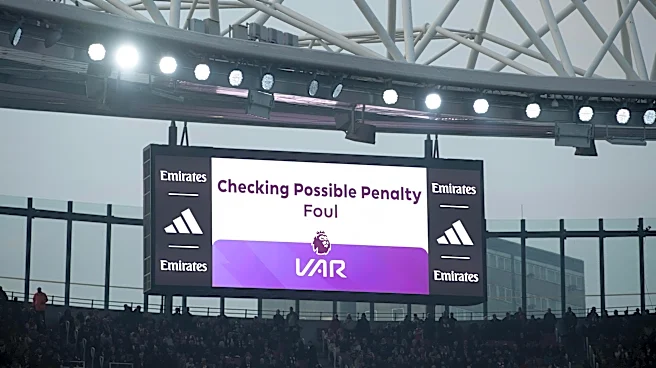
The failure of VAR to get involved against Arsenal seems like an error, an oversight; as such, it’s annoying but not worth dwelling on here. That moment is what we would want VAR for: a review system able to catch fouls the on-field referee might miss. But what happened this weekend, when VAR did review the late penalty awarded to Liverpool but decliined to intervene?
Today in The Athletic the outlet’s “refereeing expert” Graham Scott addressed some reader questions about the headline moments, including the clash-of-heads foul called on Miloš Kerkez that did not affect the outcome of the match but did certainly remove the players’ clean sheet bonuses.
In explanation for the foul call, Scott had the following to say about the referee’s initial call on the field (emphasis mine):
It is highly unusual for a player to concede a penalty after a clash of heads, and I could see no offence here.
These challenges are not specifically covered in the laws of the game, so decisions are made based on convention and precedent. Officials assess these incidents much the same way as a challenge after a shot or cross, with contact by the defender attempting to block or save the ball deemed inevitable rather than foul play.
The exception is when the defender’s actions are deemed to be reckless or outright dangerous, in which case a penalty is given and the appropriate card shown.
The most recent similar incident was at Stamford Bridge in May, when Anthony Taylor awarded Chelsea a penalty against Nottingham Forest. That was easier to explain, given the home player, Jesse Derry, suffered serious injuries, even though his opponent Zach Abbott escaped unpunished.
At Selhurst Park on Sunday, Kerkez moved into the path of the ball as [Darío] Osorio headed it towards goal, and their heads clashed. Tony Harrington awarded a penalty as if it were a routine foul, but did not show Kerkez a card.
This is, effectively, what we all felt at the time. While there was a clash of heads and Kerkez did not win the ball in that moment, none of us can remember a similar moment being given as a foul since both players were earnestly attempting to head the ball and Kerkez did not do so in a reckless or dangerous manner. Textbook “a coming together.” The convention and precedent is not to call a foul there — and contextually an even stronger reason not to call it, according to Scott’s explanation, since Kerkez was the player seemingly worse off from the contact. Kerkez not being shown a card suggests the referee did not deem the contact he saw to be reckless or dangerous on the part of the defender.
So, nothing dramatic here: The Athletic’s refereeing expert agrees with the general sense that this should not have been given as a penalty. But then things get complicated, because per Scott VAR was also correct — in terms of VAR protocols — not to get involved:
Why no VAR intervention? For much the same reason as earlier in the season, when Liverpool goalkeeper Alisson’s ‘foul’ on Neco Williams at home to Forest was allowed to stand.
Clubs agreed in the summer that VARs should overturn penalties only if the evidence is incontrovertible. In both examples, I’d prefer an intervention because the referees would almost certainly realise they had misread events, leading to the correct decision — but under the current guidance, I would have kept out.
This is where things feel quite odd. Scott’s wording is precise and frustrating; I think he’s probably correct in his understanding of things, which makes the “current guidance” the issue at play here. The guidance means that VAR would intervene only at the extremes (for example, referee thought there was contact by a defender but it was instead a dive by the attacker, etc.), which sounds good at first glance: this means that VAR would not be re-litigating every instance of contact before a goal, would leave more up to the referee on the day, would feel less intrusive to the fans in the ground and the players on the pitch. But then you get moments like this one.
In the case of time, too, VAR was still intrusive: the review still occurred, with plenty thinking due to Scott’s initial reasoning that the penalty would be overturned. We paused and waited while VAR took a look and then declined to send the referee to the monitor. The penalty stood even though we all, including our expert, think it wasn’t a penalty — and this is how VAR should function this season, per the referenced agreement.
In this case, and in the previous penalty award against Liverpool that Scott mentions in this explanation, it seems like Premier League VAR application is missing something that feels extremely obvious: if we’re reviewing things anyway, why not let the on-field referee look at the replay in full speed on the pitchside monitor with the express directive that he doesn’t need to overturn his decision?
It’s a discussion we’ve had thousands of times over, but in our present moment the pitchside monitors tend to feel like foregone conclusions. If a referee is sent to the monitor, the decision will be getting overturned, it’s just going to take a bit longer to happen because the center official has to watch the replay before making the call. This is intended to keep the match in the central official’s control (so, VAR isn’t making subjective decisions, the match official is), but feels a bit like a pantomime.
In a study that came out this April, Daniel Walker et al. found that in 1,520 matches in the Premier League between the 2020/21 season and the 2024/25 season, match officials were told to consult the pitchside monitor on 250 occasions, and overturned their initial decision 95% of the time. In practice, this means that most of us will have never seen a referee uphold his initial decision when looking at the screen, making the added time of the referee doing the little replay watch feel like a longer VAR delay for an inevitable outcome.
With the added “incontrovertible” caveat that Scott clarifies is part of the VAR application clubs agreed to this year, this feels more of a farce and waste of time. If the VAR is not empowered to let the referee even consider revising an initial call unless “incontrovertible” evidence is available, why bother sending them to the screens at all?
Though I sympathize with clubs’ agreement to the guidance of “incontrovertible evidence” being needed for overturns as it seems logical, it appears to have led directly to situations where a call experts and fans (even “neutral” ones) can overwhelmingly deem incorrect can counter-intuitively correctly not receive VAR intervention and be allowed to stand.
I agree with Graham Scott that the referee would likely have overturned his call of penalty had he been allowed to see a replay. Indeed, I think the pitchside monitors are uniquely useful for situations like this, where the central official would be better able to make calls with the help of a quick and clear review of what was seen only from some distance with the naked eye. That the VAR failed to intervene on the “incontrovertible evidence” of a shirt pull on Alexander Isak a week prior makes this incident altogether more frustrating, but the conversation should really remain in conjunction with the Nico Williams penalty earlier in the season.
To have VAR interventions like those I am loosely advocating for would make VAR more intrusive, however, because there would be more reviews. It would take more time. The kind of replay review where referees are empowered to review what they have seen and be able to uphold their decision or overturn it, depending on their view (rather than only allowed to see a replay if the VAR deems it “incontrovertible evidence” of an incorrect call, making an overturn inevitable and the replay itself a bit silly) would be time consuming, but the on-field referee would probably be more likely to leave the pitch feeling as if he actually made all the calls, and more confident in them.
It all feels like a mess, and I find myself leaning into what plenty of other sports have done with replay reviews: other than for “objective” calls (here, offside or hand-ball offenses where the question is the point of contact) we might prefer to see referees review calls based solely on a coaches’ challenge situation — though making such a thing feasible in a sport like this one is its own challenge.
That Liverpool has been on the end of two penalties conceded incorrectly with this new guidance at the scene of the crime certainly feels grating. VAR is never going to be popular if we consistently have post-match conversations where neutral experts largely agree that “yeah, that call was wrong but VAR couldn’t intervene.” As ever, there has to be a better way.