




Just hours after Knicks fans collectively exhaled at the news that OG Anunoby had avoided a major hamstring injury, I got the opportunity to hop on a call with former Knick Danilo Gallinari.
Before getting into basketball, there was one thing worth acknowledging first: Gallinari had just won a BSN (Baloncesto Superior Nacional) championship. When congratulated on the title, he seemed pleasantly surprised that it was brought up, flashing a brief but unmistakably genuine smile before offering a quick
thank you.
For a player whose NBA journey began in New York, it felt only natural to start with his first impressions of the Knicks organization and the city itself. “I didn’t know much about the organization,” Gallinari admitted. Relaxed and candid throughout the conversation, he explained how the franchise laid out its vision for the future after drafting him in 2008 before joking, “Obviously I didn’t stay long,” with a laugh.
His introduction to the NBA, however, came rather brutally. “When most people think about a welcome moment, it’s good,” Gallinari said. His was anything but. Even now, he recalled the week of February 1, 2009 in remarkable detail. First came Kobe Bryant, who walked into Madison Square Garden and dropped 61 points on the Knicks in what was then the highest-scoring game ever by an opposing player at the arena. Two nights later, LeBron James followed with 52 points, 11 assists, and what Gallinari still remembers as a triple-double, despite one rebound later being taken away.
For Knicks fans, those games remain burned into memory for all the wrong reasons. But for Gallinari, the welcome tour still wasn’t over. That Friday, the defending champion Boston Celtics came into the Garden and beat New York 110-100. More than anything, Gallinari remembered the awe of suddenly sharing the floor with the biggest stars in basketball night after night.
That experience, he explained later in the conversation, is part of what makes New York such a difficult place to play. “You got to be strong-minded,” he said. “New York is a tough place to play with tough fans, so you have to be able to take that.”
Because of how the latter stages of his career unfolded, it can be easy to forget just how productive Gallinari was at his peak. Across a 10-season stretch, the 6’10” forward averaged 16.7 points per game while building a reputation as one of the league’s most skilled offensive forwards. A player capable of handling the ball, shooting from deep, posting up smaller defenders, and attacking off the dribble, Gallinari was a very good player for a very long time.
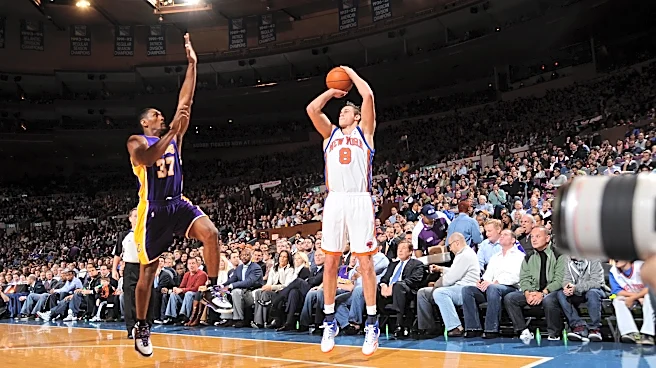
Naturally, that versatility meant drawing some difficult defensive assignments. When asked about that, after pausing for a few seconds, Gallinari gave his answer decisively. “Metta World Peace.” Then came a few more names. “Tony Allen, Kawhi [Leonard], Draymond [Green]. They defended me well.”
The conversation eventually shifted from the NBA Gallinari entered to the one that exists today. At 37 years old and officially retired, Gallinari was asked whether there are any current players who remind him of himself.
“Cooper [Flagg],” he answered immediately before laughing. “He had a few more posters than I did as a rookie.” Gallinari pointed to Flagg’s versatility. His ability to handle the ball, shoot, and play multiple positions were all traits that he resonated with.
That naturally led to an interesting thought: what might Gallinari’s own career have looked like had he entered the league in today’s pace-and-space era? He agreed that today’s NBA may have suited him even more, though he was quick to credit his first NBA coach, Mike D’Antoni, for already implementing an early version of the modern game. That style, Gallinari explained, fit him perfectly.
Still, the funniest moment of the entire conversation came when discussing the differences between eras. “The money,” he said with a grin.
Beyond styles of play, Gallinari also reflected on how much the perception of international basketball has evolved since his initial years in the NBA. As one of the most successful international players of his generation, he has witnessed that change firsthand. “Just the global level has gotten so much higher,” he said. “It’s a bit easier now. When I came into the league, there were stereotypes.”
That comment stood out.
It wasn’t long ago that international prospects, particularly European ones, were often labeled as soft. Since then, though, those preconceived notions have slowly disintegrated, and the league has become increasingly dominated by international talent.
Gallinari has partnered with AT&T for the AT&T Dunk Bus, a traveling game-day experience designed to bring fans closer to the game and the league through live dunk showcases, NBA 2K competitions, and player meet-and-greets.

Gallinari spoke enthusiastically about the partnership and how it creates an interactive experience for fans before revealing one final detail with a laugh.

“I don’t know if AT&T knows this,” he said, “but I’ve been a customer of theirs for 18 years, so it’s a neat opportunity.”