
We are two weeks from the trade deadline, and the Celtics are among a handful of teams rumored to be buyers seeking a positional upgrade to prepare for a postseason run.
The rumor mill has swirled around
Boston’s frontcourt in particular, and anyone even a little online has seen the team linked to big names like Jaren Jackson Jr. and Ivica Zubac over the past month. Both options would require a substantial trade package, likely involving draft capital and the expiring $27.6 million contract of Anfernee Simons, but what if the Celtics aren’t looking at a splashy move?
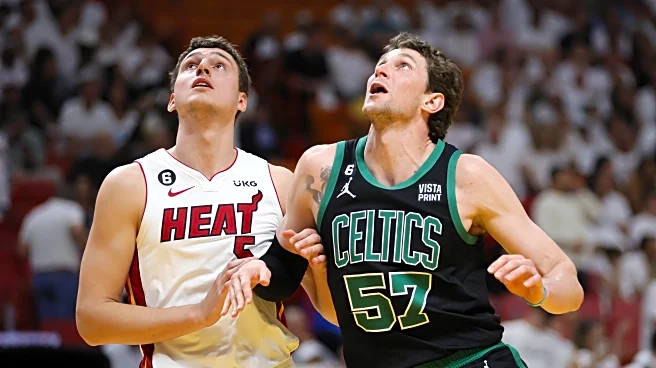
At this point, you’re probably wondering why, in the year of 2026, the name Mike Muscala is holding any relevance to this franchise. Muscala is perhaps the quintessential modern journeyman by force, a living and breathing trade throw-in whose 11-year career featured seven teams, seven trades and a lot of perfectly fine stretch shooting off the bench.
To some, he’s a hero (he may never buy a beer in Philadelphia again for his contributions to the selection of Tyrese Maxey); to others, he was a welcome bench piece, and to the Celtics specifically, he was a passing ship, whose 26-game pit stop started right at the trade deadline for a team in need of an additional bench big.
Boston finds itself in a similar spot. Between Neemias Queta and Luka Garza, the Celtics have surprised many NBA pundits that predicted a league-worst frontcourt, but they’re still in search of another big man to round out that spot. The bigger names will earn all the headlines, but today we’ll be searching for low-cost, low-risk options that likely don’t push the needle significantly, but also don’t require significant trade assets to improve the position.
Utilizing the Muscala Model (not a real thing, nor quantifiable), we’ll see if this dive into the bottom and mid-level of the NBA’s frontcourt barrel can help the Celtics in the short-term.

Marvin Bagley III
There’s a reason we’re starting with Marvin Bagley on this list.
Bagley, in his second stop with the Washington Wizards and fourth team overall in his seven-year NBA career, may fit the Muscala Model better than anyone.
In fact, Bagley was miraculously involved in a trade with the Moose himself, getting moved by Detroit alongside Isaiah Livers and a second round pick in a swap for Muscala and Danilo Gallinari. We all remember where we were for that Shams notification right?
In all seriousness, Bagley, currently on a one-year minimum deal with Washington, is having a fine season off the bench for one of the league’s premier tanking organizations.
In 36 games and under 20 minutes a night, the 6-foot-10 center is averaging 10 points on a career-best 62% efficiency, 6 rebounds and 1.5 assists. In seven starts in place of an injured Alex Sarr, he’s averaged 14 points, 8 rebounds and 2 assists.
When it comes to Bagley, what you see is what you get. In a lot of ways, he’s exactly the player he was when he came out of Duke as one of the most hyped one-and-done freshmen in the country.
His shooting range never extended beyond the arc in a way many hoped it would out of Duke, and he’s long been considered a negative defender in his various career stops, yet he has earned a living as a capable, and still quite athletic, paint finisher.
This year, Bagley has cut a lot of the fat out of his scoring, and focused entirely on the areas he already thrived in. He has taken shots out of the mid-range and beyond almost entirely out of his shot diet, and his current 91% shot volume from inside of 10 feet would easily mark a career-high.
Bagley’s game is not complicated. While still a frequent post-player, something we likely see little of if he was traded to Boston, he makes his living as a putback glass-crasher, dunker spot dump-off threat and play-finishing roll man.

Defensively, while a fine rim deterrent and solid rebounder, the expectation would be that, for a third center option, he’s fine, albeit unexceptional, if occasionally frustrating. If we were talking about him as a starter? It’d likely be a different, more concerning story.
All to say, while it can be hard to separate the Bagley that could have been from the Bagley we see today, I think it’s safe to call him an entirely playable backup big, and on his minimum contract, it would take pennies to acquire him, with zero strings attached beyond this season.
Washington is easy to please these days: a late draft pick in any form is a win to them, considering Bagley willingly came back after the trade that netted them Marcus Smart. Between some form of a second round pick attached to the minimum contracts of either Xavier Tillman or Chris Boucher, the Celtics could be bringing in a third center to their rotation that’s a capable rebounding and scoring threat.

Nick Richards
Keeping in trend with their current frontcourt options, obtaining the services of Nick Richards would provide the Celtics with their third big man option to have been drafted in the second round that worked their way from the G-League into an NBA rotation.
Before last year’s deadline, Richards was the first of a few trades around the fringes for the Suns, who picked him up in a swap with Charlotte for Josh Okogie in an attempt to solve their interior defensive dilemma.
But now, Richards has found himself low on the Phoenix pecking order behind Mark Williams, Oso Ighodaro, and the small-ball tenacity of Dillon Brooks. Add to that the lottery selection of Khaman Maluach, and it’s clear Richards really doesn’t have a place in the Suns rotation in the short or long-term once his contract expires this summer.
The rumor mill backs that up, and it’s clear it wouldn’t take a lot to get Richards off their books to duck the tax.
Despite falling out of Phoenix’s favor, Richards has been a proven commodity in a bench capacity during his six years in the NBA. In Charlotte and in his first season with Phoenix, Richards proved to be a physical paint deterrent and a scrappy rebounder, whose mission on offense was to screen hard and roll straight into board-crashing duties. His 5.58 defensive rebounds per game last season had him in the 93rd percentile in that category, and his 2.6 on the offensive glass had him even higher in the 95th percentile.
While he has an interior-minded defensive game, he shows enough foot speed to defend out to the perimeter, not exclusively sticking his feet in the paint and waiting for a slasher to attack.
Richards’ game is not complicated, and his effort in the minute details has always stood out, particularly during his final season and a half in Charlotte. He does not need to be significantly involved with the ball in his hands to make an impact, something we’ve seen from Garza this year as a screener and rebounder in his own right.
For a Celtics team looking for additional rebounding and paint protection, Richards checks the box as a career bench big that’s willing to play his role in an effectively high-motor manner.
It helps that Richards is also a quality rim protector. Last year’s tape shows a player whose 7-foot-4 wingspan aided a Suns team that desperately lacked shot-blocking options. It was a temporary breath of fresh air for one of the league’s worst defenses.

Like Bagley, obtaining Richards would not require a significant haul. It’s unlikely a trade would take more than a second round pick to acquire Richards. In Boston’s case, that deal could work as is, however, they could also attach one of their veteran minimum contracts alongside the pick to also make it happen.
Jalen Smith
This has long been a rumored low-cost center of interest for the Celtics, really up until Jalen Smith penned a 3-year, $27 million contract with the Bulls in 2024.
Smith, a former 10th overall selection for the Suns, has carved out a respectable NBA career as a bench stretch big, ramping up his outside shooting volume this season with the Bulls. In the past four seasons to this point, he’s averaged 9 points on 50/34/75 splits in under 20 minutes, and in Chicago, he’s been heavily encouraged to shoot the rock, with 55% of his shots coming from beyond the arc.
In this new role in Chicago, he’s been less of a pick-and-pop big, and more of a jumbo, movement-shooting compliment to Nikola Vucevic, who is the team’s primary screening operator. Chicago runs an entirely different brand of offense from Boston behind Josh Giddey and Coby White, pushing one of the fastest paces in the league and relying on first-read shooting that can often leave Smith in the corner or trailing up the floor with the intent to fire off the catch. In Boston, the role would certainly look a little different, possibly utilizing him in the screen game similar to Al Horford’s role as a stretch shooter.
While it’s inherently intriguing to see a big man with that confidence and range, he has been a mostly below-average 3-point shooter since he shot 42% from deep in his final season with the Pacers, which played a big role in his new contract.
So, does he provide anything else? Luckily, he is more than just an off-the-catch shooter. Smith has proven to be a strong rebounder, averaging 1.97 offensive boards per game, which places him in the 88th percentile in that category according to Basketball Index, and he is in the 98th percentile in defensive rebounding talent, a value that factors in opportunity creation and conversion on the defensive glass.

He is also a solid interior defender despite being slightly undersized at 6-foot-8, using his strength to handle business in the post while being an athletic and active help defender. The field goal percentage for opponent shots contested at the rim by Smith compared to expectations is -7.10%, and while not often a switch defender, Smith is a mobile big that displays swift foot speed in drop coverage and good instincts defending the rim.
Of the three players listed, he probably fits the Muscala Model the least, having been traded just a single time with a price tag that’s possesses more risk/reward than your average Bagley or Richards transaction (although his lone trade was Muscala-coded with a swap of second round picks and Smith moved for Torrey Craig).
Yet, everything outside of Matas Buzelis and Giddey seems to be on the table for the Bulls, who once again find themselves in Play-In Purgatory.
When it comes to Smith, you’re getting a pretty intriguing stretch forward/center capable of getting Boston back into its double-big roots, but the only way a direct trade makes real sense is if it involves the contract of Sam Hauser, a championship piece currently on a fiery hot streak that’s not easy to part with, even with Boston’s wing depth being a strength area so far this season. A more expansive multi-team deal is not out of the question to get it done in a way that adds more moving parts, but if Boston was looking at this option, a hard decision would need to be made.
Barring a trade next week that settles Boston’s trade market strategy, I’ll be back next week for another search for that Muscala-sized void the Celtics could look to fill.
What low-cost trade options do you see as a possible boost to Boston’s rotation?