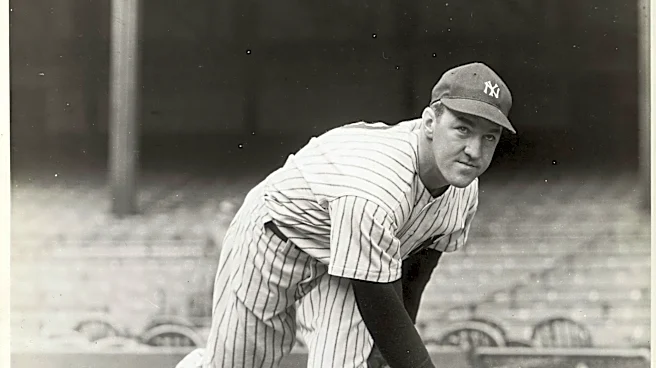







A New York-born boy who grew up to play for the Yankees. The dream! That is exactly the story of Johnny Murphy. The story and legend of Johnny Murphy and New York baseball are as intertwined as those of just about anyone in baseball history.
John Joseph Murphy
Born: July 14, 1908 (New York, NY)
Died: January 14, 1970 (New York, NY)
Yankees Tenure: 1932-46
Born in the shadow of Manhattan’s skyscrapers, the Yankees first scouted Murphy while he was a student at Fordham Prep in the Bronx. The club bided
its time before signing him near the end of his collegiate career at Fordham University.
After signing, the Yankees sent Murphy into their farm system. In his second professional season, and first full year, he won 16 games while throwing 256 innings. That performance earned Murphy an invitation to spring training before the 1932 season. After a strong showing, the Yankees brought the 23-year-old north to open the year.

On May 19, Murphy made his major league debut. He made one more appearance before his cup of coffee went cold and he was sent back to the minors for more seasoning. Murphy remained in the minors the following season, appearing primarily in relief.
The following year, in 1934, Murphy made the club and actually split time between the rotation and bullpen. The 20 starts he made that season would not only stand as a career high, but would ultimately account for exactly half of his career starts. Prior to the 1935 campaign, manager Joe McCarthy decided to move Murphy into the bullpen permanently.
Murphy reluctantly accepted the move. At the time, the save was not yet an official statistic, and the modern bullpen had not even begun to take shape. The role McCarthy envisioned for Murphy, however, would become one of the earliest blueprints for the modern closer. Over the next 11 seasons, Murphy established himself as one of baseball’s premier relief pitchers, becoming known as “Fireman” Murphy due to his penchant for extinguishing jams.
As a Yankee, Murphy played a major role during one of the greatest stretches in franchise history. The run began in 1936 with the Yankees defeating the Giants in the World Series. Murphy then earned All-Star selections in each of the next three seasons as New York captured championships over the Giants again in 1937, the Cubs in 1938, and the Reds in 1939.
During those four championship runs, Murphy posted a 2.16 ERA while going 1-0 across 8.1 postseason innings. He finished four games and would have been credited with three saves had the statistic existed.
After that run, the Yankees did not return to the World Series until 1941. That season was arguably the best of Murphy’s career. He posted a career-high 2.8 WAR, finished a career-best 31 games, and recorded a 1.98 ERA as the Yankees defeated the Brooklyn Dodgers in five games.

Murphy had a down year in 1942 but rebounded in 1943. That season, Murphy and the Yankees captured another World Series title, this time defeating the Cardinals. Following the 1943 season, and during the final years of World War II, Murphy voluntarily retired to serve his country during the 1944 and 1945 seasons.
Returning to the Yankees in 1946, Murphy enjoyed another solid campaign, going 4-2 with a 3.40 ERA. The Yankees again fell short of the pennant, and the offseason brought sweeping changes, including a new manager and Murphy’s release.

The Red Sox signed Murphy, and he pitched the 1947 season in Boston. Following that season, he retired and moved into scouting before eventually joining Boston’s front office as vice president and director of the minor leagues.
After his stint in Boston, Murphy helped build the Mets organization from the ground up. He worked his way through the front office and was named the third general manager in franchise history before the 1968 season. Murphy is credited with helping assemble and guide the legendary “Miracle Mets,” who won the 1969 World Series behind Tom Seaver, Jerry Koosman, Gary Gentry, Nolan Ryan, Tug McGraw, Cleon Jones, Tommie Agee, and manager Gil Hodges, who Murphy successfully recruited.
Sadly, only a few months after earning his sixth World Series ring, Murphy died of a heart attack at just 61 years old. Long before anyone tracked saves, Murphy helped define what a relief ace could be, and the way he was utilized laid part of the foundation for the closer role that would eventually become commonplace throughout baseball.
To a man known for appreciating the finer things in life, happy birthday, Johnny!
See more of the “Yankees Birthday of the Day” series here.