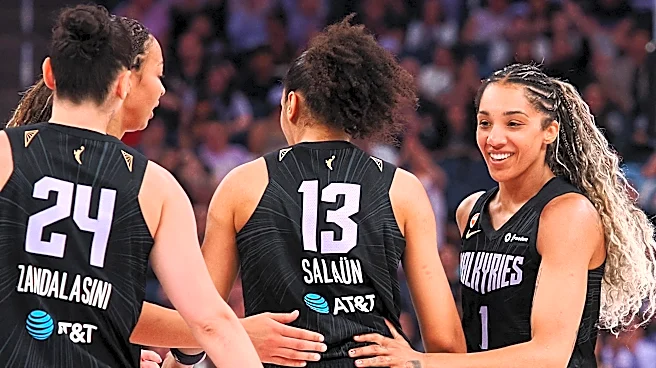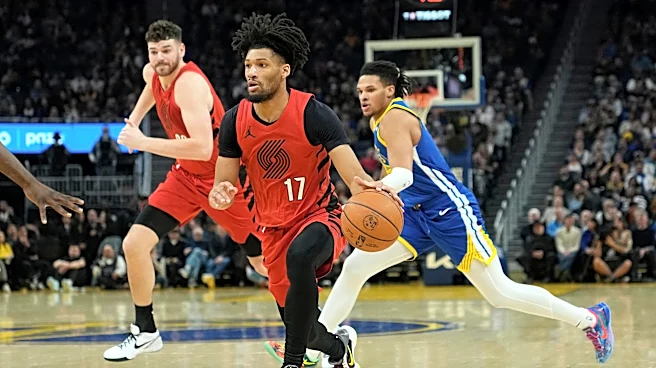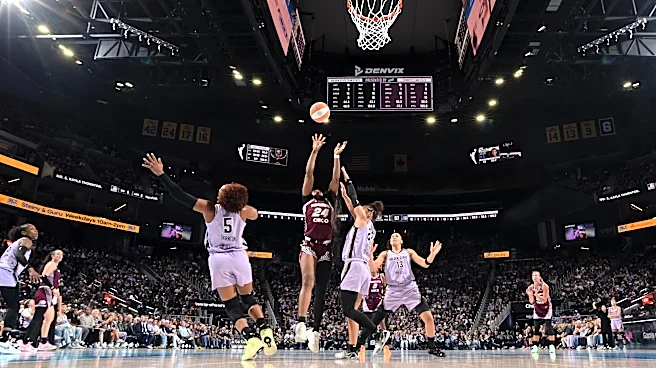


It’s not easy being an expansion team. Last year’s Golden State Valkyries were the first of 12 expansion squads in WNBA history to make the playoffs, doing so as a No. 8 seed, and while this year’s Toronto Tempo entered with similar expectations, back-to-back losses at Golden State have those Tempo playoff hopes dwindling fast. Toronto sits 10-20, 13th of 15th in the league and seven games out of the eighth and final playoff spot with 14 games left to play. The team has lost its last seven, including
the two recent double-digit losses to the third-seeded Valkyries, and focus, as it so often does for expansion teams, may be beginning to shift toward next season.
Morrow’s Room
The headlines from the last week in Tempo world, consequently, are about the acquisition of Aneesah Morrow from Connecticut (take care, Maria Kliundikova, a 2028 2nd-round pick, and Tima Pouye, who was waived to create roster space). Morrow was the Sun’s first-round pick, No. 7 overall, in 2025, after starring at LSU, where she finished with 104 career double-doubles, the second-most in NCAA Division I history. It’s not a win-now trade, although Morrow is poised to help the Tempo immediately in some areas. With the realistic understanding of how the season has gone, it’s a flyer on a high-upside young player who can be under cost-effective team control through 2029 (team option 2028, restricted free agent 2029).
One area in which Morrow can help in the present and future is rebounding, which, as we noted last week, is a real weakness: Toronto ranks second-last in team rebound rate (47.3 per cent). Morrow’s calling card in the pros, as it was in college, is her rebounding.

She led the WNBA in defensive rebound rate as a rookie in 2025, and ranks second in the league in 2026, behind only Brionna Jones (who has played just five games this year). Morrow’s 13.1 per cent offensive rebound rate is also in the league’s 96th percentile, per HerHoopStats. Given that Toronto has only two players with a DREB% greater than 15 per cent, and one of those is no-longer-rostered Kayla Alexander, Morrow’s 26.7 per cent DREB% should provide an immediate boost.
Outside of rebounding, what will Morrow bring to the table? Playing, essentially, on a minutes restriction in her first game with Toronto (the second of the away-and-away at Golden State), Morrow flashed a pretty representative offensive performance. Never afraid to shoot—and posting a 24.9 per cent usage rate, in the 85th percentile—Morrow would like to be a three-level scorer: she ranks in the league’s upper third in shots taken from all four general zones of the floor (restricted area, non-restricted paint, midrange, three-point).
The key is efficiency. Morrow’s 0.98 points per shot attempt is just an 18th percentile mark, and her by-zone eFG% eclipses 1 PPSA in only the restricted area (59.1 per cent, itself a 33rd percentile mark). She also has room to grow as a playmaker (just a 0.92 AST/TO ratio this year, a 14th percentile mark, but a literal double improvement on last season’s 0.46 ratio) and as a foul-drawer (12.1 per cent FT rate, down from last year’s 16.4 per cent, is a 19th percentile mark). She’s still young, and with Brittney Sykes still injured and a raft of frontcourt injuries for Toronto more generally, Morrow should have an opportunity to grow in the remaining 14 games.
Defensively, it can hardly be said that Morrow has played much for shutdown teams. Last year’s Sun ranked third-worst in defence (108.8 DRTG), and while this year’s Sun have posted essentially the same rating (108.4) and rank 10th in defence, Morrow join a Tempo defence that has struggled mightily (115.2 DRTG, last in the W).
Morrow has solid defensive numbers this season—with defensive win share and steal/block rates all above-average—but the on/off splits and Databallr’s all-in one RAPM are less enthusiastic (a partial explainer on RAPM here; very simply, it is the estimation of a player’s plus-minus that adjusts for teammates and opponents). Opponents took more rim, free throw, and three-pointers against Connecticut with Morrow on the court. Her best defensive attribute at present is probably her ability to limit second-chance points, by virtue of that aforementioned defensive rebounding.
Cautiously, one game being a small sample size, I think the defence was as reflective as the offence in her Tempo debut.
She exhibited the athleticism and the desire to be switchable, especially against wings, but struggled guarding faster guards in isolation on the perimeter. There are the usual rookie defensive mistakes to curtail, but perhaps a flash of potential in her block-from-behind of Veronica Burton (swallow that whistle, ref!). Most similar to offence, I think, is that her defence needs reps; again, something she should see plenty of in these last 14 “let’s see what we have” games.
Explained: Peel Switching
One of the defensive mistakes in the Morrow video offers us an opportunity to break down a “peel switch,” wherein a defender beaten off the dribble switches onto the helper’s defender instead of trying to recover to the ballhandler.
We can also look at an example where the Tempo executed the peel switch effectively, with Maria Conde even blocking the corner three:
Peel switches don’t have to be strongside switches (rotation comes from the same side as the ball)—you’ll notice Nyara Sabally getting into weakside help position in the second clip—but those can be a more straightforward rotation. If Williams had driven to the middle, for example, Allemand couldn’t have taken the drive from the corner, and the switch would depend on the help. If Sabally took the drive, the weakside defenders would zone up, and the switch would be as follows:

Alternatively, x4 could rotate on the drive from nail (middle of the free throw line) help position, and x3 could peel to x4’s cover for a two-defender switch that is the horizontal equivalent of our examples’ vertical switching. The leverage of the defence, the direction and angles of the drive, and the gameplan itself, among other factors, can all cue peel switches more or less, but good defences successfully execute more, however frequently they attempt the switch.
Getting peel and other switches correct has been an ongoing process for Toronto. It’s not easy. Then again, as we said, neither is it easy being an expansion team. The Tempo next play the Portland Fire, Toronto’s fellow expansion franchise, for the second time (Portland won the first matchup 99-80) and for the title of which expansion team has it the easiest… or not.