

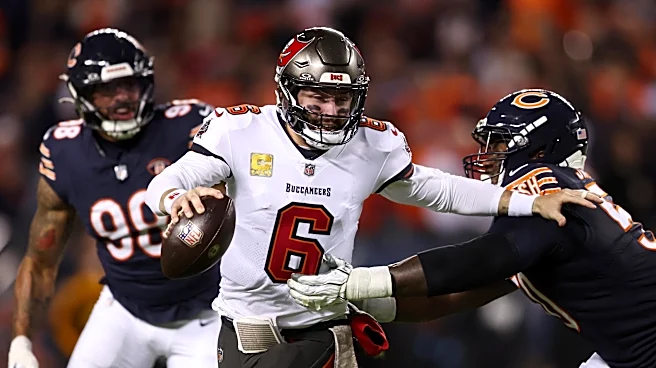
After three consecutive weeks of some of the best football we’ve seen from Caleb Williams, Week 9 appeared to be shaping up as more of the same. For roughly the first quarter and a half, Williams was playing about as well as you could ask of him, and Chicago looked poised for another convincing victory.
Instead, what followed was one of the strangest performances of his young career, as Williams threw four interceptions for the first time at any level of football, for periods struggled with accuracy
in ways we haven’t seen the early 2025 season, and yet still managed to deliver when the Bears needed him most.
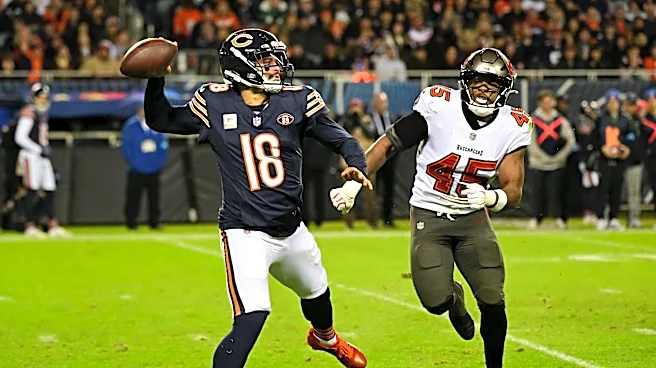
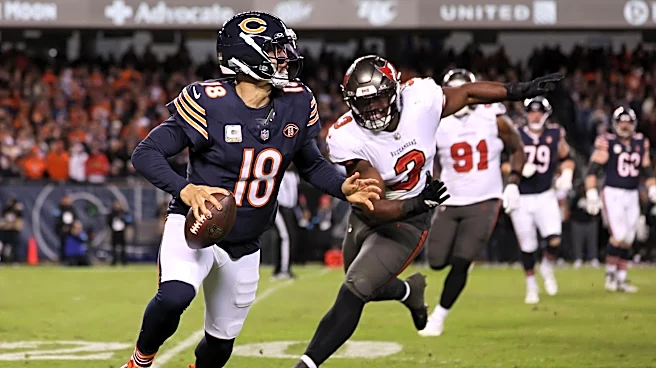
Chicago escaped Soldier Field with a 27-24 victory over the Tampa Bay Buccaneers, improving to 7-2 and extending its winning streak to four games. Williams finished 22 of 37 for 279 yards, two touchdowns, and four interceptions, resulting in a 61.5 passer rating. But as is often the case with quarterback play, the box score doesn’t tell the entire story, and this week that distinction is particularly important.
The Bears couldn’t have asked for a much better start, scoring touchdowns on their opening two possessions, with Williams finding Rome Odunze for a nine-yard score before connecting with Luther Burden III on a 56-yard catch and run. Through roughly the midway point of the second quarter, I had Williams charted with just one off-target aimed throw. He was consistently putting the football where it needed to be, giving his receivers opportunities to make plays and looking every bit like the quarterback who had been carving up defenses over the previous three weeks.
Unfortunately, his receivers weren’t always returning the favor.
Chicago had already dropped three passes during that stretch, including two by Odunze, one of which looked like it would have put the Bears up 21-3, potentially changing the complexion of the game entirely. Colston Loveland also dropped a ball that would have resulted in a nice gain of roughly 15 yards. These weren’t examples of Williams failing to execute or putting his receivers in difficult positions. He was delivering accurate footballs, but the offense was leaving opportunities on the field.
The turning point appeared to come midway through the second quarter, when an unnecessary roughness penalty by Zavion Thomas pushed the Bears back 15 yards from the Tampa Bay goal line. Rather than taking what the defense was giving him, Williams attempted to get all those yards back immediately, forcing a poorly advised throw to Odunze into double coverage that was undercut and intercepted by Tykee Smith.
It was a poor decision, plain and simple. Williams was trying to erase a mistake that wasn’t his to begin with, and unfortunately, that interception seemed to be the beginning of a downward spiral. Williams would throw two more interceptions before halftime and another in the third quarter, bringing his total to four on the night.
For a quarterback who had never thrown four interceptions in a game before Sunday, not in the NFL, college, or even high school, this was about as uncharacteristic as it gets. But there’s an important distinction I want to make when evaluating those turnovers.
Of the four interceptions, only one represented what I would consider a clear breakdown in Williams’ decision-making process. The first was an example of him trying to do too much, forcing the football to a player into coverage that gave no chance at completion. The next two came on attempted throwaways that failed to make it out of the field of play, while the fourth resulted from a deflection on a pass intended for Burden, who also ran a less-than-ideal comeback route on the play.
Does that excuse the four interceptions? Absolutely not. A throwaway that ends up in the hands of a defender is an unacceptable result, regardless of the original intention. However, there’s a meaningful difference between a quarterback repeatedly failing to diagnose coverage and one who recognizes that a play isn’t with pressure baring down, but fails to execute. Three of these interceptions weren’t the result of Williams being fooled by the defense or forcing the football into coverage. They were failures of execution, with an unfortunate deflection thrown into the mix.
That doesn’t mean his performance was without other serious concerns. In fact, what bothered me most about Williams’ afternoon wasn’t necessarily the interceptions themselves, but the stretch of football he played in the third quarter.
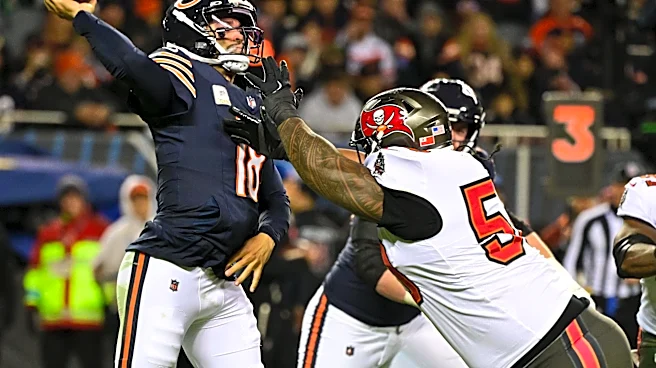
This was where we began seeing accuracy issues that have been largely absent from his game in 2026. There was a sequence of six throws in which I graded four as “Below Average” or worse, including two “Poor” throws due to extreme inaccuracy. Williams was missing open receivers and failing to put the football in catchable locations on opportunities we’ve seen him convert consistently throughout the season. His footwork also became increasing erratic, as the Buccaneers began to blitz Caleb Williams repeated, eventual hitting a 68% blitz rate on the evening. Considering the noticeable strides he’s made with his ball placement and overall consistency, it was an unusually shaky stretch from the young quarterback, no doubt aided by the pressure he faced on Sunday Night.
However, not all of these mistakes were pressure-induced, and there were opportunities that Williams simply failed to capitalize on. At that point, it was fair to wonder whether the rough outing was going to spiral into an outright disaster.
Fortunately, when the fourth quarter arrived, Williams returned to looking like the Iceman we’ve become familiar with. He completed six of seven passes for 72 yards in the final quarter, including three of four on Chicago’s final possession after Tampa Bay tied the game at 24 with just under three minutes remaining.
The biggest play came on a 38-yard connection with Loveland down the left sideline, on a perfectly designed play (more on that later) moving the Bears to the Tampa Bay 16-yard line and into comfortable field goal range. Eight plays after the drive began, Cairo Santos connected on a 38-yard field goal as time expired, sending Chicago into its bye week with another victory.
After everything that had gone wrong, Williams was still the quarterback who ultimately put his team in position to win. That’s not something I’m willing to overlook. And when all was said and done, since Caleb’s return four weeks ago, the Bears have yet to trail a single second during this four game winning streak.
The victory itself produced some remarkable statistical oddities. Chicago managed to score points in all four quarters for the fourth straight game, something done just twice previously in franchise history, while also accomplishing a rather unusual first, becoming the first time in NFL history to win on Thursday night, Monday night, and Sunday night in back to back to back weeks.
The Bears also overcame five turnovers to secure the victory, joining some infamous statistical company, becoming just the 4th team since 2016 to overcome that hurdle. These aren’t exactly circumstances you’d want to replicate, but Chicago continues to find ways to win even when things don’t go according to plan.
As for Williams, his confidence certainly doesn’t appear shaken, and neither is mine. There are absolutely things to clean up from this performance, particularly the failed throwaways and the uncharacteristic accuracy issues that plagued him in the third quarter. However, one rough outing doesn’t erase the improvements we’ve seen in his accuracy, processing, decision-making, and overall command of Ben Johnson’s offense throughout 2026.
If anything, the fact that this performance feels so out of character speaks to just how far he’s come. Williams was far from his best on Sunday, but when the game was on the line, he was exactly who Chicago needed him to be.
My confidence in Caleb Williams remains unwavering, and lost in all the mix a tremendous positive: Caleb Williams became fastest quarterback in Chicago Bears history to reach 9,000 career passing yards in the win over the Buccaneers. Amazingly he now sits 9th all time in passing yards in Chicago Bears history, another 1,000 yards on the season will see him pass Billy Wade and Ed Brown, and it’s not out of the realm of possibility that he hits 5th all time, where Mitchell Trubisky sits at with 10,609 passing yards.
But enough of all of that, let’s get into some metrics and film breakdown!
Benchmarks
(Season totals are underlined, Season Averages in Italics, and this week’s stats appear in regular text.)
C/A: 112/158 (70.9%) | 22.4/31.6 (71.0%) | 22/37 59.5%
Yards: 1267 | 253.4 | 279
Touchdowns: 8 | 1.6 | 2
Turnovers: 1 | 0.2 | 4
QB at Fault Sacks: 1 | 0.2 | 0
aDOT: 7.1 | 10.3
Passer Rating: 104.6 | 61.5
True Passer Rating: 123.2 | 78.1
Time to Throw: 3.16s | 2.80s
Time to Pressure: 2.55s | 2.59s
Pressure Rate: 36.65% | 39.02%
On-Target Rate: 85.9% | 78.8%
Poor Play Rate / Big Play Rate: 2.9% PPR / 8.2% BRP | 18.6% PPR / 11.6% BRP
EPA per dropback: +0.19 | -0.21
ANY/A: 6.6 | 3.6
Game Scorecard

The full grading sheet for each play can be foundhere.
Game Notes
NFL Passer Rating / True Passer Rating / PFN Impact Score: 61.5 / 78.1 / 71.9
- The NFL’s average passer rating through Week 9 sits at 91.1, putting Williams’ 61.5 nearly 30 points below the league average.
- Williams entered the game with just one interception on the season before throwing four against Tampa Bay. Despite finishing with 279 yards and two touchdowns, the turnovers absolutely crushed his traditional passer rating.
- A 78.1 TPR represents a Bad outing, a significant departure from the 139.7 he posted against Seattle just one week earlier.
- While his interceptions certainly contributed to the decline, TPR paints a slightly less disastrous picture than the traditional passer rating. Williams still produced several quality plays, but his uncharacteristic mistakes and inconsistencies prevented him from maintaining the efficiency we’ve seen in recent weeks.
- On the PFN scale, where 75 represents an average qualifying starter and 90 is elite territory, Williams finished Week 9 with a 71.9 Impact Score, ranking 18th among 30 qualifying quarterbacks.
- All three metrics agree that this was a below-average statistical performance, although the degree to which they penalize Williams varies considerably.
On-Target Throws: 2026 Average: 85.9% | Week 9: 78.8%
- Reminder: Completion percentage ≠ On-Target Percentage. I only chart aimed passes, meaning throwaways, spikes and passes deflected at the line are excluded. Drops can still be credited as on-target.
- Short-Level Passing (Behind LOS–9 yards): 16/17 | 94.1% On-Target
- Deep-Level Passing (10+ Yards Downfield): 10/16 | 62.5% On-Target
- Williams remained remarkably accurate underneath, missing his target on just one short-level throw. However, his accuracy beyond 10 yards left plenty to be desired, with six off-target throws on 16 attempts.
- The overall 78.8% On-Target Rate sits 7.1 percentage points below his season average. Considering he had just one off-target aimed throw through roughly the midway point of the second quarter, that tells you just how much his accuracy deteriorated as the game progressed. The relentless Buccaneers defense had a large part to do with that.
Poor Play Rate / Big Play Rate: 18.6% PPR / 11.6% BPR
- This might be the most interesting statistical combination from Williams’ performance, illustrating just how wildly inconsistent his afternoon was.
- After recording zero Poor Plays against Seattle, Williams finished Week 9 with an 18.6% Poor Play Rate, meaning nearly one in every five graded plays qualified as Poor or Turnover Worthy.
- Despite those struggles, he still managed an 11.6% Big Play Rate, actually exceeding his 10.8% mark from Week 8. The big plays were still there, but this time they were accompanied by far too many costly mistakes.
EPA per Dropback: 2026 Average: +0.19 | Week 9: -0.21
- Williams finished with negative EPA per dropback for the first time since Week 2 against Minnesota, a significant departure from the positive efficiency we’ve become accustomed to seeing.
- The four interceptions played a considerable role in dragging this number down. Despite generating several explosive plays, the negative value of those turnovers outweighed much of the positive production, resulting in a performance 0.40 EPA/dropback below his season average.
- Interestingly enough after throwing his third pick, he was still sitting at a positive EPA, the 3 quarter struggled and eventual deflection that turned into a pick killed his changes of a positive outing here.
ANY/A: 2026 Average: 6.6 | Week 9: 3.6
- Williams’ 3.6 Adjusted Net Yards per Attempt was three full yards below his season average, another reflection of how damaging those four interceptions were.
- Interestingly, Williams was sacked just once for a loss of two yards, so the poor ANY/A wasn’t the result of a particularly punishing pass rush. Instead, the interceptions overwhelmed an otherwise respectable 7.5 yards per pass attempt, demonstrating just how heavily turnovers factor into this metric.
Time to Throw: 2026 Average: 3.16s | Week 9: 2.80s
- For the second consecutive week, Williams recorded a Time to Throw under three seconds in my charting, improving upon the 2.87 seconds he posted against Seattle.
- The quicker release time is an encouraging development, particularly after Williams spent much of his first two seasons holding the football and extending plays (which of course, isn’t a negative by any means.) Unfortunately, getting the ball out faster didn’t necessarily translate to better execution this week, as the accuracy issues and turnovers ultimately overshadowed the improvement.
Solider Field is no bakery, but there sure were a lot of turnovers:
- There’s no way around it, you’re not going to feel great after throwing 4 interceptions. But as Ben Johnson says “Every interception tells a story.” Let’s investigate.
- Fresh off a 15-yard personal foul setting the Bears back, Williams targets Rome Odunze deep, ultimately forcing the ball into a window that did not exist. Buccaneers Safety Tykee Smith read the route and throw perfectly, undercutting the pass and forcing the first turnover of the game. This interception in my opinion was the most egregious of the four.
- Williams fields the snap and is staring down near immediate pressure from the A gap, attempting to throw the ball away without getting tagged with an intentional grounded, Williams fires the ball down field in the direction of Luther Burden, but doesn’t get enough on the throw to get the ball out of the field of play, Cornerback Zyon McCollum makes a toe tapping catch to turn the ball over. So while the execution of not getting the ball out of play looms largely, this isn’t a matter of Williams misdiagnosing a defense or getting fooled by coverage.
- Almost a mirror image of the second interception, immediate A gap pressure effects Williams, who fires a ball towards Kalif Raymond, in order to avoid an intentional ground call. This time the ball ends up in the field of play even more, and Zyon McCollum makes a diving interception, his second of the day. Same issue with this play, just not getting the ball out of bounds when he needed to.
- Luther Burden is running a quick comeback route for 4-5 yards, but he chops up his break pretty poorly, allowing Cornerback Jacob Parrish to break on the throw and deflect the ball with a well placed hand. The ball deflects perfectly into the waiting hands of Linebacker Alex Anzalone. This is the only interception I did not grade as turnover worthy, as batted balls are completely up to chance and out of the control of the Quarterback.
- I call these “Jay Cutler” picks, because I’ve never seen a quarterback more snake bitten with back luck leading to picks, and he rarely needed any help throwing those.
- Williams wasn’t alone in turning the ball over, Baker Mayfield added two of his own, including a critical 67-yard pick-six.
- Just one game after breaking Aaron Rodgers streak of consecutive games with 20 attempts and less than 2 interceptions, and having thrown only one interception in 158 attempts in 2026; Williams threw four in 37 attempts against Tampa Bay, a defense that now leads the NFL in interceptions. I guess if you’re going to do something, you don’t half ass it.
Play Reviews
The plays we’ll be reviewing are presented in the order they occurred in the game.
Note: For this week I added defensive assignments, blue lines will represent a player dropping into zone coverage and their approximate area of responsibility while green lines will represent man coverage and align with the man they are responsible for.
Situation: 1st Quarter, 1st and 10 TB13 10:25
Play Grade: Great
Result: Drop by Rome Odunze
Notes: (+) Anticipation (+) Throw Difficulty (++) Mid-Level Accuracy
Analysis: For our first play were looking at a missed opportunity (that was rectified the following play.)
At the top of the screen, the Bears have a switch release into a corner-flat combination. Luther Burden III releases from inside and works to the corner, the outside receiver crosses underneath him, and D’Andre Swift gives Caleb an outlet in the flat. At the bottom, Rome runs a post while Sam Roush pushes up the seam and draws a defender underneath.
The Bucs are in three-deep match. The outside defender carries Rome and ends up trailing him through the break, while the middle defender closes from inside. Caleb starts his delivery as Rome is making his break, before that window opens up. He puts enough air under it to clear both defenders and gives Rome a ball he can get both hands on with room before the end line. This throw has to be perfect to get the ball over the undercutting Safety while still giving Rome a play, and it absolutely is. Unfortunately Rome bobbles the ball causing an incompletion.
Caleb was dialed in early, and a throw like this should be rewarded on the field, at least we can reward it on tape!
Situation: 1st Quarter, 3rd and 8 CHI44 06:11
Play Grade: Above Average
Result: 56-yard Touchdown by Luther Burden III
Notes: (+) Short-Level Accuracy/Completion (+) Explosive Play
Analysis: I picked this play out not for the explosive touchdown created by Luther Burden (while no doubt cool) but to highlight the pre-snap process Caleb Williams had that creates this play.
The Bears motion Kalif Raymond across the formation to set up trips at the bottom of the screen. Reacting to how the Buccaneers defense reacts to this motion, Williams changes the play at the line, recognizing man coverage which more than likely means the heat is coming.
The bottom side of the formation is running Levels, with three in-breakers at different depths. Colston Loveland pushes deepest from the inside, Raymond breaks in around midfield, and Luther Burden III gives Caleb the shortest route from the slot. Tampa does indeed bring pressure and is playing man across the board with no deep help, giving Caleb a quick answer underneath.
Caleb gets it to Burden coming across around the Chicago 48, a few yards short of the sticks. Burden turns upfield, breaks a couple tackles and takes it the rest of the way for 6.
Caleb’s pre-snap ability has come a long way since Ben Johnson came to Chicago, and it’s becoming more and more apparent he has a very good grasp of command on the offense. Simply recognizing a mismatch leads to points, and that’s 100% on Caleb’s pre-snap recognition.
Situation: 2nd Quarter, 1st and 10 TB39 11:59
Play Grade: Elite
Result: Drop by Rome Odunze
Notes: (+) Explosive Play (++) Deep-Level Accuracy (++) Anticipation
Analysis: First I want to say I absolutely love this wrinkle. Caleb Williams is working from under center, which usually means play-action. But this time it’s just an old school straight dropback.
At the bottom of the screen, the post and corner routes cross with a flat route underneath, giving that side a Scissors look. Caleb works the topside, most likely recognizing the zone defense, choose to split the two deep defenders with a bullet anticipation ball. Rome is isolated and runs a skinny post against the three-deep zone.
When Caleb starts his delivery, Rome is still on his vertical stem around the 30 and the outside corner still has depth on him. Caleb throws to the space inside that corner and behind the underneath defender. By the time the ball gets there, Rome has crossed the corner’s face and the middle safety is still too far away to make a play on it.
The anticipation is key here, Caleb throws this ball before the deep safety has flipped his hips, committed to a side of the field. Throwing when Caleb decided to allows the biggest potential window for completion.
The throw is on the money, and if Rome brings this in he could very well be off the the races to the endzone, making this a 21-3 game, and perhaps completely changing how the rest of the game went.
Situation: 2nd Quarter, 2nd and 21 TB21 08:12
Play Grade: Poor, Turnover Worthy
Result: Pass Intercepted by Tykee Smith
Notes: (–) Decision-Making (–) Deep-Level Accuracy/Ball Placement (–) Throw Leading to Turnover
Analysis: This is a bit of a callback to the first play we covered, this time with Colston Loveland working across underneath him. That gives Caleb two levels over the middle. Tampa again has a defender carrying Rome from the outside and help waiting inside deep in a Cover 3 shell. On Play 1, Caleb put the ball high and towards the back of the endzone, deep enough into the end zone for Rome to get both hands on it.
This one feels like a little bit of arm arrogance, and blame is squarely on Caleb on this throw. Caleb may have felt like he could hit that same window again. Like the first play, Tykee Smith is already in position to drive on the post from the middle, leaving the ball short on the throw is a recipe for disaster.
Which is unfortunately what happens, and Smith cuts in front of Rome at the goal line. On 2nd and 21, there’s still another down to work with. Forcing the post gives Smith a chance to take the whole possession away. Caleb later said he should have worked the concept and made his way to his underneath guys, where both Luther Burden and D’Andre Swift could have picked up something. Instead it’s a drive ender, and with how the game spiraled from here, a monumental momentum shift.
Situation: 3rd Quarter, 3rd and 3 CHI27 10:44
Play Grade: Bad
Result: Pass Incomplete
Notes: (—-) Mid-Level Inaccuracy/Ball Placement
Analysis: We jump to the third quarter, which in my opinion is where Caleb really started to get shaky. Which is a strange thing to say considering he threw three interceptions in the span of seven attempts. But as we know two of those I don’t put much worry on.
The Bears have a variation of Levels at the top of the screen. Luther Burden III settles short, Rome Odunze breaks inside underneath, and Kalif Raymond runs the deeper dig. Raymond finds space behind the underneath defenders around the Chicago 40, well past the sticks on 3rd and 3. The bunch formation creates a little chaos on the defensive side, allowing Raymond to pop open on the crossing route.
The pocket is squeezing in as Caleb lets it go, but he still has room to deliver. Pay attention to his feet, he gets very choppy with his footwork, which was a common issue more and more as the game progressed up until the final drive of the fourth quarter. That lapse in footwork contributes to him missing low and out in front of Raymond, putting it in the turf on what should’ve been a fairly easy conversion even with the pressure. It’s a little flashback to early 2025. For most of 2026, Caleb’s been making this throw in his sleep.
Situation: 4th Quarter, 2nd and 9 CHI46 00:47
Play Grade: Good
Result: 38-yard Completion to Colston Loveland
Notes: (+) Explosive Play (+) Game Situation (+) Deep-Level Accuracy
Analysis: This play was broken down fantastically by thefilmwatcher I suggest giving that a watch, I will keep this brief and say I agree with his breakdown to a tee. Ben Johnson called this play knowing Tampa had been relying on Cover 3 for a majority of the night (and I hope you’ve picked up on me highlighting a lot of Cover 3 in my play breakdowns to drive that point home.)
The Bears run Flood at the top of the screen. Kalif Raymond pushes vertically and takes the deep coverage with him, while Sam Roush releases to the flat and draws the underneath defender. That leaves a ton of room for Colston Loveland to break outside on the corner route, attacking the Cover 3 perfectly with an overload of numbers. Loveland is about as open as a player can be in the NFL, and Caleb hits him with an easy completion all things considered.
Loveland turns up the sideline and gets out of bounds at the 16, good for 38-yards while putting the Bears well within Cairo Santos’ range. After running the clock down with two kneel downs, Cairo drills the 38-yard field goal as time expires, extending the mythos that is the Iceman.
Summary
Williams finishes Week 9 with final grades of 1st Half (1.10) / 2nd Half (-1.00) / Game (0.10), which lands him almost perfectly on an “Average” outing.
Considering he threw four interceptions, an Average grade might seem generous at first glance, but this is a perfect example of why I prefer evaluating every play rather than relying solely on the box score. This was a performance filled with extremes, featuring stretches of impressive quarterback play mixed with some of the ugliest mistakes we’ve seen from Williams this season.
The first half was particularly frustrating because of how well Williams started, with just one off-target aimed throw through roughly the midway point of the second quarter. Unfortunately, the wheels began to fall off following the unnecessary roughness penalty by Zavion Thomas, with Williams forcing an interception on the following play. As we’ve discussed, only one of his four interceptions represented a clear breakdown in decision-making, while the others were failures of execution or an unfortunate deflection. The uncharacteristic accuracy issues in the third quarter were arguably more concerning, particularly a six-throw stretch featuring four grades of “Below Average” or worse.
Fortunately, the fourth quarter reminded us why I’ve been so encouraged by Williams’ development. He completed six of seven passes for 72 yards, including the crucial 38-yard connection with Colston Loveland that set up the game-winning field goal. That ability to put a rough performance behind him and deliver when it matters most continues to be one of my favorite aspects of his game.
Ultimately, the 0.10 grade tells the story rather well. The highs were impressive, the lows were uncharacteristically ugly, and the two nearly canceled each other out. One rough outing doesn’t erase the strides Williams has made throughout 2026, and my confidence in his continued development remains unchanged.
Of the six quarterbacks I’m grading this season, Williams landed with the 3rd best grade in the Week 9 rankings. You can also read some additional notes from this week’s evaluations here.
Chicago now enters its Week 10 bye at 7-2, riding a four-game winning streak with an opportunity to regroup and get some much needed rest and health before hosting the New Orleans Saints in Week 11. That matchup should be particularly interesting for this series, as we’ll get to see two of the quarterbacks I’ve been grading all season go head-to-head in Williams and Tyler Shough. With Williams looking to bounce back from an unusually shaky outing, it’ll be interesting to see how the two compare when they share the field.
Until next time, Bear Down!
Gary Baugher Jr. is a second year contributor to WCG, bringing football insight backed by over 16 years of experience in organized football and more than 30 years as a passionate fan of the game. You can follow him on Twitter at @iamcogs.