

Sometimes the beginnings of something special don’t announce themselves with a national championship, an undefeated season, or even a winning record. Sometimes they begin in the middle of a difficult season, when a team that’s struggled to find its footing starts putting the pieces together. The victories begin to come, the confidence starts to grow, and suddenly, the future looks a little brighter.
That’s exactly where Notre Dame found itself in the fall of 1986.
Lou Holtz was in his first season
as head coach of the Fighting Irish, and things hadn’t exactly gotten off to a storybook start. Notre Dame had lost four of its first five games, and although the Irish had shown flashes of potential, the results weren’t what anyone in South Bend had hoped for. But Holtz wasn’t about to give up on his team. He believed in his players, believed in his system, and believed that Notre Dame could once again become one of college football’s premier programs.
By the time Southern Methodist University arrived at Notre Dame Stadium on November 8, the Irish had won two consecutive games and were looking to climb back to .500. The Mustangs, meanwhile, were dealing with challenges of their own, including NCAA probation stemming from recruiting violations. Just two years earlier, SMU had defeated Notre Dame 27–20 in the Aloha Bowl. Now the Irish had an opportunity to turn the tables.
And turn the tables they did.
Before a crowd of 59,075, Notre Dame piled up 615 yards of total offense and rolled to a 61–29 victory, scoring more points than any Irish team had since 1977 and producing its highest offensive yardage total of the 1980s to that point. It was the team’s third consecutive victory, evening its record at 4–4, and perhaps most importantly, offering a glimpse of what Holtz was beginning to build.
A Hometown Boy Steals the Show
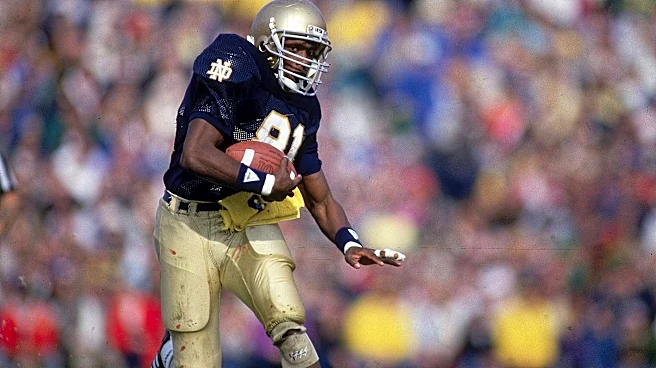
If there was one player who seemed particularly motivated to put on a show that afternoon, it was Tim Brown. The junior flanker was a Dallas native, and there was something wonderfully fitting about watching him dismantle the team from his hometown.
Brown was already establishing himself as one of the most electrifying players in college football, but against SMU, he was practically unstoppable. He finished with 235 all-purpose yards, including 176 yards on just four receptions, and scored two touchdowns. It was his third consecutive game with more than 200 all-purpose yards, and every time he touched the football, there was a sense that something spectacular might happen.
His biggest moment came in the third quarter, when quarterback Steve Beuerlein connected with him on an 84-yard touchdown pass. Brown raced down the sideline, hauling in a perfectly executed deep throw and leaving the SMU defenders chasing him toward the end zone. It was the third-longest touchdown pass in Notre Dame history at the time, and it effectively slammed the door on any hopes the Mustangs had of mounting a comeback.
Afterward, Brown offered a simple explanation for his increasingly impressive performances.
“I’m starting to settle down and play like I know how to play,” he told The Observer.
And Holtz, who clearly appreciated what his star player had accomplished, joked that Brown had earned “two desserts” for his performance.
Of course, Notre Dame fans know what happened next. Brown would go on to win the Heisman Trophy in 1987, becoming the first wide receiver to receive college football’s most prestigious individual honor. But on this November afternoon in 1986, he was still a young player developing his confidence and discovering just how much he could accomplish in Holtz’s offense.
And he wasn’t the only one.
Thirteen Seconds That Changed the Game
Looking at the final score, it’s easy to assume Notre Dame dominated SMU from the opening kickoff. But that wasn’t quite the case.
The Mustangs actually gave the Irish plenty to worry about during the first half. After Alonzo Jefferson scored on a two-yard run to give Notre Dame an early lead, SMU answered with a touchdown of its own. John Carney added a field goal to put the Irish ahead 10–7 at the end of the first quarter, but the Mustangs came right back. Running back Jeff Atkins scored his second touchdown of the afternoon early in the second quarter, giving SMU a 14–10 advantage.
For a team still trying to establish its confidence, this was an important moment. Would Notre Dame respond, or would the mistakes and frustrations of the season’s early weeks return?
The Irish answered emphatically.
Beuerlein connected with Brown on a spectacular 60-yard pass play that carried Notre Dame deep into SMU territory. A few plays later, freshman Anthony Johnson, a South Bend native, powered into the end zone from one yard out on fourth down. The Irish were back in front, 17–14.
And then came the sequence that changed everything.
On SMU’s very next offensive play, Notre Dame defensive tackle Robert Banks broke through the line and chased down Mustang quarterback Bobby Watters. Banks knocked the ball loose, and outside linebacker Cedric Figaro recovered the fumble at the SMU 15-yard line. It was Figaro’s seventh fumble recovery of the season, extending his Notre Dame single-season record.
“It was close to a perfect play,” Figaro told The Observer. “Everybody did what he was supposed to do.”
One play later, Brown took a pitch out of the wishbone formation, followed his blockers, and raced untouched into the end zone.
In a span of just 13 seconds of game time, Notre Dame had turned a three-point lead into a 24–14 advantage. The Irish had seized control, and they weren’t about to give it back.
Carney added two more field goals before halftime, sending Notre Dame into the locker room with a 30–14 lead.
An Offense Finding Its Identity
While Brown provided many of the highlights, the victory was far from a one-man show.
Beuerlein enjoyed one of the finest passing performances of his Notre Dame career, completing 11 of 20 attempts for 269 yards. But rather than taking credit for the impressive numbers, the senior quarterback was quick to praise the players protecting him.
“It all starts with the offensive line and our ability to set up the running game,” Beuerlein explained to The Observer.
That philosophy was at the heart of what Holtz was trying to accomplish. Establish the running game, control the line of scrimmage, and create opportunities for explosive plays. Against SMU, the approach was working beautifully.
The Irish offensive line opened running lanes, gave Beuerlein time to throw, and helped Notre Dame keep the Mustangs off balance throughout the afternoon. And when the defense managed to create turnovers, the offense made SMU pay.
John Carney also turned in a memorable performance, connecting on four field goals to tie Notre Dame’s single-game record. Meanwhile, Alonzo Jefferson, Anthony Johnson, Pernell Taylor, Aaron Robb, and backup quarterback Terry Andrysiak all found their way into the end zone.
For Jefferson, who had missed nearly the entire 1985 season with a knee injury, his first touchdown in almost two years was especially meaningful. And for Andrysiak, who entered the game in the fourth quarter, the opportunity to lead the reserves on a scoring drive and finish it with a 20-yard touchdown run was another reminder that Holtz was building depth throughout the roster.
The Irish weren’t simply relying on a handful of stars. They were beginning to develop into a complete football team.
A Freshman Named Stonebreaker
While the offense was putting on a show, Notre Dame’s defense was doing its part to make sure SMU couldn’t keep pace.
Banks’ forced fumble and Figaro’s recovery provided the game’s pivotal turning point, but another important defensive contribution came from a freshman linebacker who would eventually become one of the most recognizable names of the Holtz era.
Mike Stonebreaker.
When senior captain Mike Kovaleski left the game with a concussion, Stonebreaker stepped into the lineup and delivered an impressive performance. The freshman recorded 10 tackles and intercepted a pass from Watters, helping Notre Dame maintain control as the Mustangs attempted to fight their way back.
It’s one of those details that becomes even more interesting with the benefit of hindsight.
Two years later, Stonebreaker would be a key member of Notre Dame’s undefeated 1988 national championship team. But in November 1986, he was a freshman getting an opportunity to prove himself, learning what it meant to compete at Notre Dame and contributing to a team that was still discovering its identity.
And he wasn’t alone. Johnson, who had scored that important fourth-down touchdown in the second quarter, would also become an important part of Notre Dame’s championship offense.
Looking back, it’s fascinating to recognize how many pieces of the future were already beginning to fall into place.
The Play That Put the Mustangs Away
Despite Notre Dame’s impressive first half, SMU wasn’t quite ready to surrender.
The Irish extended their lead to 37–14 in the third quarter when Pernell Taylor scored on a seven-yard run, but the Mustangs responded with an 80-yard touchdown drive and a successful two-point conversion, cutting the deficit to 37–22.
Suddenly, the game felt a little less comfortable.
Holtz admitted afterward that he was still concerned about the outcome. SMU had demonstrated its ability to move the football, and a 15-point lead wasn’t necessarily enough to put the game away.
But then came the play that erased any remaining doubt.
Beuerlein dropped back and launched a deep pass toward Brown, who was streaking down the sideline. Brown hauled it in and raced to the end zone for an 84-yard touchdown. In an instant, Notre Dame’s lead grew to 44–22, and whatever momentum the Mustangs had gained disappeared.
From there, the Irish kept rolling.
Banks recovered another SMU fumble, setting up Carney’s fourth field goal. And when Holtz turned the game over to his reserves, they responded with two more touchdowns. Sophomore Aaron Robb scored from one yard out, and Andrysiak added his 20-yard touchdown run to complete Notre Dame’s scoring.
By the time the final whistle sounded, the scoreboard read Notre Dame 61, SMU 29.
The Irish had scored their most points in nine years, accumulated 615 yards of total offense, and delivered their most convincing victory of Holtz’s young tenure.
But perhaps the most encouraging part wasn’t the final score.
It was the growing belief that Notre Dame was finally headed in the right direction.
Building Something Bigger
After the game, Holtz reflected on how far his team had come in just a few weeks.
“We were 1-4,” he told The Scholastic. “But I had faith in these guys and all the credit goes to them.”
That quote might be my favorite part of this entire story.
Because in many ways, it captures what made the 1986 season so important to Notre Dame’s future.
The Irish would finish the year with a 5–6 record, hardly the kind of season that would normally be remembered as the beginning of something extraordinary. But the record doesn’t tell the whole story. Notre Dame was learning how to compete, how to respond to adversity, and how to believe in itself again.
Holtz was establishing expectations. The players were beginning to understand his system. The offensive line was improving, the defense was creating opportunities, and young players were gaining valuable experience alongside veterans who were determined to help restore Notre Dame’s winning tradition.
And the results were beginning to show.
Just two years later, Notre Dame would complete a perfect 12–0 season and claim the 1988 national championship. The journey from a struggling program to the top of college football wasn’t instantaneous, and it certainly wasn’t easy. But games like the 1986 victory over SMU helped lay the foundation.
When we look back at championship seasons, it’s tempting to focus only on the defining victories, the unforgettable plays, and the moments when everything finally came together. But those moments don’t happen in isolation. They’re built through the difficult seasons, the frustrating losses, the lessons learned, and the small victories that give a team the confidence to keep moving forward.
On November 8, 1986, Notre Dame wasn’t a national championship contender. It was a 4–4 football team celebrating its third consecutive victory.
But for one glorious afternoon in South Bend, with Tim Brown racing past defenders, Steve Beuerlein finding his rhythm, Mike Stonebreaker making plays, and Lou Holtz watching his team come together, the Irish offered a glimpse of something much bigger.
The 1988 national championship didn’t begin in 1988.
Its foundation was already being built.
Cheers & GO IRISH!!
Historical reporting and player quotations drawn from Ed Jordanich’s “Brown Rides Mustangs Out of Town” in The Scholastic and Marty Strasen’s “Irish Overpower Mustangs for Third Straight Win” in The Observer.