
The Baseball Hall of Fame Class of 2026 was finalized yesterday with the election(s) of Carlos Beltrán and Andruw Jones. While so much has been said about the electees, I’m curious about the players who
didn’t get in.
Of the 11 first-time nominees who fell off the ballot yesterday, none were Twins; of returning players, Torii Hunter came closest, getting 37 votes (8.4 percent). This sent me on a sojourn of Looking Up Far Too Many Names manually in order to learn about the Twins who only saw one opportunity to get their name checked.
Here are the Twins since the 1979 balloting, when the under-5-percent elimination rule was introduced, to go one-and-done on the Hall of Fame ballot. (Years listed are time in Minnesota, not entire career.)
Ron Perranoski
relief pitcher, 1968-71
1979 ballot: 6 votes (1.4 percent)
After seven seasons with the Dodgers, Perranoski was traded to the Twins before the 1968 campaign, serving as the team’s closer for the 1969 & 1970 AL West-winning seasons. He earned MVP votes both years and finished seventh in Cy Young voting in the latter.
Bernie Allen
second baseman, 1962-66
1979 ballot: 0 votes (0.0 percent)
A prototypical light-hitting second baseman, Allen started his career with a third-place Rookie of the Year finish in 1962 (.269/.338/.403 with 12 home runs), but that was his best offensive season.
Rich Reese
first baseman, 1964-72, 73
1979 ballot: 0 votes (0.0 percent)
The Twins’ first baseman through their 1960s success, Reese had his best season in 1969, slashing .322/.362/.513 and receiving an MVP vote for the only time in his career.
Andy Kosco
right fielder, 1965-67
1980 ballot: 0 votes (0.0 percent)
Kosco started his career in Minnesota but was never more than a part-time player for the Twins, putting up minus-0.8 rWAR in 89 games across those three years.
Bob Miller
relief pitcher, 1968-69
1980 ballot: 0 votes (0.0 percent)
Miller was already an 11-year veteran by the time he joined the Twins (in the same trade that brought Perranoski to Minnesota). Across the following two seasons, he pitched in 93 games with a 2.91 ERA; however, he was traded following the 1969 season, playing five more seasons for seven clubs.
Jim Perry
starting pitcher, 1963-72
1981 ballot: 6 votes (1.5 percent)
The Twins acquired Perry from Cleveland during the 1963 season, and while he was used in a mix of starter and relief roles through 1968, he became a dominant starter in 1969, going 20-6 with a 2.82 ERA, 12 complete games, and 6.3 rWAR, finishing third in Cy Young voting. The next season, he won the award with a 24-12 record, a 3.04 ERA, 13 complete games, and 3.8 rWAR. Perry was inducted into the Twins Hall of Fame in 2011.
John Briggs
first baseman & outfielder, 1975
1981 ballot: 0 votes (0.0 percent)
Bill Hands
relief pitcher, 1973-4
1981 ballot: 0 votes (0.0 percent)
Briggs and Hands are similar, both veteran players who joined the Twins at or near the end of their careers for unceremonious stints.
César Tovar
everywhere, 1965-72
1982 ballot: 0 votes (0.0 percent)
An electric superutility man, Tovar was a mainstay atop the Twins’ lineup for seven seasons, receiving MVP votes each year from 1967 (his highest finish, seventh place) to 1971. In 1970, he led the AL in doubles (36) and triples (13); the following season, he led the AL in hits (204). Tovar was inducted into the Venezuelan Baseball Hall of Fame in 2003 and the Twins Hall of Fame in 2022.
Randy Hundley
catcher, 1974
1983 ballot: 0 votes (0.0 percent)
Known as a Cub (and a member of that team’s Hall of Fame), Hundley spent the 1974 season in Minnesota, playing in 32 games, before ending his career with three part-time seasons in the National League.
Bill Singer
starting pitcher, 1976
1983 ballot: 0 votes (0.0 percent)
Another late-career Twin, Singer spent four months in Minnesota, putting up a 3.77 ERA in his 26 starts before being selected by the Blue Jays in the 1977 expansion draft (and nearly being traded by them to the Yankees for Ron Guidry… but Peter Bavasi, Blue Jays president, nixed the trade).
Mike Marshall
relief pitcher, 1978-80
1987 ballot: 6 votes (1.5 percent)
The workhorse reliever’s heyday may have been in the early 1970s with the Expos and Dodgers, the latter for whom he won the 1974 Cy Young and set an MLB record with 106 appearances, but Marshall was still a dominant reliever during his first two seasons in Minnesota. In 1978, he appeared in 54 games (saving 21) and putting up a 2.45 ERA (3.0 rWAR); a season later, he pitched in 90 games (saving 32) with a 2.65 ERA (4.4 rWAR).
Larry Hisle
outfielder, 1973-77
1988 ballot: 0 votes (0.0 percent)
Hisle was a regular in the Twins’ lineup for five seasons, saving his best seasons in Minnesota for his last two, slashing .273/.335/.394 in 1976 (4.3 rWAR) and .302/.369/.533 in 1977 (5.1 rWAR), leading the league with 119 RBIs and finishing 12th in MVP voting. He improved that placement the following season with the Brewers: .290/.374/.533 slash line, 5.3 rWAR, third in MVP voting.
Dave Goltz
starting pitcher, 1972-79
1989 ballot: 0 votes (0.0 percent)
Goltz went from solid as a starter during his first five seasons to electric over his latter three in Minnesota. Across the 1977-79 campaigns, Goltz put up 16.2 rWAR and a 3.34 ERA, going 49-34 (including an AL-leading 20 wins in ‘78) with 44 complete games.
José Morales
designated hitter, 1978-80
1990 ballot: 0 votes (0.0 percent)
Morales was never more than a part-time player in MLB but enjoyed his most success (and playing time) in Minnesota, totaling 290 games, 756 plate appearances, and 200 hits across those three seasons. By rWAR, he had his worst (1979, minus-1.0) and best (1980, 1.0) seasons as a Twin.
Jerry Koosman
starting pitcher, 1979-81
1991 ballot: 4 votes (0.9 percent)
While best known for his 12 seasons as a Met, including his closing out the 1969 World Series, Koosman’s best season by rWAR came as a Twin in 1979: 20-13, 3.38 ERA, 7.2 rWAR, sixth-place Cy Young finish. Koosman had previously finished second in NL Cy Young voting in 1976 (21-10, 2.69 ERA, 4.7 rWAR).
Geoff Zahn
starting pitcher: 1977-80
1991 ballot: 0 votes (0.0 percent)
Zahn’s very good 1978-9 seasons in Minnesota (combined 27-21 record, 3.25 ERA, 16 complete games, 8.2 rWAR) were bookended by mediocre seasons in ‘77 and ‘80 (combined 26-32, 4.53 ERA, 20 complete games, 0.7 rWAR).
Bill Campbell
relief pitcher: 1973-76
1993 ballot: 1 vote (0.2 percent)
A very good reliever during his four seasons in Minnesota, Campbell finished seventh in Cy Young voting and eighth in MVP voting in 1976, appearing in 78 games with a 3.01 ERA and 17-5 record (1.9 rWAR). The following season, with the Red Sox, he was even better: 2.96 ERA in 69 appearances with a 13-9 record and 4.7 rWAR, good for fifth in Cy Young voting and 10th in MVP voting.
Joe Niekro
starting pitcher, 1987-88
1994 ballot: 6 votes (1.3 percent)
Chris Speier
shortstop, 1984
1994 ballot: 1 vote (0.2 percent)
Speier’s best seasons came during his initial six-plus-year stint with the Giants. Minnesota was his third and final team of the 1984 season; he played in just 12 games as a Twin, collecting seven hits.
Rick Dempsey
catcher, 1969-72
1998 ballot: 1 vote (0.2 percent)
Dempsey spent the first four seasons of his career as a reserve for the Twins, playing in just 41 games over that time. It wasn’t until joining the Orioles in 1976 that Dempsey became a starter and Baltimore mainstay, remaining their starting catcher for his entire 10.5-season tenure at Memorial Stadium.
John Candelaria
relief pitcher, 1990
1999 ballot: 1 vote (0.2 percent)
The longtime Pirates starter was a reliever by the time he landed in Minnesota, appearing in 34 games for part of the 1990 season while putting up a 7-3 record and 3.39 ERA (1.3 rWAR).
Jeff Reardon
relief pitcher, 1987-89
2000 ballot: 24 votes (4.8 percent)
Reardon joined the Twins coming off consecutive All-Star campaigns in Montreal; while his stats dropped in 1987 (4.48 ERA, 0.7 rWAR), he still finished eighth in Cy Young voting and helped the Twins win the World Series. He returned to form in 1988 (2.47 ERA, 2.5 rWAR, 15th in MVP voting), and he ultimately finished his career with 367 saves against 358 walks allowed.
Kent Hrbek
first baseman, 1981-94
2000 ballot: 5 votes (1.0 percent)
The Twins first baseman (alongside Justin Morneau), Hrbek spent all 14 seasons of his career playing for his hometown team. He finished second in Rookie of the Year voting in 1982 (also his sole All-Star selection) and second in MVP voting in 1984, ending his career with 293 home runs and more walks (838) than strikeouts (798). The Twins retired his uniform number 14 in 1995, he was inducted into the Minnesota Sports Hall of Fame in 1996, and he was one of the inaugural members of the Twins Hall of Fame in 2000.
Steve Bedrosian
relief pitcher, 1991
2001 ballot: 1 vote (0.2 percent)
Bedrosian’s top individual accolade is the 1987 NL Cy Young award, won while a Phillie (2.83 ERA, 40 saves, 2.3 rWAR), but as a Twin, he’s known for the other World Series year: although putting up a subpar individual 1991 season (4.42 ERA, minus-0.1 rWAR) and postseason (three World Series appearances, 5.40 ERA), he earned a ring with Minnesota.
Jim Deshaies
starting pitcher, 1993, ‘94
2001 ballot: 1 vote (0.2 percent)
The longtime Astro spent most of 1993 and all of 1994 with the Twins, having a solid former season (11-13, 4.41 ERA, 2.8 rWAR) and a terrible latter one (6-12; 7.39 ERA; minus-1.3 WAR; led MLB with 25 starts, 107 earned runs allowed, and 30 home runs allowed).
Frank Viola
starting pitcher, 1982-89
2002 ballot: 2 votes (0.4 percent)
The ace of the 1987 staff hit his peak just in time to lead the Twins to the World Series championship that year, going 17-10 with a 2.90 ERA and 8.1 rWAR. He won the Cy Young the following year (24-7, 2.64 ERA, 7.7 rWAR) before being traded to the Mets during the ‘89 season, and he remained a strong pitcher through the 1993 season.
Jim Eisenreich
center fielder, 1982-84
2004 ballot: 3 votes (0.6 percent)
Eisenreich was a reserve when he started his career with the Twins, playing in just 48 games over three seasons in Minnesota. He became a regular in 1989 with the Royals and helped the Phillies reach the World Series in 1993.
Bob Tewskbury
starting pitcher, 1997-98
2004 ballot: 0 votes (0.0 percent)
Tewksbury peaked with his 6.4 rWAR, third-place Cy Young season in 1992, going 16-5 with a 2.16 ERA for the Cardinals. His two seasons in Minnesota were the last of his career, totaling 6.5 rWAR while going 15-26 with a 4.49 ERA.
Chili Davis
designated hitter, 1991-92
2005 ballot: 3 votes (0.5 percent)
Davis served as the Twins’ DH and cleanup hitter during their 1991 pennant run, clubbing 29 home runs during the regular season and two more in the World Series.
Terry Steinbach
catcher, 1997-99
2005 ballot: 1 vote (0.1 percent)
After 11 seasons in Oakland, Steinbach came to his home state of Minnesota for his last three MLB seasons, serving as the Twins’ primary catcher each year. Over those three years, he slashed .256/.321/.399 with 30 home runs and 3.2 rWAR.
Otis Nixon
center fielder, 1998
2005 ballot: 0 votes (0.0 percent)
Nixon’s last season as a regular came in 1998, his sole year as a Twin, when he put up a .297/.361/.344 slash line (0.2 rWAR) across 500 plate appearances in 110 games.
Gary Gaetti
third baseman, 1981-90
2006 ballot: 4 votes (0.8 percent)
All-Star, World Series champion, Minnesota Twins Hall of Famer (2007), and triple play machine.
Rick Aguilera
relief pitcher, 1989-95, 96-99
2006 ballot: 3 votes (0.6 percent)
Aguilera joined the Twins in the trade that sent Viola to the Mets and became a decade-long closer, reaching three All-Star teams and serving as the closer for the 1991 World Series winners. He was inducted into the Twins Hall of Fame in 2008.
Chuck Knoblauch
second baseman, 1991-97
2008 ballot: 1 vote (0.2 percent)
The 1991 Rookie of the Year and leadoff hitter for the trophy winners, Knoblauch proved an elite second baseman in Minnesota. Then he went to New York, and he wasn’t, and Minnesotans hated him. Then he was named in the Mitchell Report, and most of baseball hated him. Then he assaulted two spouses, and no one in baseball wants anything to do with him.
Jesse Orosco
relief pitcher, 2003
2009 ballot: 1 vote (0.2 percent)
Fifteen years after closing out the Mets’ 1986 World Series win, Orosco joined the Twins for the last month of his age 46 season, the last month of his career. He retired after 24 seasons with the record for games pitched; his mark of 1,252 still stands.
Mike Jackson
relief pitcher, 2002
2010 ballot: 0 votes (0.0 percent)
The ‘02 season was Jackson’s penultimate in the league (he did not play in 2003) and his only one in Minnesota; in 58 games, he put up a 3.28 ERA and 1.2 rWAR.
Bret Boone
second baseman, 2005
2011 ballot: 1 vote (0.2 percent)
After having broken out as a star for the Mariners a few years prior, Boone lasted less than a month with the ‘05 Twins, slashing .170/.241/.170 (minus-1.1 rWAR) in 14 games, the last of his career.
Brad Radke
starting pitcher, 1995-2006
2012 ballot: 2 votes (0.3 percent)
The ace of the late-’90s/early-‘00s Twins staffs, Radke received almost no national recognition for his ability and reliability, with one All-Star selection (1998), a ninth-place Rookie of the Year finish (1995), a third-place Cy Young finish (1997), and a 25th-place MVP finish (also 1997) his sole award placements. Radke totaled 45.6 rWAR over his career and was inducted into the Twins Hall of Fame in 2009.
Terry Mulholland
relief pitcher, 2004-05
2012 ballot: 0 votes (0.0 percent)
A regular Twinkie Town meme, Mulholland pitched two of his final three seasons for the Twins, appearing in 78 games to the tune of a 5-11 record, a 4.89 ERA, and 0.9 rWAR. Back in 1986 for the Giants, though, he did this:
Phil Nevin
designated hitter, 2006
2012 ballot: 0 votes (0.0 percent)
Rubén Sierra
designated hitter, 2006
2012 ballot: 0 votes (0.0 percent)
Another pair of last-season-of-career Twins. Nevin, the first overall pick in 1992 (a choice that led Hal Newhouser to quit the Astros’ scouting department as he wanted Derek Jeter), joined Minnesota for September 2006 and played in 16 games (plus a single 0-3 playoff showing), slashing .190/.340/.286 and putting up minus-0.1 rWAR. Sierra had spent 14 games in Minnesota earlier in the year, slashing .179/.273/.214 (minus-0.2 rWAR) before being released in July.
Jeff Cirillo
designated hitter, 2007
2013 ballot: 0 votes (0.0 percent)
Same story, just a year later: Cirillo was a Twin for part of 2007, his final season, and while his stats weren’t terrible (50 games, .261/.327/.386, 0.7 WAR), he didn’t finish the season with the team, being claimed off waivers by the Diamondbacks in August.
Todd Walker
second baseman, 1996-2000
2013 ballot: 0 votes (0.0 percent)
Walker became the Twins’ starting second baseman after Knoblauch’s departure, and while his ‘98 and ‘99 seasons were respectable (combined .297/.357/.435 slash line and 2.2 rWAR), he was traded to the Rockies in 2000 after his hitting began to fall off.
Rondell White
designated hitter, 2006-07
2013 ballot: 0 votes (0.0 percent)
Yes, those were his last two seasons. Yes, he hit badly (combined: 137 games, minus-1.5 WAR, .226/.266/.354 slash line).
Jacque Jones
left fielder, 1999-2005
2014 ballot: 1 vote (0.2 percent)
The leadoff hitter for the early-’00s squads, Jones peaked in 2002 with a 5.5-rWAR season (.300/.341/.511, 27 home runs) before leaving after the ‘05 season for the Cubs.
Kenny Rogers
starting pitcher, 2003
2014 ballot: 1 vote (0.2 percent)
Rogers was… fine, I suppose, in 2003 for the Twins, putting up a 4.57 ERA (1.9 rWAR). He proceeded to join the Rangers for two seasons and the Tigers for three, and the first three of those final five seasons resulted in All-Star appearances and Gold Glove awards, plus a fifth-place Cy Young finish in 2006. Of course.
Todd Jones
relief pitcher, 2001
2014 ballot: 0 votes (0.0 percent)
The Twins traded for longtime Astros and Tigers closer Jones midway through the 2001 season, and he appeared in 24 games for the team (3.26 ERA, 0.3 rWAR), saving two.
Eddie Guardado
relief pitcher, 1993-2003
2015 ballot: 0 votes (0.0 percent)
Everyday Eddie began his career as a starter before quickly converting to the bullpen, leading the league with 83 appearances in 1996. It wasn’t until 2002 that he served as the regular closer for a full season, and he earned All-Star nods that year and the next, finishing his Twins tenure with 116 of his 187 career saves.
Luis Castillo
second baseman, 2006-07
2016 ballot: 0 votes (0.0 percent)
After a decade with the Marlins, Castillo joined the Twins for the next season and a half, serving as a reliable glove (though with a negative Fielding Runs Above Average) and steady contact bat (.299/.357/.363) at second base.
Casey Blake
third baseman, 2000-01, ‘02
2017 ballot: 0 votes (0.0 percent)
Blake didn’t become a starter until the 2003 season in Cleveland, having only appeared in 49 games over his first four seasons. Those included 29 games across three different seasons in Minnesota.
Orlando Cabrera
shortstop, 2009
2017 ballot: 0 votes (0.0 percent)
Cabrera played only the last two months of the 2009 season as a Twin, and while his stat line was average (.289/.313/.430, minus-0.1 rWAR), Twins fans remember him fondly for his go-ahead home run in Game 163.
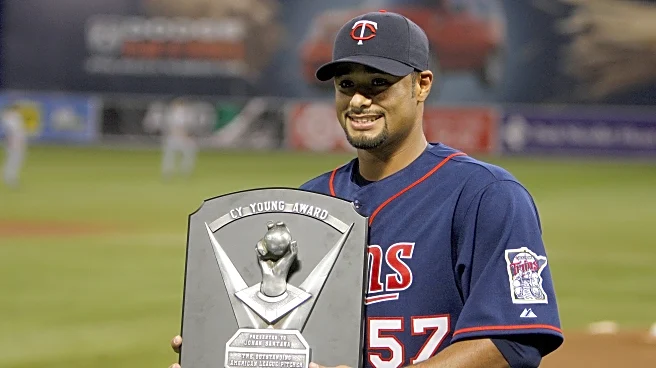
Johan Santana
starting pitcher, 2000-07
2018 ballot: 10 votes (2.4 percent)
One of the most egregious one-and-dones in balloting history, Santana was arguably the best pitcher in the majors across the 2004-08 seasons. Over that span, he averaged 7.1 rWAR, a 17-8 record, a 2.82 ERA, and 238 strikeouts per season, winning a pair of Cy Youngs. The rise in votes for Félix Hernández this year (from 20.6 percent to 46.1 percent, the largest year-to-year jump since 1967) bodes well for Santana’s chances of being elected by committee: both pitchers had extraordinary several-season peaks but had their careers cut short due to injury.
Liván Hernández
starting pitcher, 2008
2018 ballot: 1 vote (0.2 percent)
Hernández made 23 starts for the ‘08 Twins and was not particularly good, going 10-8 with a 5.48 ERA (minus-0.3 rWAR) before being designated for assignment at the start of August.
Orlando Hudson
second baseman, 2010
2018 ballot: 0 votes (0.0 percent)
After Cabrera’s departure following the 2009 season, the Twins brought in Hudson to fill their middle-infield quota of Orlandos. He responded with a 2.9 rWAR season (.268/.338/.372, league-leading 5.31 Range Factor per 9) before leaving for San Diego the following year.
LaTroy Hawkins
pitcher, 1995-2003
2021 ballot: 2 votes (0.5 percent)
Hawkins was a middling starter turned okay closer turned fantastic setup man, spending his first nine seasons with the Twins before playing another 12 years in the majors. After appearing as an occasional TV commentator for the team the last few seasons, he has now joined the club as its bullpen coach.
Michael Cuddyer
right fielder / third baseman, 2001-11
2021 ballot: 0 votes (0.0 percent)
While never reaching an elite level of player, Cuddyer was a reliable middle-of-the-0rder bat and fan favorite, first in Minnesota, where he spent his first 11 seasons, then in Colorado and Queens. He earned his first All-Star nod during his final year as a Twin, picking up one more as a Rockie in 2013, the year he won the NL batting title.
Joe Nathan
closer, 2004-11
2022 ballot: 17 votes (4.3 percent)
After coming to Minnesota in the A.J. Pierzynski trade (more on him in a bit), Nathan became one of the best closers of the 2000s, earning four All-Star selections and twice placing in the top five in Cy Young voting during his Twins tenure. He ended his 16-year career with a 2.87 ERA (2.16 in Minnesota) and 377 saves, 10th-most in MLB history, and he was inducted into the Twins Hall of Fame in 2019.
Justin Morneau
first baseman, 2003-13
2022 ballot: 5 votes (1.3 percent)
Morneau was my favorite of the mid-to-late ‘00s Twins stars ever since he came up through AA-New Britain, and I believe he could have been on a Hall of Fame track were it not for that fateful 2010 concussion. From 2006 to ‘10, he was a dominant hitter, winning MVP in 2006 and coming in second in 2008, and averaging a .298/.372/.528 slash line (32 homers, 4.6 rWAR) per 162 over that span. He now serves as a frequent color commentator on TV broadcasts for the team, and he was inducted into the Canadian Baseball Hall of Fame in 2020 and the Twins Hall of Fame in 2021.
A.J. Pierzynski
catcher, 1998-2003
2022 ballot: 0 votes (0.0 percent)
Before developing his league-wide reputation as an asshole during his time with the White Sox, Pierzynski worked his way into the starting catcher role in 2001, earning an All-Star selection in 2022 and putting up a 4.5 rWAR season (.312/.360/.484) in 2003.
R.A. Dickey
relief pitcher, 2009
2023 ballot: 1 vote (0.3 percent)
Three years before ascending to the top of the National League with his 2012 Cy Young award, Dickey was a journeyman knuckleball reliever for the Twins. He appeared in 35 games for Minnesota in 2009, putting up a 4.62 ERA with 42 strikeouts versus 30 walks (0.6 rWAR).
J.J. Hardy
shortstop, 2010
2023 ballot: 0 votes (0.0 percent)
The Twins traded for Hardy before the 2010 season, and he put up a respectable line: .268/.320/.394 and 1.3 rWAR. Then they traded him to Baltimore, where over the next four seasons he put up three straight 20-homer years, three straight Gold Gloves, and four straight 3-plus-rWAR seasons.
Bartolo Colón
starting pitcher, 2017
2024 ballot: 5 votes (1.3 percent)
Well after the legend of Big Sexy took hold of baseball fans’ collective consciousness, Colón became a Twin, joining the team in July 2017 at age 44 and making 15 starts for the club. While his play was far from that at his peak, putting up a 5.18 ERA and 0.3 rWAR, one of his five wins (to go with six losses) came against the Diamondbacks, making him the 18th pitcher in history to earn a win against all 30 teams.
Fernando Rodney
relief pitcher, 2018
2025 ballot: 0 votes (0.0 percent)
The Twins were treated to the Fernando Rodney Experience for the first half of 2018, during which Rodney made 46 appearances (with 25 saves) to the tune of a stressful 3.09 ERA and 0.7 rWAR. That August, the Twins traded him to the A’s, for whom he appeared against Minnesota (at Target Field) on Player’s Weekend. The team handed out player nickname shirseys to fans, and both my dad and I ended up with Uiya Clara. (And in the second game, when Rodney entered in the seventh inning, a fan named Matt in the outfield seats did Rodney’s bow-and-arrow motion, dislodged his contact lenses, and had to leave early.)
That’s all of them, every Twin who went one-and-done since the 1979 five-percent rule. HOF watchers now look ahead to Beltrán and Jones’ July 26 induction before setting their sights on the 2027 ballot, awaiting the news of who might join the voting pool for a shot at election… or a spot among the one-and-dones.