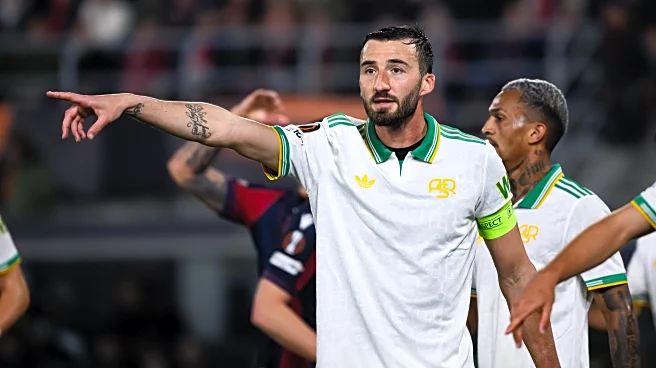


At this stage of the season, the margins disappear, and the stakes get brutally clear. When Roma travel to face Como at the beautiful Stadio Giuseppe Sinigaglia Djarum (it’s really something, just right by the water), the situation doesn’t require much framing: Roma need three points against their biggest rival for fourth place. A respectable performance won’t do. Neither will a gritty draw. A win is needed, and needed now, because the race for UEFA Champions League qualification has compressed into
a week-to-week survival test. Every dropped result now is a surrender of ground that simply may not be recoverable before May.
For much of the winter, Roma have hovered inside the Champions League qualification zone without ever fully securing their grip on it. Strong stretches have been punctuated by frustrating slip-ups, keeping the Giallorossi tangled in a crowded pack of contenders below them, chasing the same limited prize. That’s where matches like this one become defining. On paper, a meeting with Como might not carry the glamour of clashes against Italy’s traditional heavyweights, but the table doesn’t care about brand names. If Roma want to make their case for a return to Europe’s top competition, these are exactly the kinds of games they must treat as non-negotiable.
Como has built its campaign on organization and opportunism, and that’s the kind of approach that can turn a match ugly and tense in a hurry. For Roma, they just need to handle the pressure, control the match, and leave with the points. Survival is key here, and a win will let the club hope to keep its best players around for another season without the financial realities of Europa League penny-pinching ruining the dream of a truly dominant side.
What To Watch For
Can Koné Be the Difference Maker?

Roma’s midfield has looked awfully short on answers lately, and the absence of Manu Koné has only made the problem more obvious. The French international has spent recent weeks sidelined with injury, leaving the Giallorossi without one of the few midfielders in the squad capable of consistently winning duels, recovering possession, and driving the ball forward under pressure. When Roma’s midfield has struggled to control tempo, like their frustrating loss to Genoa CFC in their last Serie A match, the lack of a true ball-winning presence has been glaring. If Koné can return and play meaningful minutes, Roma could suddenly regain an element that has been missing in recent performances.
Beyond the obvious need for healthy players, the key for any Koné return is which version of Koné shows up. Roma don’t need the erratic, speculative-shot version of the midfielder who occasionally drifts out of games and settles for low-percentage efforts from distance. They need the version that earned him a place in the France national football team setup: the relentless ball-winner who covers ground, disrupts opposing attacks, and moves the ball forward with purpose. When Koné is playing that role effectively, Roma’s midfield looks faster, more aggressive, and far harder to play through.
Looking ahead, there’s also a broader question about what Koné represents for Roma’s long-term plans. Transfer rumors have floated the possibility that he could depart this summer for the likes of Inter or Real Madrid, but performances down the stretch could easily change that conversation. A midfield partnership built around Koné and Niccolò Pisilli offers an intriguing blueprint, creating a dual pivot focused on youth, energy, and the ability to control matches both physically and technically. If Roma is going to dominate this matchup with Como, and perhaps lay the groundwork for a stronger midfield identity going forward, Koné has to be the player who makes it possible.
Will We See the Real Bryan Zaragoza?

When Bryan Zaragoza arrived in January, the move looked like a classic late-window swing from Ricky Massara. The Spaniard has built a reputation of being a dynamic winger with pace, creativity, and a bit of unpredictability, and he was arriving just in time to bolster AS Roma’s faltering attack. The 24-year-old joined on loan from FC Bayern Munich after spending the first half of the season back in Spain, but so far in the capital, Zaragoza has looked interesting, but not decisive. He’s shown off flashes of acceleration and creativity regularly without the kind of consistent end product that would cement his spot in the starting eleven. In limited minutes since the move, he has managed only a small statistical footprint, including one assist in early appearances.
Context matters here, though, because Roma’s attacking depth chart is in rough shape. Injuries have taken Matías Soulé out of the picture for now, while Paulo Dybala continues to battle the same availability issues that have defined his Roma tenure. That leaves Roma in desperate need of wide players who can actually create something, which is exactly the kind of role Zaragoza was brought in to fill. That’s why this stretch of the season may end up defining Zaragoza’s stint with Roma, and his ability to stick around with the Giallorossi for the long-term. The opportunity is there for him to seize, because this squad desperately needs someone to soak up playing time and attacking responsibility while injecting creativity into the final third. If Zaragoza can create chances out of nothing in a way Roma normally expects Dybala and Soulé to, Roma suddenly has the weapon they’ve been begging for. If not, he risks becoming just another interesting January experiment that fizzles out. For a Roma side chasing points and attacking identity at the same time, the difference between those two outcomes could very well be Champions League qualification.