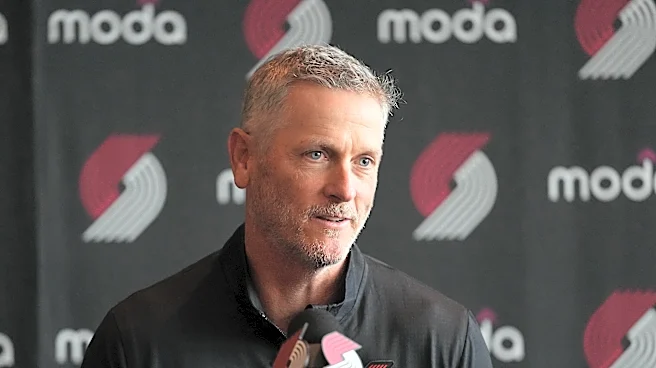








Since he took over the reins of the team in March of this year, various controversies have dogged Portland Trail Blazers owner Tom Dundon. A Texas billionaire, hockey-team owner, and businessman, Dundon now faces a provincial audience steeped in a five-decade tradition of fandom and community interaction. It’s not surprising that the transition has been rough-edged. But has it been fair? Does the Portland media have it out for Tom Dundon? That’s the question occupying this edition of the Blazer’s
Edge Mailbag,
Dave,
Will you weigh in on the controversy that seems to follow [Tom] Dundon and the media? I’m going to hold back from offering an opinion myself because I am curious what you’ll say. Do you perceive a bias already, as many are claiming?
Walt
And then there’s this one…
Dave,
I’m disappointed to hear you join in the chorus of media hacks going after our new owner. I thought you were better than this. Since before he took over you’ve been piling on him and finding faults wherever you can even if you have to make them up. What do you all have against him? What has he done? He should get credit for the success in life and sports not just condemnation from hacks behind a keyboard. He’s done more than any of you ever have. I’d love to read a little truth for once instead of slanted hit pieces from you and your media friends.
[Name Kept Anonymous]
So, the first thing we have to ask when we’re talking about “media” is what we mean by that term. Are we just talking about traditional outlets with wires and bylines? Do we mean sports analysis sites or report/rumor/aggregating websites? Do podcasts count? How about Reddit and other community forums? All of those are forms of media, but they approach things very different ways.
I think, in 2026, we’re to the point that it’s impossible to say that “media” says, does, or thinks anything. Once upon a time when newspapers dominated the landscape, you could point to definitive voices taking predictable angles on the issues of the day and claim a consistent, if not coordinated, message. It was like throwing a rock into a defined, fairly placid lake. Even if you didn’t see the stone, you could trace the ripples. Nowadays it’s like throwing that same rock into a raging river. There’s too much stimulus coming from too many sources. You can’t get from Point A to B to C like you once could. Things move fast. Words are more plentiful than ever and come from a near-infinite number of sources. At some point media says everything.
Given that, it’s quite common for people who want to make their point to reach into that media river, fish out whatever statement they need in order to justify their position, and present it as representative of the whole story. They’re not entirely incorrect. It’s part of the story, just as those drips of water were part of the river. Claiming that the small sample represents the whole is a fallacious argument, though. Just because you found something in the river doesn’t mean the whole purpose of the river was to deliver that something. That’s a wee bit narcissistic. The river exists independently, beyond just what you make of it.
I think it is possible to talk about general characteristics of media in this era, just as it has been in eras past. Plenty of peculiar things have cropped up as the industry has evolved. Among the easily-observed tendencies are these:
- Today’s media tends to value whatever aspect of the story will garner the most instant attention. They’ll report the whole story but they’ll lead with the part that will get you to take notice. They have to stand out in a crowded field, else they don’t get patronized at all.
- They will value the “every-person” perspective over expertise in general, favoring relatability to the common consumer over education or, sometimes, information.
- The requirements of sourcing have become less strict. Single sources are now considered valid. The requirement for becoming a source is “someone who could or should know”. Rank, access, and the aforementioned expertise are less critical than they once were. How far this goes depends on the outlet. Some media members are absolutely scrupulous. When they say, “An unnamed source,” you can pretty much guarantee they’re referring to critical decision-makers and experts. Others are a half-step away from citing the nephew of the assistant custodian who might have overheard something. Consumers have to judge by logic, common sense, and eventual outcome.
- Because of the near-infinite number of outlets—ranging from the AP to your cousin’s blog—repetition of information is inevitable. When one outlet breaks a story, a hundred others will pick it up and run with it, either with or without citation. Plenty more will augment with analysis and expanded scenarios. That amount of repetition can’t help but lend unearned credibility to the information. “If a hundred people say it, it must be true.” Well, again, in today’s environment, a hundred people are going to say everything.
- Media members do tend to support each other in a chaotic, disorganized way. The upper crust, professional side of the business is shrinking. The participants who remain tend to know each other, at least in a given field (like NBA coverage). They know who’s good and who’s full of it. The people who pass that test tend to get credit because of who they are, over and above the nature and quality of the information they provide. That means it is possible to get on the wrong side of a certain segment of the media by getting on the wrong side of a particular media member.
- This works both ways, however. Sometimes media members fight. As far as I can see (and this is just my impression) the history of old-school Portland sports media is a little like the history of a house full of grandmas with broomsticks in their hands and bees in their bonnets. They live in the same place and generally tolerate each other, but they don’t necessarily like each other and each one thinks the world would be better if the house belonged to them. Some people would secretly cheer a public figure giving a fellow media member their comeuppance. Some media members have actually aided people in power doing so.
- Professional media members in sports also depend on access. They’re beholden to the people they cover. This is even more true since—ever ready to simplify the issue—sports franchises view the media market as crowded and pluralistic. They’re more than willing to deemphasize one media outlet in favor of another should the second prove more biddable than the first. Nowadays they have a near-endless variety to choose from. The quality from outlet to outlet may be vastly different, but sports figures tend to view “quality” and “telling the story the way I see it” as essentially interchangeable. For that reason, media members are more apt to appease prominent sports figures than expose or rail against them.
We could go on, but you get the idea: frantic information/stimulus overload, massive variety of sources and participants, constantly-shifting relationships with peers and subjects covered, all driving towards the almighty consumer experience interacting with the river while sometimes focusing the origin and sanctity of the news that forms it.
Here are some things that are NOT happening in this environment:
- There is no secret “media meeting” where all media members get together to decide how to frame, cover, and explain a story. There’s no monolithic media membership. If you tried to hold such a meeting, nobody would agree on who should be invited. The people who came would either reminisce over beers or swat each other’s bonnets with broomsticks. If any consensus was reached, the first person who either ingratiated themselves with a person in power or got a source to say something hot about the subject would immediately break the deal. The one thing we don’t have here is unity.
- With a premium on standing out strongly from others in a crowded industry, media members have incentive to keep things away from each other and think differently, not to echo each other. They do repeat each other often, as mentioned above, but that’s because they don’t have anything contrary to add, not because they do and they’re suppressing it. Anybody with any credible alternate story is going to get that thing published ASAP in hopes of being the one that other people are repeating.
- While people may range far and wide in their definition of “sources” and the implications they draw from a story, very few media members make things up or lie. I’m not saying it never happens, but anyone basing their career on untruths is going to get exposed pretty quickly. First, other media members will have plenty of those contrary stories we just referenced. And believe me, they will publish them. If you’ve ever read a story that says, “Credible, High-Ranking Source says that Media Member X just published some completely unfounded BS,” you’ll remember the near-gloating glee in the tone of the outlet that got to run with the correction. It’s usually delivered as, “This proves you can believe us, not them!” Broomstick bashing AND more credibility gained? Dream scenario! And if fellow media members don’t do it, media consumers will. Consumers will quickly turn away from people who aren’t credible unless those people are insanely charismatic, entertainingly controversial, or a segment of the public agrees with the lying media member and wants to leverage their takes into self-satisfaction. If that’s not happening, lying is a dead end.
So now, let’s convert all of this into the current situation with Tom Dundon.
- We know for sure that there is no coordinated media conspiracy against the Trail Blazers owner. That’s less about the ethics of the media and more about its nature. Why in the world would I want to say the same thing that a dozen other people are saying if I don’t have to? How would we determine what to say? More importantly, how would we determine who got to say it first and get the credit/reputation for it?
- We know that, in this landscape, things will get repeated nonetheless, simply due to the need to keep up with stories and the lack of contrary evidence. We saw this happen with things like, “The Blazers are looking for a coach on the cheap.” That may be true! But it was also reported in one place, then echoed, then analyzed, then linked with other (non-related) evidence, then repeated as fact after a certain point. We still have no idea, beyond the original claims of the original source, whether this is accurate.
- We know that counter-stories, while plentiful, will only get as much attention as their sensationalism allows. We heard counter-reports to that “hire on the cheap” claim, but those stories don’t make you sit up in your chair as quickly as the original story, so they get repeated less. This also is the nature of the system.
- This also extends to Tom Dundon’s actions and character. He could pet a dog, buy flowers for his auntie, give a nice donation to the American Heart Association, and say Portland is a backwater town full of hippies and degenerates all in the same day. Only one of those is going to get reported and repeated. The media is more apt to give you the ends of the bell curve than the middle. This makes them seem biased when, in reality, they’re simply acting like the radar system at your local airport. It doesn’t ping when it sees normal sky, only when it detects something different in it. Otherwise it would just be a constantly-lit screen emitting an eternal shriek. We don’t know Tom Dundon. We only know the different—maybe extreme—things Tom Dundon does.
- That said, the things that are reported are probably true, especially if they’re things Dundon actually said or did in public himself. They also represent both ends of the spectrum. There’s no bias towards, “Tom Dundon fired 92 people today,” or away from, “Tom Dundon leaped out of an airplane into the ocean to save a drowning kitten.” If a set of actions—good or bad—is getting reported over and over again over time, that’s probably the edge of the bell curve Dundon is trending towards.
- Most importantly, no matter what gets reported, people are going to do what they’ve always done: dredge the river for the items they want to make use of. One person will cite Dundon’s history with predatory loans. Another will lift up the Carolina Hurricanes winning the NHL Championship. Both are true. Both are relevant, depending on what kind of argument you’re making. Those two people will likely talk right past each other as they try to come to a conclusion about Dundon and who he is because they’re fishing in a completely different part of the river for completely different purposes.
- Sometimes those differences give rise to accustaions like we’ve seen in the above questions (and other arguments about Dundon on site): emotion, bias, and personal unfitness. In other words, “When YOU fish in the river and pull out your conclusions you’re being totally unfair and stupid because of your emotion-based process but when I do it, I’m being totally logical and correct!” Yeah, no, not usually. You’re starting with the conclusion you want to be real, “Tom Dundon is going to be a good owner!” and then fishing for the items that will make it look true, throwing back the rest. That’s neither logical nor unbiased.
Which brings us to Mr. Dundon himself, who has famously proclaimed that he doesn’t care about PR or media takes. It’s possible that the reason why is embedded in this whole process. When you look at it, it’s kind of ridiculous! If you’re going to believe something, why not just believe it? Why go fishing in that river just to come up with what you already had? And if you’re going to do that no matter what anybody else thinks, writes, or says, why should anyone bother conversing with you at all? It’s a waste of time. When the media process works like this, that’s what it ends up being: a huge time sink for no meaningful change.
As for me, and this site, I fully acknowledge the above. We’re part of that landscape, a tributary to that river. The things I write get taken, interpreted, and used exactly this way. Even as I write each day, I acknowledge preemptively that much of it is a waste of time, at least in some circles. All people want is a place to come and share what they already think. If that’s how you use the site, that’s fine. More power to you. I do believe that different people with different viewpoints have the right to do that. You can’t advance your view without also acknowledging and respecting the people who are advancing theirs. But as long as you do that, welcome home.
But I also believe that, in the midst of this, there’s value beyond just our interpretation and experience of it all. The world exists outside of any of us. The reporting river echoes that world…not perfectly, but also not unrealistically. As soon as we lose public reporting and analysis, we lose the common connection between us. If a bad piece of work comes down the river, we can fish it out, examine it, and toss it away as an acknowledged pollutant. If the river itself dries up, we have no flow of information from the world and no reason to gather around it to begin with. That’s infinitely worse.
As such, I tend to trust our communal ability to parse these things out as we go. I find it more advantageous and healthy to present reports to our community as they’re given—with appropriate editorial reflection when necessary—than to try to filter the river unduly. In that way, we may be one of the more unbiased tributaries out there. We’re not going to repeat things we know are not credible, but we’re going to use community conversation as a filter, not a pre-existing presumption about what’s real or not based on what we already think.
That means it’s not a bad thing to find argument or controversy in our comments section. That’s just the community doing its work. The point when it turns sour—and we have been getting some during Dundon conversations—is when people claim that the community around them is monolithic and biased just like they claim the media is. “This site always reacts this way! It’s Pollyanna!” or, “It’s doom and gloom!” Some people at the site react positively or negatively to every report, analysis, or story. Again, that’s the filter in action. But not everybody is reacting that way, nor do they ever, nor is reaction bad. Nobody ever regards their own opinions as “Pollyanna” or “Doom and Gloom”. Our opinions form our baseline “normality”. Seeing people disagree with us is an important reminder that we are not the center of the universe.
When we condemn others sweepingly—accusing them of bias, emotion, and the like—we usually mean, “You disagree with me.” Except we’re not owning it. We’re trying to invalidate and dismiss, kicking holes in the filter to let our particular contaminates through while straining out others. That’s icky and, ironically, just as emotional and biased as we accuse others of being when we do it. That’s not cool.
As for me, personally, I’m pretty neutral on the whole affair. I don’t think we have enough stimulus to declare whether Dundon will be a good or bad owner of the franchise. Those judgments usually depend on perspective anyway, so I despair of finding a firm answer.
I am appropriately suspicious of Dundon’s past, as I don’t believe that billionaire status whitewashes the means by which you earned your riches. But I don’t begrudge him the wealth either. If that’s your purpose in life, well…I’ve seen worse. I suspect that developing that level of economic power requires buying into conventions that aren’t exactly humanitarian, if nothing else corporate practices that tend to devalue real, human relationships. I don’t love that, but I’m not surprised by it either. So far the Trail Blazers’ moves can be pretty well described by, “What would a corporation do under these circumstances?” That’s comforting because it’s predictable, less so because corporations tend to be selfish and manipulative. But that’s business in the big leagues.
I’m certainly reading, analyzing, and commenting on the things about Dundon that come down the river. That’s part of my job. I don’t particularly enjoy it, but it’s not that stressful either. I just do what I always try to do. If something is notable and has an effect, I comment on it. If ramifications go deeper or people have questions, I might do an extended piece on it. When something happens that seems really good, that’s easy to share. If the Blazers and/or Dundon appear to be harmful, counterproductive, or foolish, we won’t shy away from saying that either.
I don’t claim to have or know the truth in absolute terms, but I do know that billionaire status and team ownership shouldn’t buy anyone immunity from discernment and criticism. Maybe even with a bit of humorous snark, because the pedestal is high enough already. You shouldn’t need us all kneeling down to proclaim your greatness, especially if the things you’re doing and saying deserve a critical look.
That last part is, of course, a bias, but hopefully it affects the flavor of the coverage more than the substance. We do try to keep reporting/relating information and our analysis of it in separate posts, so there’s little inherent crossover. Even our biases have checks and filters here.
Long story short, I don’t find the Tom Dundon “controversy” that controversial. The tension surrounding it is just things working pretty much as they should in this chaotic media environment. Nobody is capable of bringing the whole, unvarnished truth. The best we can do is put the raw material in front of you and let everybody refine it, drawing wisdom and information from each other as you do so. The site isn’t going to choke on Dundon any more than it did on a hundred other controversial inflection points before him.
I do find the accusations of “media bias” un-credible, along with their cousin accusations of site bias. Both entities are biased, of course! But not in the way you’re claiming. The basic nature of the process would argue against it. If this were a court of law, admitting that absolutely certain knowledge is impossible, we’d probably say that the people leveling those accusations throwing up mostly-unsubstantiated claims of “bias” to clear the way for their viewpoint is more likely than any unproven media conglomerate (or even group think) keeping truth away from consumers and readers for their own purposes.
Thanks for the questions, even the tough ones! You can always send yours to blazersub@gmail.com and we’ll try to answer as many as possible!