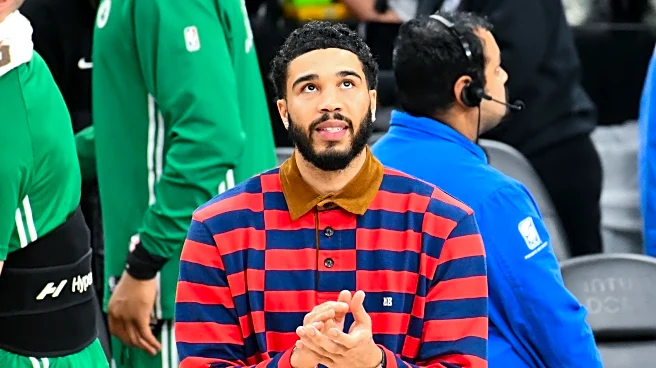




BIRMINGHAM, Mich.— Behind the scenes and away from the cameras, Jayson Tatum has been tirelessly rehabbing from the Achilles tendon rupture he suffered last May.
Occasionally, the Celtics star has shared glimpses of his workouts on his YouTube channel and Instagram, but he has yet to let the media in for an extensive, unfiltered look at his recovery.
That all changed on Monday morning, when Tatum took the floor for a 45-minute workout in front of more than a half-dozen reporters at Seaholm High School,
a school located in a northern suburb of Detroit, where the Celtics held shootaround ahead of Monday night’s primetime game against the Pistons.
Tatum began his morning with some form shooting from various spots on the court, then went through various, more active shooting drills: getting threes off of screens, practicing off-the-dribble pull-ups, and driving to the basket for dunks and layup with defensive pressure. He seemed to demonstrate an increased level of explosion, shot efficiently from various spots on the court, and got to his usual spots in the midrange.
Throughout the workout, Celtics assistant coach Tony Dobbins guarded Tatum pretty aggressively, while Craig Luschenat, the team’s head of player development, directed traffic. Dobbins guarded Tatum with an undeniable level of physicality — hand-checking him, and poking the ball out of his hands at time. (For reference, Dobbins was named the French League’s best defender three times in his EuroLeague basketball career — and while he wasn’t going all out, he was certainly upping the pressure).
Steve Tchiengang, one of the Celtics’ player enhancement coaches, partook in drills as a screener and passer, as did Tatum’s former Duke University teammate, Celtics assistant coach Amile Jefferson. Tatum’s trainer, Nick Sang, took the floor to watch.
The workout was not a full-speed NBA workout, but pre-injury, Tatum also often went through his shooting drills as half-speed, so this fact isn’t particularly notable. Luka Garza, Payton Pritchard, and several other Celtics watched Tatum’s workout from the sidelines after they concluded their own film study and shootaround obligtions.
You can watch the highlights from Tatum’s workout for yourself on the Derrick White, who was shooting on the other side of the gym throughout shootaround, said it’s been great to watch his teammate’s progress.
“It’s been amazing to see, obviously, all the work he’s putting in,” White said. “You just kind of see him being around more, and being able to do more. So that’s exciting to see, as a friend. Every day he’s been working hard, and it’s good to see all that hard work add to some more movement and more opportunities.”
Here’s one more thing I’ll add: Tatum has not worked out in front of the media this extensively since he first got hurt. He has no shortage of access to gym space, even on the road. Previously, he’s waited for media to wrap up before taking the floor for his post-shootaround workout; that’s what he did earlier this month in Los Angeles, for example, and that’s what he often does at home at the Auerbach Center.
It’s possible that Tatum’s morning schedule was simply compromised today and he had no choice but to work out when shootaround was open for reporters. But, it feels unlikely. Celtics shootaround began at 10am, but the media only went upstairs at 10:50am — and that’s exactly when he got started. And, Tatum opted to work on the basket right by the cameras.
Jayson Tatum has not been shy about wanting to return this season
It’s no secret that Tatum hopes to return at some point this season. In late October, in his only media interview since the Celtics season began, Tatum told me that he was eyeing his return.
“I’ve been working my butt off for the last 24 weeks now, just trying to get healthy and trying to get 100% and it’s just something that motivates me,” he said. “Every day, I go to rehab and work out, and I’m on the court. [Coming back this year] is something I can try to get to. It’s a goal for myself. I challenge myself every day.”
Still, just because Tatum continues to progress, it doesn’t mean that a return is around the corner. Last month, Celtics general manager Brad Stevens shone some light on the lengthy return-to-play process.
“[There are] strength thresholds he has meet,” Stevens said. “After that, several weeks of progressions, from the standpoint of scripted against small groups, scripted against bigger groups, scripted in 5-on-5, unscripted random, all the way up through those. But it’s a long progression, and it’s almost like, once you hit the strength, then you do your thresholds of a progression of play, and then you’re also reconditioning to play real minutes whatever that looks like.”
It’s been exactly 8 months and one week since the injury occurred. But what exactly that means is uncertain, because different NBA players have had vastly different return-to-court timelines.
For reference, Miami Heat guard Dru Smith missed 9 months recovering from his Achilles rupture, while New Orleans Pelicans guard Dejounte Murray ruptured his Achilles 12 months ago, and has yet to make his return.
Dr. Lou Soslowsky, the founding director of the Penn Achilles Tendinopathy Center of Research Translation, told CelticsBlog that Tatum’s unique situation — from his previous health to his quick surgery timeline — means that it’s challenging to determine what a “normal” recovery timeline would look like.
“The sample size of how many people who’ve been in his situation is very small, even compared to other professional athletes,” Soslosky said. “So we’re trying to extrapolate data from the population to a guy like Jayson Tatum, who is young, extraordinarily healthy, extraordinarily committed, who has the resources of a professional sports team at his disposal, who is committed to do everything he possibly can to come back. That’s not the data we have, right?”
Jayson Tatum has also been more engaged on the sidelines
One other note: since the season began, Tatum has been with the team for nearly every shootaround, practice, and film session. He even travelled with the team for all of their preseason games, and has been as around and as visible as any player on the roster.
“Not being able to be out there with the team is already tough enough,” Tatum said. “But still traveling and being with them during meetings and game[s] and practices and shootarounds, still trying to feel as much a part of the team as I can, I think it really helps my mental health a lot.”
Over the past few weeks, my personal observation is that something in him has shifted; he has become increasingly animated on the sidelines, and was particularly celebratory on the sidelines of Thursday’s game against the Miami Heat as Anfernee Simons exploded for 39 points. (Just from watching, Tatum appears to be a big Simons fan).
Maybe he’s just increasingly relishing in the Celtics on-court success, and particularly in the recent improved play of players like Simons and Sam Hauser. But, in my (albeit limited) experience, injured players usually reach a an increased level of engagement on the sidelines when their return is inching closer.
That was always what I observed with Kristaps Porzingis as he rehabbed various injuries throughout his two-year Celtics tenure; when he was getting closer to returning, Porzingis would always become increasingly animated on the bench — standing more, celebrating more, fake shooting during timeout breaks, etc. That’s what I’ve seen Tatum do more and more on this roadtrip.
Again, this is all speculation. It’s possible that Tatum won’t return this season and has simply become increasingly celebratory because he feels like being that way. But, those are my observations from having been around him and this team for most of the season, so I’m sharing them here.
Either way, Tatum’s vibrant sideline presence has been appreciated by his teammates.
“He doesn’t want to watch — he wants to go out there and play,” White said. “But he’s been amazing, just supporting every game, just having him over there, it’s been a lot of fun.”
Tatum has done a lot more than just celebrate; throughout the year, he’s been pulling players aside and giving them insight about things he’s seeing on the sidelines.
“He knows the game, he knows the system, just even when you’re struggling — he’s there supporting you and picking you up,” White said. “Just having a guy like that around, it’s always impactful.”
Regardless of what happens next with Tatum’s rehab, the Celtics are in a great spot. They have the second-best record in the Eastern Conference at 26-15, and the NBA’s second-best net rating at a +7.6. Since December 1st, they have the NBA’s best record at 15-6.
They also might have one of the best players in basketball coming their way.