






When talking about the 2026 NBA draft, everyone knows about the top 4.
But there is a player who will almost certainly be available when the Mavericks pick at 9 who matches all of the top 4 statistically, so why isn’t he viewed with the likes of AJ Dybansta and Cam Boozer?
Well, he’ll be 24 when the season starts.
The basics
Yaxel Lendeborg was born Sep. 20 2002 in Puerto Rico, before moving to Ohio when he was 2 years old. He attended Pennsauken High School in New Jersey, but only played in 11 varsity games in his
high school career.
This unusual circumstance was caused by his bad grades, which kept him from playing on the varsity squad. This began his roundabout basketball career, as Lendeborg would commit to Arizona Western, a junior college school, where he would play for 3 seasons.
He would be recognized as the NJCAA and ACCAC player of the year in his 3rd season, averaging 17.2 points and 13 rebounds per game. After this season he would transfer to the University of Alabama at Birmingham.
He would again dominate this level, where he would win back-to-back American Athletic Conference (AAC) defensive player of the years, where he averaged 17.7 points 11.4 rebounds, 4.2 assists, 1.8 blocks and 1.7 steals per game in his final season.
Following this season Lendeborg would enter the transfer portal, while also attending the NBA draft combine. After the combine, Lendeborg would choose to return to school, where he would transfer to the Michigan Wolverines.
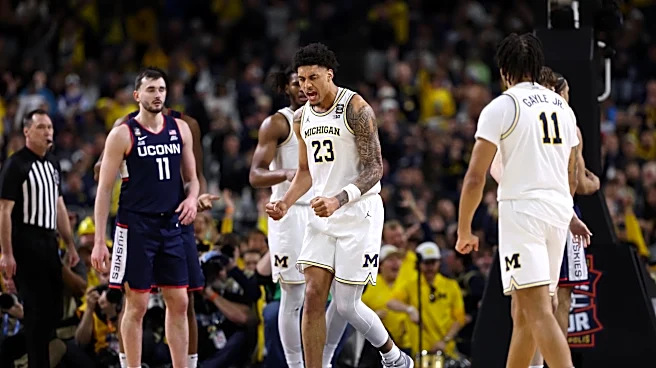
This decision proved to be the right one, as Lendeborg and the Wolverines would cap off a dominant season with a National Championship.
Lendeborg would have a tremendous season, being named the Big 10 National player of the year, as well as a consensus first team All-American.
Lendeborg averaged 15.1 points, 6.8 rebounds, 3.2 assists, and 2.3 stocks per game.
The good
- Lendeborg’s biggest strength is his combination of size and athleticism. He measured in at 6’8.75 barefoot, and weighed in at 241 pounds, with a 7’3 wingspan. These measurables are absolutely outstanding, as Lendeborg should be able to play the 3-5, giving him supreme positional versatility. He also has a fluidity that is rare for his size. This shows itself both as a driver, and as a defender, as he’s able to guard both speedy wings, and powerful big-men. This frame is also NBA ready, as he should have the strength to battle with almost any player in the league.
- Lendeborg also possesses elite efficiency across almost all play-types. He shot 72% at the rim, and 37% from three, both being great numbers for his playstyle. He was also efficient in every context: attacking the rim, posting up smaller defenders, or popping off of a screen for a three. He’s able to effortlessly switch between off and on-ball play-types, capable of creating his own shot, or playing off of others. His shot diet is also nearly perfect, as almost all of his shots come at the rim or three point line. While he may not posses the self-creation ability of the truly elite prospects, his versatility allows him to be impactful whether he has the ball or not.


- Perhaps the most NBA ready part of Lendeborg’s skillset will be his defense, as he projects to become an elite backline menace. Lendeborg doesn’t necessarily have one skill that sets him apart defensively; rather, it is his ability to slot in wherever a team is lacking. He can perform as a great secondary rim-protector next to a center, a wing stopper, or even a small-ball five. His long arms and thick frame lead to a high number of steals and blocks. Lendeborg also could become a volume rebounder, as he has shown the ability to grab double digit boards during his college career. While those numbers dipped last season, it can be chalked up to playing alongside Morez Johnson Jr. and Aday Mara. Overall, Lendeborg will immediately become one of the more versatile defenders in the NBA, and has the potential to truly wreck games.

- An underrated part of Lendeborg’s game is his playmaking, which could have the potential to be truly great. While his raw assist numbers may be lackluster, the advanced metrics paint a different story. Lendeborg posted an 18% AST%, 3.1 AST/TO, and 2.9 rim AST a game, all numbers in the 85th percentile or better. While these numbers could suggest hidden upside as an on-ball creator, he will more than likely be limited due to his scoring ability. At the very least, he should be an effective connective passer who always makes the right play.

- Finally, Lendeborg’s advanced impact metrics cannot be ignored, as he has some of the best in this class. Lendeborg posted the second best BPM in the class, only behind Cameron Boozer. This impact felt on both sides of the ball, as he was second best in both metrics. This level of impact usually translates to the NBA, even if it’s inflated due to his age.
The bad
- Simply put, Yaxel Lendeborg’s age is the only reason he isn’t discussed as a top 5 prospect in this class. Lendeborg will be 24 years old when the 2026-2027 NBA season begins, a truly outrageous age for a rookie. To put this in perspective, he is older than Paolo Banchero, who will be entering his 5th NBA season. His age is a nuanced topic, as many have claimed that the only reason he has the impact that he showcased in college was due to his age. While this is a bit extreme, the cause for concern is not fully without merit. While Lendeborg’s raw BPM was 15.1 (second best in the class), his BPM+ (which accounts for factors such as age) was only 5.1, which is 15th in the class. His age also means that his potential is capped at being a role player, as teams can expect very few physical changes for Lendeborg at this point in his career.
- When it comes to his game the biggest concern is the three-point shot. While Lendeborg shot 37% from three last season at Michigan, it was the first season in his long college career where the 3-ball was a legitimate weapon. His form is solid, but I do have concerns about whether he will have real three-point gravity at the next level.
Fit with the Mavericks
While many Mavericks fans would hate this draft selection, his fit would be incredibly seamless. Lendeborg could immediately start at the 4 next to Cooper Flagg, helping him on both sides of the ball.
The issue is that the Mavericks already have a player that is very similar to Lendeborg, while only being 3 years older.
That being P.J. Washington Jr.
The other problem is Flagg’s timeline. Lendeborg is ready to help a contending team win now, and while the Mavericks should be feisty next year, winning is not a priority. Furthermore, Lendeborg will be 30 years old before Flagg turns 25, and will be on the decline before Flagg hits his prime years.
Player comparison
The most obvious comp for Lendeborg is Aaron Gordon with slightly less athleticism. This comp is mainly rooted in their shared physical traits and defensive versatility. While Gordon is not a star, he routinely has been one of the most impactful players in the entire league, and is vital to the Nuggets system. Lendeborg’s low end comp is the aforementioned P.J. Washington Jr.