
Special thanks to Nathan Carroll of Bronco Nation News for joining me to discuss Boise State’s roster on this week’s podcast:
Contrary to the one-note assertions of commentators, Boise State football for at least the last decade has not been defined by its bag of tricks, but rather by a very straightforward and brutally effective approach: domination of the vast majority of their opponents along the lines of scrimmage. Indeed, the number of trick plays which Boise State has run since Coach Danielson
took over mid-2023 is far lower than the FBS median, and the OC up until recently, Dirk Koetter, even considered screen passes to be too exotic for his tastes.
In the recent years I’ve been charting this team — all of the 2023 season in preparation for Oregon’s early 2024 game, 2024 for a potential playoff matchup and various other projects, and the 2025 season for this article — the offense has been a run-first, “bully ball” which leans into its strength on the offensive line and force multipliers in the running back room, while the defense has focused heavily on its aggressive front to stuff the run and send pressures to shorten the QB’s timer while playing man coverage on the back end.
Readers may recall echoes in this approach to my recent write-ups of Penn State’s conference championship-contending team and James Madison’s college football playoff team near the ends of the 2024 and 2025 seasons. In a similar way, I also think that Boise State has used this trench-domination strategy on both sides of the ball to neutralize some of the differentials with their opponents in skill talent when it comes to the passing game, tackling, and/or coverage.
And like those other teams, as Nathan and I discussed on the podcast, this approach is the only reliable way Boise State has to win – the games they’ve lost have tended to be to opponents who could take them on at the line of scrimmage. And to Bronco fans’ lament according to Nathan, there hasn’t been that bag of tricks, or found-points from special teams, or alternate schemes like a veer-shoot offense or conservative defense, to give them other ways to win.
So the point we returned to multiple times on the podcast was that Boise State games tend to go one way or the other, nothing in between – if they’re winning on the line of scrimmage, they’re just winning … but if they’re losing on the line of scrimmage, they’re just losing.
Offense

Boise State has been a run-first team in virtually all down & distance scenarios in each of the past three seasons, with at least 57% rush rates on 1st downs and at least 73% rush rates on 2nd & short / medium and 3rd & short (and even a 55% rush rate on 2nd & long in 2023, although that slipped back to typical FBS numbers around 40% in the following two years). They even more predictably pass on 3rd & medium / long, in all three years doing so at rates over 85% in all situations.
As is standard for teams built this way, Boise State is of middling efficiency on 1st down, about 55% success rate running and 45% passing, extremely efficient in when ahead of the chains (although with a peculiar dip well underwater in effectiveness only when throwing the ball and only on 2nd & short which persists all three years), and miserably inefficient when behind the chains at 40% success rates in 2nd & long and sub-30% in 3rd & long.
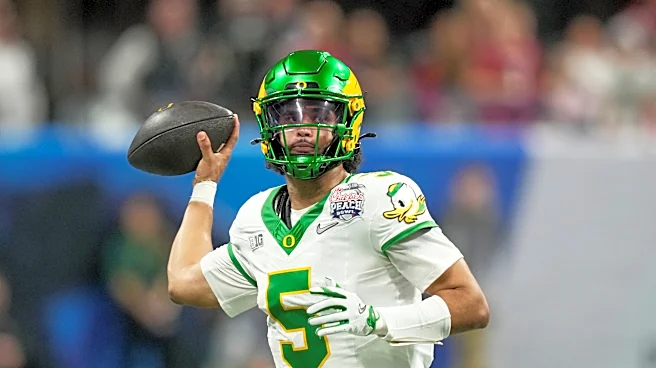
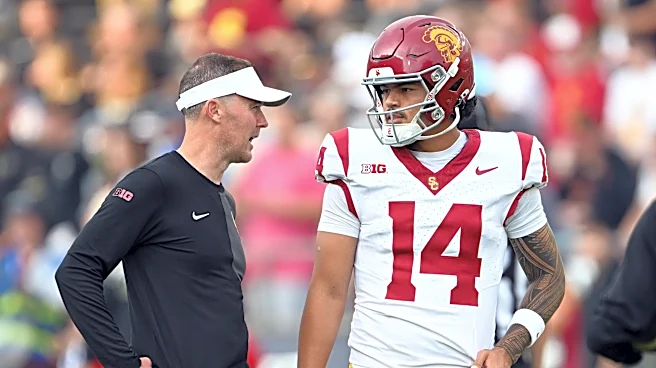
The starting quarterback for the last three seasons and returning for his fourth in 2026 is #4 QB Madsen (2023 gets an asterisk, it was a two-QB system with Madsen splitting time with a running QB Taylen Green, but it was clear Madsen was the passer of preference, and Green transferred out after that year as the writing was on the wall). Madsen missed some time with an injury in 2025 and was replaced by backup #14 QB Cutforth, who also returns in 2026. Cutforth simply lacked Madsen’s ability to push the ball down the field and that brought the overall passing numbers down, though even splitting out the two it’s clear there’s been a gradual decline in Madsen’s passing game each year:

As Nathan and I discussed on the podcast, Madsen is a commendably fearless QB with pretty impressive arm strength for his stature, he’s comfortable picking apart defenses when he has protection and is very good at avoiding sacks and negative plays. Statistically, I can attribute a part of his declining numbers to a bit of lost mobility after his return from injury, he just wasn’t quite at 100% and couldn’t quite dodge pass rushers as well (though compared to Cutforth he was so superior that the staff was probably making the right call putting him back in when they did). I also attribute part of the decline in Madsen’s numbers to a weaker and poorly organized WR corps compared to previous seasons (more on that below). Both of those factors may be on the mend to start 2026.
However I think there’s also just a natural ceiling to Madsen’s game, and Nathan seemed to agree with that assessment on the podcast. His throwing motion isn’t effortless and he needs some time to muscle up on big throws, and some of his alternate arm slot attempts cross the line from fearless to cavalier. Nathan told me about a highly rated true freshman the program won a recruiting battle against Indiana for, #10 QB Herrera, who’s likely the future of the team, but for a variety of reasons we both believe Madsen will start in the opener and if there’s any issue Cutforth will be the backup on Saturday.
Running Backs

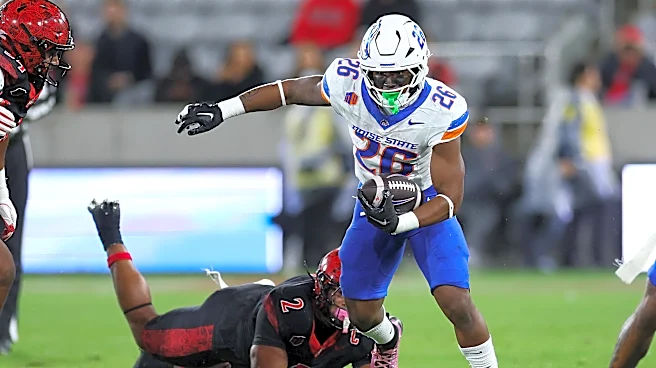
Boise State returns both of their top running backs from last year, #26 RB Gaines and #0 RB Riley. Both were true freshmen understudies to Ashton Jeanty in 2024; Gaines had the better per-carry numbers in 2025 at an impressive 61.2% success rate and 5.13 adjusted YPC and Nathan told me he was meant to be the top ballcarrier but a nagging injury kept him on a limited play count for part of the year. Riley beat out a transfer, Malik Sherrod, who started the year as the other main back to Gaines but wound up with lousy per-carry numbers and a majorly underwater success rate at 37.9%. Riley finished much better than Sherrod, but still well behind Gaines at 52.6% and 4.99 YPC.
Gaines is noticeably bigger than Riley and the diminutive Sherrod (Nathan used some colorful language on the podcast to describe his size), and so without a lot of carries to go by for the two transfers the categories Nathan put them in from his practice observations made sense: the smaller Pitt transfer #22 RB Goff with Riley as speedy, hit-or-miss outside runner, and the bigger Kansas transfer #27 Stewart with Gaines as a inside-the-tackles bruiser.
What those size categories, their relative effectiveness, and the recent large variance in success rates all communicate is that, despite this offense’s preference for rushing and pride in its offensive line, it’s not actually very good at run blocking … especially the wide zone play which is the staple of the offense and is the first thing that any halfway decent defensive line shuts down. Every Boise State back has to be his own blocker, and those too small to do so wind up with poor numbers. If the Broncos had a consistently effective o-line they would have a moderating effect on the rushing metrics; but that’s not what we see, instead it’s giant swings year to year and back to back, with Heisman numbers one year and a 6th year senior transfer the staff thought would be the top back washing out with awful numbers the next.
Against their four best opponents in F+ defense (8th ranked Notre Dame, 13th Washington, 26th San Diego State, 40th Fresno State), the gap between Gaines and Riley widened dramatically. Gaines’ numbers didn’t take much of a hit off his year-long totals against those four, running for 58.8% success and 4.76 YPC, however Riley was completely stymied on exactly the same number of meaningful carries at just a 45.7% success rate and only 3.31 YPC.
Here’s a representative sample of Gaines then Riley running against these defenses:
Tight Ends

In 2025, Boise State alternated fairly evenly between 11- and 12-personnel, around 40% multiple-TE sets during meaningful play (there’s an increase in heavy sets during clock killing garbage-time drives for obvious reasons; I exclude all non-representative play from the figures in this article). That’s more TE usage than in other years I’ve watched Boise State, and I think Nathan was right that it stemmed from having two guys they liked and some dissatisfaction with that year’s WR corps, plus the the backup QB Cutforth disproportionately loving to throw to the one of those two TEs who otherwise got fewer targets.
Those two were Matt Lauter, who’s since bounced to a couple NFL practice squads, and #88 TE Wagner, who returns. Wagner was more of the in-line blocking TE, but Cutforth’s target share and per-target success rate for Wagner jumped nearly 30 percentage points (!) compared to Madsen, while three of the four main WR options had 7-9 percentage point falloffs. That’s largely what’s responsible for Wagner’s overperformance compared to the Y-receiver built Lauter, Wagner has a 51.7% per-target success rate and 6.48 YPC on the year, while Lauter (with mostly Madsen throwing to him) had an anemic 42.5% and 5.44 YPC.
I think Nathan is right that 2025 situation was a one-off, in terms multiple TE usage, for several reasons and we’re likely to see a return to mostly 11-pers with just an additional blocker coming in sparingly for obvious situational packages in 2026. Even if they wanted to use someone in addition to Wagner I don’t see any strong candidates; the one Nathan seemed most excited about is a true freshman with a family connection to UFC royalty but who likely won’t be fully coming online until a bit later.
Wagner’s numbers with just Madsen throwing to him were 38.9% efficiency and 5.4 adjusted YPC, which are astonishingly poor for a TE. He’ll probably climb out of that basement with Lauter out of the way, though not nearly to the inflated numbers he had with Cutforth’s laser focus on him. Barring a major offseason breakthrough which strikes me as doubtful for the fourth-year, it seems unlikely that the TE unit will be an expansive part of the passing offense.
Wide Receivers

Nathan was quick to call this unit poorly performing in 2025, and that’s certainly clear. They were without any of the receivers with plus-values across all charting metrics of recent years – Austin Bolt, Cam Camper, Eric McAlister, or Prince Strachan. There was only one returner from 2024 who got any meaningful targets, Latrell Caples, and Nathan found his bad numbers in 2025 to be mysterious.
It seemed clear enough to me; Caples’ 44.1% per-target success and 6.16 adjusted YPT in 2025 weren’t far off his underwater 2024 figures, and he was playing out of position in the slot at 6’0”. The logjam of undersized receivers since the four I mentioned above — all 6’3” or taller — departed is quite baffling, as the entire WR corps with one exception in 2025 and 2026 are 6’0” or shorter. This pushed the 5’10” #3 WR Bates (last year wearing jersey #80) to a flex position instead of the slot where he should have been, and his 34 meaningful targets were effectively wasted at a miserable 32.4% success rate.
Meanwhile on the outside, they took the transfer of Chris Marshall to play X-receiver, a former bluechip and the only guy over 6’0”. Marshall wound up washing out of the program for what Nathan called “upstairs issues”, excessive drops and an off-field incident. The two receivers who were well above water in success rate were #82 WR Ford and his backup Chris Penry, for reasons I didn’t understand they weren’t on the field at the same time and at no point did the staff figure out that they should be sitting down the underperformers. When I said it puzzled me that my algorithm found a strong inverse correlation over the years between how effective a receiver was and how often he was targeted, Nathan laughed and said he didn’t want to say the offensive coordinator didn’t know what he was doing … and then I think he didn’t know a polite way of ending that sentence.
I think there’s a good chance the WR corps will be rationalized in 2026, though Nathan repeatedly shocked me on the podcast by telling me that outside receiver positions were going to be played by guys who are 5’10” or 5’11”, or in one case a true freshman. Bates returns and while his numbers have been underwater the last two years he should play out of the slot where he’s meant to. Ford returns and Nathan said he’ll play a flex position between the Z and Y spots, which, even though he’s listed at 5’10”, I agree with Nathan he plays bigger than that and makes sense for him, he had good numbers last year at 55% success and 8.8 adjusted YPT.
They return two tall sophomores I figured would be the outside guys, but Nathan shot that down and said instead a 5’11” Juco and former Div-III, #21 WR A. Wright will play X, and true freshman #19 WR R. Jones, who’s 6’2” and finally someone of appropriate height, will play Z. Nathan allowed that the FCS transfer #13 WR Morris may get some backup play, and to watch out for gadget guy #25 WR Q. Brown for specialty plays like reverses, but that he expects the vast majority to be evenly distributed to the quartet of Bates, Ford, Jones, and Wright.
Here’s a representative sample of the returning passing game, showing the issues discussed so far with the up’s and downs of Madsen’s game, Ford, and Bates:
Offensive Line

Boise State returns three starters from 2025, but Nathan told me the team is planning a major shake-up, and will likely start four linemen who have essentially no FBS experience.
Nathan felt like there was more uncertainty at the interior of the line, though I think because of how the 2025 season played out and who’s returning as cross-trained alternatives the interior is more of a solid “higher floor / lower ceiling” situation. First of all, the interior has the one extremely experienced starter, #62 RG Carreon, who I was watching start back in 2023 and Nathan said was even playing as a freshman in 2022. Carreon broke his leg against Oregon in 2024 but returned to lead the team in the playoffs that year.
Boise State had an injury situation that affected the center and LG in 2025, we got into the full details on the podcast but many of the players involved have since graduated so I’ll skip the full recitation here and simply say that it’s surprising that the other interior returner, #67 OL Steele, would have his LG job taken away in favor of a guy who was the 4th option to replace him when he was hurt in week 9 and got all of 15 reps last year, but Steele is capable of both playing any of the backup roles to which he’ll be assigned and if something goes wrong with either of the new players he’ll be available to go back to.
The new interior linemen are #64 LG Rasmussen, a senior and the aforementioned 4th option, and #52 C Tafua, a sophomore who redshirted last year. Another option besides Steele who has played competitive football before is Oregon State transfer #69 C Esty, who got about 170 snaps at the position last year. I don’t know about the idea of starting guys who’ve never played before in the opener against what should be a decent d-line instead of debuting it in a low-pressure environment like an FCS game, but with four guys to play two spots (or five for three, counting RG) they can backtrack in case there’s a problem.
At right tackle … in 2024 the starter was Hal Schmidt, who was injured late and replaced by backup #75 RT Metoyer. I thought Metoyer played better than Schmidt, Metoyer was named starter in 2025 Fall camp, and Schmidt ultimately transferred to UCLA. It would appear the past is prologue, as Nathan told me that Metoyer will have his job taken by sophomore #66 RT Tracy, who redshirted last year. Nathan allowed that Metoyer has gotten in better shape this offseason, has been working on his team-leading penalty and sack-surrendered rate, and may start in the opener, but he seemed adamant that Tracy is the future at the position and will have the job very soon if not immediately.
Nathan’s been tracking a cool story at Boise State – every starting left tackle for the last two decades has gotten at least some significant NFL play, which will doubtless include Kage Casey who was drafted in the 4th round by the Broncos (the other ones). Apparently the entire program is very excited that his replacement, Div-II transfer #78 LT Ethridge, will be even better, and Nathan told me from what he’s seen at practices he has no doubt that Ethridge will at least be a quality player and wouldn’t contemplate the notion that it doesn’t work out against FBS competition. Nathan’s a fellow quant and nothing he said made me think he’s liable to get carried away, but this was the point in our discussion where the percentages I’m forced to play since I’ve never seen Ethridge, and the eyes Nathan has had on practices, are least in concert. The odds from long testing say this move is a coin flip and Boise State needs a backup plan in case they get surprised. That appears to be #70 LT Cox, whose experience as a senior is limited to last year’s bowl game against UW, which was effectively over after 31 snaps.
Defense

There was something of a scheme transition in 2023 and 2024 as Danielson reconfigured from the previous 3-down front to the current 4-2-5. The two main upshots to this are first, by late 2024 and certainly the beginning of 2025, the team had this settled with no confusion about who was a safety or backer or end, who was on- or off-ball … everybody had clear roles and those are well locked in for 2026. The second upshot is that, for making historical comparisons, we should note that much of the run-stopping and inside tackling work which in today’s scheme would be done by front-six guys was handled by players who were technically defensive backs in 2023 and 2024.
That note is by way of clarifying the switch in rush vs pass defense performance between the 2024 and 2025 seasons. After 2024, the rush defense side got hit by a double whammy: they lost a disproportionately high amount of their big hitters from the defensive front, and the scheme shift reconfigured 3rd level resources farther (though far from exclusively) back into pass coverage.
The first part of that double whammy was losing six of the ten guys in what was effectively the defensive line rotation: interior linemen Michael Callahan, Austin Gums, and Sheldon Newton, edges Ahmed Hassanein and Tavion Woodard, and linebacker Andrew Simpson. The DB hitters also all left – box safety Alexander Teubner who was effectively another linebacker, and safeties Seyi Oladipo and Rodney Robinson who Nathan and I discussed as record-setting tacklers at the line of scrimmage. On top of all this, nickelback and UW transfer Devan Banks was benched and dismissed early in the 2025 season for a no-show effort and replaced with a converted corner who was more of a coverage player, removing another hitter who had six TFLs in 2024.
The pass defense elements, however, remained in place – two of the most effective edge rushers, the opportunistic sack creating linebacker, both of the high safeties, and both of the corners, all of whom were multi-year starters and upperclassmen in 2025. In my opinion, the combination of the scheme switch and the natural shift in experience from the rush-oriented hitters to the QB-attacking and WR-covering defenders, rather than any structural revelation or light-bulb moment, is the best explanation for the change in the charting metrics from year to year.
The relevance of this observation in 2026 is that the continuity remains strong in the front, with two of the three 2024-to-2025 returning linemen yet again returning in 2026 as well as another 2025 DT starter and several more experienced interior and edge backups, plus two of the three backers from last year both of whom have been getting reps since 2023. However the defensive backfield is losing all four of those longtime starters, and moving the one returner from 2025 to a different position.
Because I think some of the tackling and coverage in the secondary could stand to improve, and because I think they have more returning experience on the d-line in 2026 than they did in 2025, I’m expecting the rush and pass defense to even out this year. I think we’ll see more rotational trust and less fatigue on the front, and fewer whiffs from the back end (because how could there be more), but also some inevitable miscommunication issues and a lack of senior savvy that’ll come when replacing four starters. As I said at the top, I think this defense will generally go as the line goes – if they can stove in the offense up front, they’ve already won; if the d-line or simulated pressures get stood up, it’ll be a long day.
Defensive Tackles

Senior Braxton Fely has finally graduated after being part of the primary rotation for the last three years. Due to a complicated injury back-and-forth to a couple other 1st and 2nd line 1-techs, #92 DT Latu and Dion Washington (which Nathan needed to set me straight about), the 3rd line 1-tech #96 Sanusi got a substantial bump up in rep share, though Fely also stayed on the field about 5% more reps than I think he might have.
With Latu back, he should go back in as the 1st line 1-tech, with Sanusi and #99 DT Madrie resuming their roles in the 2nd line. Nathan seemed very confident that FCS transfer #97 DT Edward will be the starting 3-tech next to Latu; he’s got plenty of experience and is stout enough for it, though at three inches shorter than the rest of the group I wonder about his length and making the jump to the FBS.
With three guys returning to effectively the same spots, there’s just one question to resolve, but Nathan kept dropping hints about uncertainty – he implied Latu might be injury prone, Madrie and Sanusi hadn’t taken the step forward expected of them as upperclassmen, that the Jucos brought in for depth are emergency options and wouldn’t be as big and effective as the homegrowns, and yet refused to put the big sophomore #98 DT Imasuen clearly ahead of them on the depth chart. If there’s an issue either with Edward or an injury to the four-man rotation, I’m not really sure how or even if they’d go about moving a guy into that spot and maintaining the same effectiveness as they were able to with two different injuries last year.
Defensive Ends

This looks to me like the strength of the entire team and where the Broncos’ toughest games will be won or lost. The two starters, fist-down #95 DE Stege and stand-up #5 DE Virgin-Morgan, have been in position for the last two and three years respectively, and have NFL sizes. They return the entire unit who got playing time last year, with Nathan praising #91 DE Bol (not related to the former Oregon basketball player of the same name, we both checked) for having taken a step forward.
I tend to think #51 DE Caywood and #13 DE Lane are liabilities, Nathan seemed to agree and thinks Lane won’t see much playing time and Caywood might go in just for situational packages, though he thinks Bol will get enough of an increased rep share that they’ll actually be able to complete the rotation instead of playing some three-DT sets as they did in 2025 to give the starting edges a break.
Getting fatigue under control would certainly be a help but I think there’s a reason why the blitz rate increased while the havoc rate decreased over the last three seasons whenever Boise State played a Power conference team – they’ve feasted on G5/6 lines but top-shelf offensive tackles complete their vertical drop faster than the starters’ getoff, and the four-man pass rush essentially vanishes. The compensation has been twists, stunts, and simulated pressures, at which these guys communicate excellently – that tends to be their advantage over ostensibly more talented but less experienced o-lines.
Here’s a representative sample of the returners on the defensive line in action, the strengths and limitations discussed:
Linebackers

In 2025 the backers played three very experienced guys, Marco Notarainni at MIKE, #1 LB Phelps (then wearing #41) at WILL, and #43 LB Ripp as a rotational player and also the SAM when they went to their 4-3 configuration for obvious short-yardage run stops. Notarainni was a highly opportunistic player who’d generate a surprising amount of havoc given what I thought was an athletic ceiling. Phelps is a bit lighter and more agile, Nathan told me he should return at WILL.
The new face is senior transfer #17 LB Brantley from Kansas; he’s much less experienced than Ripp and even some of the freshmen returning who got their feet wet last year (including #55 LB M. Tuioti, brother of Oregon’s Teitum), but Nathan told me Brantley is in a battle with Ripp for the starting MIKE job, and presumably whoever doesn’t get it will take on last year’s backup/SAM spot.
Secondary

There was quite a bit of drama and stories to tell in the secondary in 2025, which we went through on the podcast. If the starters, notorious players, or CB coach returned in 2026 it might be worthwhile to relay these things as commentary on the current group’s decision-making. But as it happens this is basically all new between backups and transfers with a re-arranged coaching situation, and I think I’ve covered the only relevant upshot in the top of the defensive section of this article.
I’m left to extrapolate depth probabilities at the sub-units from first principles. The outside corner spots look like they’re the best reinforced: three backups return who got substantial meaningful play due to an injured starter in 2025, and in addition they’re adding two more experienced players #15 CB J. Washington from Kennesaw State who was a former all-conference player and converting back #7 CB Mickey who had started at nickel / inside corner for most of 2025 after being switched into that spot to resolve the Banks affair. Nathan also told me that junior #35 CB Tolmaire looks like he’d be playable in a pinch, though I haven’t seen him before.
Nathan said that Mickey and #8 CB S. Smith, one of the three 2025 backups, should get the two starting jobs, but with six guys for two spots of whom five are seniors who’ve played serious time before, they’ll be fine. (In fact, I thought one of their starting corners in 2025 was such a massive liability, going back to his days at Cal, that it would be difficult for me to believe this unit doesn’t improve. I think taking one of the guys who dresses up as Elvis out of the stands and playing him instead of that guy might have been an improvement.)
At the safety and nickel spots, Nathan seemed confident that they’ve got the six guys — three starters and three backups, each slotted exactly — but there’s question marks of one type or another hovering over all of them and he said it was the group he was least bullish about. Boundary safety seems to be going to #9 DB Ganter, the safety backup who got the most reps, though his backup #29 DB de Boachie will have gotten practically none. Field safety is even less experienced at this level, #38 DB Anderson who only played about 10% of meaningful reps last year, and Nathan indicated he’s probably in a battle with the much larger Juco #20 DB Hall.
The likely starting nickel comes in from FCS South Dakota, #22 DB Tillmon who got close to a hundred tackles during the Coyotes’ playoff run, though there’s always the question about translating to the next level, and Nathan surprised me by saying the likely backup is true freshman mid 3-star #10 CB Soliai.
At the expected rate of getting unhappy answers on question mark replacement players, there are about even odds of having a starter and backup at the same position (though which one, search me) being unsatisfactory and the staff needing to scramble to shuffle somebody else into place midseason. There’s a few other options but they’re also question mark guys who’ve essentially never played, so the staff might dip into the cornerback depth if that happens – it was their solution last year when they used Mickey to solve the nickelback problem.