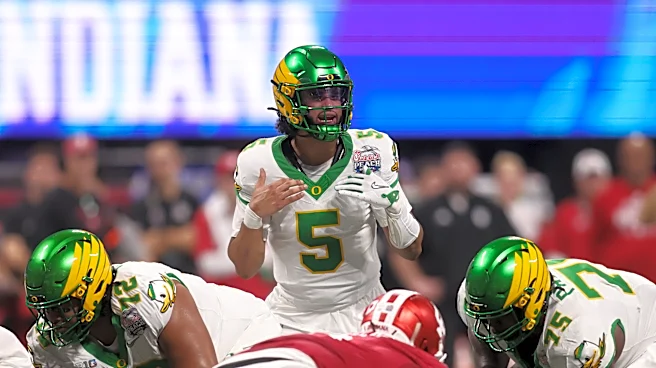

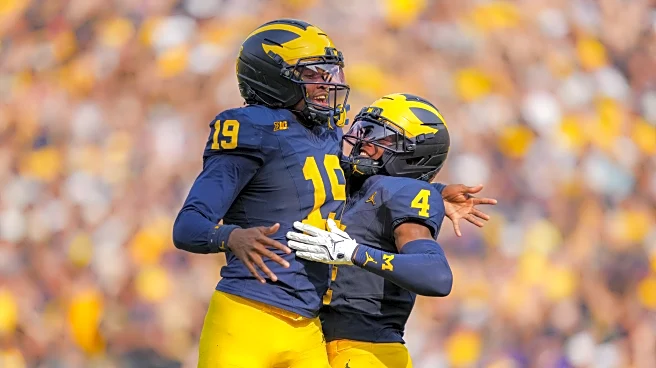


Dante Moore transferred to Oregon after the 2023 season when he started 8 games for the Bruins. He had time to learn OC Will Stein’s offense as a backup to Dillon Gabriel in 2024 before starting every game in 2025. The only meaningful playing time he missed was the second half of the Wisconsin game in Week 9. The 2025 offense as a whole took a step back this season in two of the six metrics ATQ charts: efficiency passing and explosive rushing.
While quarterback play is the most influential factor
in a team’s passing game, quarterbacks don’t operate in a vacuum. Receiver play and pass protection have a great influence on the passing game, which makes it difficult directly comparing different passers with raw performance numbers. With that context in mind, the following chart shows not only season long performance numbers for Oregon’s passing game but also havoc rate (the number of plays marked as ‘sack,’ ‘scramble,’ or ‘throwaway’ on my tally sheet), as well as the error rate (the percentage of plays with weighted negative grades on my tally sheet for the QB on passing plays) for each passer the last three seasons.
It’s important to keep in mind some of the context around the performances posted by these three players. Each had a strong cast of pass catchers to work with. At its healthiest the 2025 squad may have had the most talent at WR and TE as any unit in Oregon but late season injuries tested their depth. Nix and Gabriel each set the record for most starts by a QB in Division 1 history. Gabriel only had one off season to transition from a very different scheme at Oklahoma to OC Will Stein’s playbook, while Nix already had a year at Oregon under a much more similar version of the offense under then-OC Kenny Dillingham. Moore had the benefit of a full year working with Stein, but was much less experienced overall and also played behind the shakiest Ducks offensive line of the past ten years.
The database ATQ has compiled over the years indicates that after a QB’s starting debut (with the proviso that the data on true freshman starters is highly unreliable and noisy, as they’re often thrown in unwisely or due to emergencies), most passers improve between 1.25% and 1.75% each full season. Gabriel was quite a capable quarterback, but between changing systems and a good-not-great offensive line in front of him he was never going to reach the “second OC” level of mastery Nix had. Moore has the potential to get there if he chooses to exhaust his eligibility but it would be surprising if he stayed in school for the 2027 season.
Thanks to hythloday’s work on season long performance statistics for the entire Big Ten Conference (part 1 and part 2), I was able to compare how Moore and Oregon’s passing offense performed against their Big Ten foes’ season long averages. I’ve charted the difference (Oregon’s performance compared to each opponent’s season long defensive average) for each of the three passing statistics ATQ tracks and displayed the results as graphs below.


This comparison allows us to better examine how Moore and the passing offense performed based on what was within their own control (as opposed to the quality of their weekly opponent). The thing to notice (aside from the fact that Rutgers’ pass defense was significantly more helpless against Oregon than their other foes) is that while relative efficiency was highly dependent on the opponent, relative yards per play was less so. Relative explosiveness was nearly constant with the only exceptions being Rutgers, the Penn State game (a highly conservative game plan), and Indiana (Stein failed the midterm and the final…). Taking these numbers in context of film study, I do not think Moore was the primary cause of any of the sub-par performances. To be sure, he had some games where I thought he played more poorly than others (the first Indiana game and the Washington game in particular). There were mitigating factors in each case though: a conservative/just plain bad game plan (Penn State, Indiana, the 1st part of Wisconsin), weather (Wisconsin, Iowa), injuries to receivers (Iowa), and offensive line play (every game except Rutgers and Minnesota).
Once the season ended, ATQ was able to get access to all-22 footage of most of the Ducks’ games this season. I went back and reviewed all of Moore’s plays from the new vantage during representative play. Though I made additional notes on my charts for each game for Moore specifically, I have chosen to (as much as possible) exclude clips from blowouts against less talented competition. As such, all the clip compilations below will feature plays from conference games and/or the playoffs. Attentive readers will also notice some of these were originally included in recaps of each game (good clips are good clips). I have added the all-22 angles (if they weren’t included in the original broadcast) and updated the description to study what Moore does on each play specifically.
The biggest surprise as the season progressed was how much Moore’s legs were featured as an integral part of the offense. When reviewing his time as UCLA, hythloday had noted that while he displayed decent athleticism he was very much a scramble-to-throw quarterback and wasn’t a major factor rushing the ball. By contrast, after spending a year with Oregon’s strength and conditioning staff he showed foot speed far beyond what his previous film indicated, which while still not elite was well above average for an FBS passer. The Ducks did incorporate more traditional run designs and plays from under center this season to play to Moore’s strengths, but zone read concepts were retained as a staple of the offense. I had expected zone reads and RPOs to stay, but not called carries by Moore. Using the quarterback as a designated runner as a big part of the plan during the Penn State game and was retained in each game afterwards.
I found Moore executed run reads at a high level. Though he was unlikely to break an explosive run if a defender left his lane open, he was fast enough to pick up first downs if his option wasn’t respected. He showed no hesitancy in taking contact (in fact I think he needs to work on protecting himself). The biggest advantage of using him as a runner was simply allowing the running back to act as an extra blocker when the offensive line was struggling. Here is a representative sample successful running plays when Moore was involved.
(Reminder: You can click on the gear icon to control the playback speed.)
- :00 – This play shows the advantage of having the quarterback as a run threat in short yardage. Once RB #0 Jordon Davison pulls across the formation the only unblocked defenders are too far away from the play to stop Moore falling forward for a critical first down, even with left tackle #76 Isaiah World being shoved into the gap by a smaller linebacker.
- :27 – Moore doesn’t keep the ball on this play, but he plays a pivotal part in it’s success. The backside defender on the LoS (Iowa #48) has to respect he possibility of the QB keeping the ball, so when left unblocked he does what he’s been coached to do and stays wide with his hips parallel to the line of scrimmage. Once the line washes down the rest of the front this creates a gap that RB #6 Noah Whittington can exploit.
- :59 – When the play side edge defender (USC #1) steps down toward the path of the running back Moore knows he has a chance to get around the outside. He has the speed to out run his read defender who is now out of position. Even if he isn’t fast enough to beat the secondary defenders to the pylon, the play still gives Oregon a first down inside the 5-yard line.
- 1:29 – A couple of things make this an atypical read play for Moore. The line is executing counter towards the offense’s left so he is actually the play side option while giving to Sadiq would be testing the edge. The end stays wide so Moore keeps. He does well here to run right behind his linemen before being tackled so he can fall forward and avoid a head on collision with the defenders.
Using Moore as a dedicated ball carrier was an effective wrinkle when introduced against Penn State, but gave diminishing returns as the season progressed. Once opponents had these plays on film defenses were better able to fit their run gaps when the Ducks had an extra blocker. Moore’s straight line speed is good but not great, he doesn’t possess the size of Bo Nix, nor the instinctive vision of Dillon Gabriel. To be effective as a runner Moore needs the call to put the defense in a bad position or to make the correct option read (which he almost always made). In the future, I think he should continue to be a part of the run game with zone read concepts but his other carries should be limited. This would minimize the number of hits he takes in addition to maintaining the element of surprise for such plays at critical moments. I’ve compiled examples of failed run plays when Moore was a threat:
- :00 – I don’t think the screen pass to the running back is live. This is a called QB-draw all the way. Picking through traffic in the middle of the defense relies on instinct that cannot be directly taught, only refined with coaching and practice if a player has the innate ability and Moore’s film doesn’t show he possesses it. He should be trimming off C #72 Iapani Laloulu’s left shoulder in order to give the defense the worst angles to him. When he decides to run to his right it gives the safety a clear shot at him.
- :32 – Using the quarterback in the run game does give the offense an extra blocker, but that advantage doesn’t help if the blockers don’t do their jobs. When the linebacker (Iowa #43) gets past TE #83 Saleapaga (drawing a holding penalty in the process) it forces the play wide. The backfield penetration also results in a traffic jam so World doesn’t get to the cornerback. Without this block Moore has neither the speed to outrun the defender to the sideline nor the strength to run through contact.
- :55 – Over the course of the season Moore executed his run reads at a high level, but nobody is perfect. Once the backside defensive end (washington #41) pulls up from his rush and comes under control the quarterback needs to let RB #23 Hill take the ball. As soon as he pulls from the mesh Moore knows he has made a mistake and tries to follow Hill. This gives the defense time to get off their blocks (which aren’t well executed) and shut the play down.
- 1:21 – None of the three lead blocks on this draw play are made, and Moore simply doesn’t have the physicality to run over a linebacker. The form tackles from the defenders at least let him take the contact on his lower body so he can get up again after the hit.
The biggest issue with Oregon’s passing game this season was under performance (by historical Oregon standards) by the offensive line in pass protection. The greater pressure rate led directly to a major drop in efficiency as Moore spent too much throwing before he wanted to, changing the launch point, or simply running for his life. The yards per play numbers (which do not include sacks or scrambles that turn into rush attempts) and explosive rate are still similar to previous years thanks to talented receivers and a quarterback who could reliably get them the ball when he had time.
Going back over the film again only reinforced that Moore handles pressure well in most instances, he was just facing more of it than either Gabriel or Nix did. Moore frequently was letting go of the ball knowing he was going to take a hit after the throw and still delivering accurate passes. He showed the ability to throw on the run as well as step up into the pocket to manage threats coming from the edges. I’ve compiled a sample of Moore successfully handling pressure from the defense below.
- :00 – With protection like this, there is no chance this play will be successful for the offense. The right tackle is getting beaten around the edge and only Big Ten blocking saves a sack. The back falls down reaching back for the blitzer (also holding, also uncalled), so both the interior rushers who are twisting come free when the guard gets tripped. Moore shows his athleticism to break the pocket along with good judgement under pressure to throw the ball away when nobody is open.
- :39 – Moore’s peripheral vision sees the defender coming from his left so he knows he can’t keep going through his progression. He doesn’t panic and throws a soft, catchable dump off to Davison. It’s not a big gain, but much better than a sack. All this happens as he knows he is going to be knocked to the turf, but it doesn’t affect the quarterback’s form. On the high angle you can see if the protection held up WR #1 Dak. Moore was open for a first down toward the boundary.
- 1:06 – Speed wins around the right side of the offensive line (a frequent issue in 2025). Moore had been waiting for Sadiq to break open on the crosser, but feels the pressure and realizes he doesn’t have time. He quickly checks down to Davison who does a marvelous job of improvising. Look at the throw on the reverse camera angle: the passer’s feet aren’t properly set and he’s using a side arm release to save time in his windup. Despite this the ball is headed right for the back’s face mask. This is the kind of thing Patrick Mahomes has inspired countless quarterbacks to try, but few are physically capable of pulling off.
- 1:44 – Both tackles are being driven backward, so Moore steps up in the pocket to take away the angle for the edge rushers. Unfortunately for him the interior protection hasn’t fared any better as the center and right guard fail to communicate when handing off the interior twist. The ball has to come out or it’s a sack, but thankfully RB #22 Harris is open. The field safety has blown the coverage (as attentive readers knew he would) and if the pocket had held up it could be a touchdown to Sadiq.
There were plenty of times last season when defenders were in his face so quickly Moore never had a chance to do anything. When I did have errors for him on my tally sheet when under pressure there were two areas I thought he could stand to improve. One is that he showed at times to be too confident in his abilities and would take off running or trying to squeeze a throw into his first read when he would have been better off moving to buy time. He also needs to improve on collaborating with the offensive line in picking up blitzes, something that comes down to reps as he enters his second season as a full time starter. There were a smattering of other errors that showed up on film, but were rare enough I would put them down to “sometimes that happens in football.” Here’s a sample of Moore not handling pressure properly.
- :00 – This is a case of trying to squeeze a throw into a window so tight even a quarterback with Moore’s physical abilities cannot make it work. The first read is Dak running a crosser, but both linebackers are sitting in the middle of the field so there isn’t much space to work with. With a rusher threatening him right up the middle Moore decides to chance it. It’s a good throw because it is out of reach of the defenders, but the timing has been sped up so the receiver doesn’t have a chance at it either. Had he shuffled to his left and stepped up in the pocket Moore could move on to either WR #2 Gary Bryant Jr. or WR #4 Malik Benson as better options.
- :25 – This play shows a combination of being too eager to run, along with not having a proper feel for the pocket. At first Moore feels the pressure coming from his right he tries to take off through a gap in the line. The DT has leverage to defend this, so he has to spin out and check the ball down. If the defense had been playing man coverage I wouldn’t blame him for trying to run, but with the linebackers sitting in short zones he was never going to gain much. He’d be better served stepping up and drifting left where he could find Dak has gotten behind the defense.
- 1:09 – This bootleg is supposed to buy time for Moore to roll out to his right by faking a stretch play to the offense’s left. The Minnesota defensive end is playing the QB the whole way though, so the offense is dead in the water right from the snap. All Moore can do is try to limit the damage, and by trying to juke the defender he ends up taking a sack. He’d be better served side arming the ball right at the feet of WR #14 Lowe.
- 1:33 – The protection breaks down quickly and as can be seen on the high angle there aren’t any wide open receivers near the line to gain on third down, so Moore doesn’t have any great options. The outcome of getting about ten yards of field position is acceptable in a low scoring game like this. My criticism is that Moore tries to run straight up the field and put a spin move on the linebacker who is looking back at him playing zone. It’s better to either dump the ball off to TE #9 Ja. Johnson or cut toward the sideline to protect himself from a head on collision.
One of the most difficult aspects of Moore’s play to evaluate during this project was his ability to analyze the defense both before and after the snap. The main reason for this is that the play calling affects what he’s looking for. At times he appeared to be properly executing the play as drawn up but the defense had won the rep on the chalk board. In 2023 Bo Nix had been given carte blanche to improvise or even change the play call at the line (as shown on some of the Ducks vs Them videos). I had assumed that Dillon Gabriel had similar leeway given his experience. While I’m not in the quarterback meeting room, I didn’t pick up any indication on film that Moore was given similar authority on the field. This makes sense given his relative inexperience. I’ll be very interested to see if I can find signs that the offensive staff has given him more responsibility in the coming Fall.
With that background in mind I still gave Moore very high marks for picking proper targets given the coverage he was facing. Once he recognized what the defense was doing, he showed the ability to anticipate when receivers would be open and time his throws accordingly. I liked his ability to go through full field progressions, though he frequently didn’t have a chance to do so because the line couldn’t hold up long enough. Later in the season it seemed he was also getting more half-field reads as the coaches tried to mitigate their line issues. I have very few RPO errors for him on my tally sheet. In fact, I was disappointed the RPO game wasn’t used more frequently late in the season to try and slow down the opposing pass rush. Here are some examples of Moore successfully reading the defense.
- :00 – This a classic example of a quarterback “looking off” the coverage. With two deep safeties and the field side corner playing well off the line of scrimmage Rutgers is showing their defensive hand of Cover-3 Cloud (two safeties and one corner deep at the snap). Anticipating this tactic, the offensive play call has all four receivers in the pattern run deep routes. Moore has diagnosed the defense before the snap and knows that either Dak (into the boundary) or Sadiq (in the slot) will be left one-on-one with the defender trailing behind them. He looks left toward Dak first and when his head causes the boundary safety to move in that direction, comes back to his right and throws to Sadiq for a touchdown (even if the ball was touch high).
- :40 – The defense here is Cover-3 Sky (one deep safety in the middle of the field and the outside corners bailing deep at the snap), with the added complexity of a simulated pressure on the offense’s left. Moore is looking to see what USC #18 does once the play begins. From his initial position he look’s like he is taking away Benson, but once the defender move’s outside to guard the flat (since the corner has deep responsibility), the throwing lane for the slant is open. Notice how Moore is keeping the receiver in his peripheral vision but aligning his head straight down field at first so the inside linebacker cannot anticipate who the intended target is. Benson does a great job with his run-after-catch, but even if he had been tackled where he caught the ball it would be a first down.
- 1:14 – It’s fourth down in plus territory, and the northern school tries to get fancy by having both linebackers rush but bailing both defensive ends into coverage as replacements. The line holds up this time so the quarterback has time to go through his progression. Moore wants a quick conversion with a throw into the boundary at first, but he sees the corner has Davison in the flat and the safety has stayed on top of Lowe so he looks toward the field. Here washington #41 is in tension; he can gain depth to take away Benson running a crosser or pick up Sadiq in the flat, but not both. Moore sees the defender take Sadiq and finds Benson as the deepest defenders haven’t reacted quickly enough to drive on the route.
- 2:01 – Once again Moore looks dead ahead after taking the snap so the deep safety in the middle of the field cannot anticipate where he wants to throw. He sees the field side corner turn his hips to bail deep and knows this will leave WR #11 McClellan wide open when he stops on a comeback route.
We got to see more full field progressions this season in Oregon’s offense than when Moore was playing for Chip Kelly at UCLA (where route concepts typically came down to “if the first receiver isn’t open, run”). He does need to continue to mature in recognizing coverage, and he was still testing the limits of what throws he could get away with. Both of these are elements of his game one anticipates will improve with experience rather specific weaknesses that need to be addressed. Below is a sample of poor defensive reads by Moore.
- :00 – On this play Moore doesn’t trust what he is seeing and tries to improvise when he doesn’t need to. There is room in the pocket to step up and avoid the outside rush then throw to Dak on the far sideline. He breaks contain too soon, looks like he wants to run, then tries an awkward pass to a well covered Sadiq that falls incomplete.
- :43 – On fourth and short Moore needs to be decisive here, but instead he hesitates. His first look is toward Dak running toward the boundary and he is right to hold on and continue his progression. As soon as he looks toward Sadiq he needs to start his throwing motion. He seems to not be confident in what he is seeing as he waits a beat too long and once the pocket starts collapsing he tucks the ball back in and takes a sack.
- 1:09 – On this play Moore makes the mistake of staring down his intended receiver the whole way and a veteran defender makes him pay for it. If he checked the middle of the field rather than looking to his left after the snap he would have seen the safety rotating over and known the best throw was to Ja. Johnson on the slant (though it would be been incomplete since the tight end winds up tripping over the defender’s feet). Since he’s looking at WR #17 Perry the entire time the corner is able to abandon his assignment and when he cannot follow through in his throwing motion because of pressure the ball sails on him right into Iowa’s grasp.
- 1:43 – The quarterback has to do some extra chicanery with his hands to sell this fake on fourth and short, but he should still see the only defender deeper than five yards from the line of scrimmage standing still and know Sadiq is going to blow by him. He waits too long and misses his window. Once pressure arrives Moore makes an admirable effort to sacrifice his body for a conversion but can’t quite reach the sticks.
There has never been any doubt that Dante Moore is a uniquely talented passer. His core is so strong that he is able to generate velocity with a minimal throwing motion and a whisper quiet lower body. This makes for a very quick release as he doesn’t have to “wind up” to generate velocity on this throws. It also makes it possible for him to “reload” quicky after pump fakes, though I didn’t actually see this from him very often and would hope he gets more comfortable doing so during the off season.
Moore is capable of making throws that only a handful of current quarterbacks (college or professional) could. Fortunately he also consistently makes routine throws catchable. I’ve compiled a sample of passing plays where Moore showcases his gifted mechanics and fundamentals.
- :00 – A quarterback’s first responsibility isn’t necessarily to throw the ball where it would be the easiest for the receiver to catch it, but rather where the defenders cannot interfere while still being catchable. Moore sees off coverage on Bryant and makes his decision before the snap. The throw is low and away where the veteran wide out can still get it, but even with a quick break on the route the defender cannot get his hands on the ball. Watch Moore’s lower body: his feet don’t even move during the throwing motion but the pass still has both accuracy and velocity.
- :36 – A true freshman running back goes the wrong way in the backfield, so even though the linebacker didn’t bite on the run action this RPO is now pass-or-bust. Moore steps into the throw and delivers a perfect spiral that is just far enough inside that the linebacker cannot interfere but Dak can still snatch it out of the air in stride.
- 1:15 – I trust this clip needs no explanation.
- 1:56 – Timing is critical on this pass to McClellan running a corner route from the bunch on the left side of the formation. Throw too soon and the corner might abandon Benson and beat the receiver to the ball, but throw too late and the linebacker can gain depth and knock the ball down (or worse). Moore is just right and his accuracy lets the receiver secure the catch before the defenders converge.
Having reviewed full seasons of both quarterbacks, I would compare Moore’s ball placement favorably with Dillon Gabriel (though not by a lot, Gabriel was also a very accurate QB). There is some room for improvement when it comes to hitting receivers in stride, but part of this also comes down to reps with individual receivers in the same scheme so I think there is a good chance to see progress next season. The one quirk I detected during my film review is that there are instances where Moore’s talents can serve as a double edged sword. Specifically, he doesn’t have to align his hips and step into throws to generate sufficient velocity, but failing to do so does sometimes affect his accuracy. Some examples:
- :00 – This is a case of Moore trying to do too much. There is really nowhere for him to fit this pass into. He steps into the throw but doesn’t follow through with his back foot, and this predictably causes the ball to sail on him. Oregon is fortunate it was overthrown as far as it was since the Penn State safety was the closest to it.
- :35 – The quarterback does well to spin out of trouble and buy time. In fact, Moore has more time than he seems to realize as despite there being no imminent threat he never comes under control and resets his lower body to create a steady throwing platform. This leads to him over rotating his shoulders and the pass sailing out of bounds.
- 1:07 – Watch the quarterback’s legs on this quick throw. Moore aligns his hips too far outside for this in breaking route and he seems to “rebound” off of his plant foot and turns this into a back foot throw. Despite being able to put plenty of zip on the ball the pass is too far behind the intended receiver.
- 1:31 – Moore did have some accuracy issues after breaking his nose and exiting the Wisconsin game. He wore a clear visor with his face mask as extra protection against Iowa and Minnesota, and in interviews he said it affected his depth perception. Partially due to this, and also partially because of incomplete follow through, the ball is a bit too far in front of Ja. Johnson on this play.