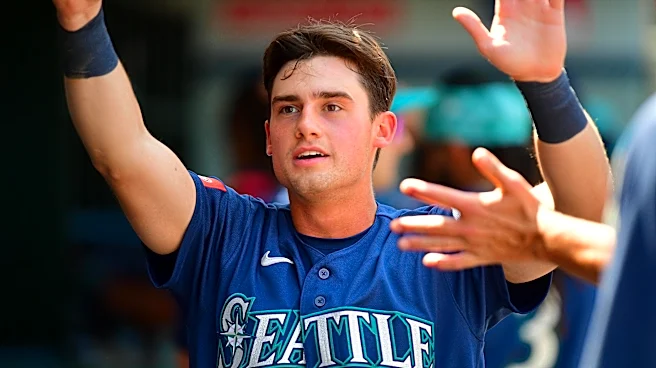


His go-to coffee order is a vanilla latte. He prefers to stick close to the team hotel during road trips rather than exploring the city. His walk-in outfit, as captured by team photographers, is usually joggers and a plain t-shirt. You could, fairly, call it boring; Cole Young prefers to call it keeping things simple.
It’s that simple mindset that’s driving a successful season for the second-year Mariner. After carrying his spring training success into a strong first month of the season (126 wRC+),
May was a tough month for Young, who saw his wRC+ crater to 66. Looking at the numbers, nothing really jumps out to explain why May was such a slog for the sophomore. He was walking a little less (8.8% down to 7.2%), but still striking out at about the same rate (20-21%). His hit distribution remained almost equal: half to the pull side, a third up the middle, and the rest oppo, so he wasn’t changing his approach drastically or selling out for power, despite a slight (2%) uptick in pull hits. The opposite, actually: the biggest difference was a spike in him putting the ball on the ground more (30% to 45%) and a subsequent loss in hard contact and line drives. In May, an awful lot of Cole Young at-bats ended like this:
But in June, Young’s line drive contact rebounded to where it was in March/April, and his hard contact along with it – back to the exact same mark, 32.6%. He stopped pulling the ball as much, but more importantly, stopped pulling the ball on the ground so much, leading to more hits and fewer 4-3 ground ball putouts. Even more interestingly, he basically stopped striking out. His K% fell to 9%, and in turn, his average jumped by a hundred points from where it was in May – from sub-Mendoza-line to All-Star.
What changed? According to Young, not much other than simplifying his approach even more. During the nadir of his struggles in May and well into June, Young was frequently spotted working with hitting coordinator Edgar Martinez. Edgar helped Young work extensively on his setup, making sure his hands were ready to fire so he could be on time for the fastball and do the damage we’ve seen lately. Around late June, you can see a clear change where he streamlines his approach, synchronizing lifting the bat off his shoulder with lifting his front foot. From June 23 on – the start of the roadtrip to Pittsburgh/Cleveland, where Young was often a lone bright spot in a rough sea – he’s been running a 140 wRC+, slashing .257/.297/.557.
Maybe it’s fitting that Young has found such a mentor in Edgar, who built a Hall of Fame career out of not overcomplicating things: see the ball, hit the ball.
“It’s huge to have him,” said Young about working with Edgar. “He’s so knowledgeable, and I’m so grateful that he’s in the cages every single day. He’s been through everything that you can think of in the game of baseball, so it’s great to have him every single day and just pick his brain. When times are going tough, it’s always nice to have someone to talk to, to help you get through those, and he’s been such a great help. It’s awesome.”
“I feel like struggles in a season are inevitable. Like, it’s going to happen, and the biggest thing is just learning from the struggles, and not trying to let the struggles keep going on and on, really just learning from those and making adjustments on the fly.”
Appropriately enough for someone who values the gift of simplicity, that change might have made a significant difference. Here’s Young’s setup back in late April. Pre-pitch, he goes from bat on shoulder, to bat straight up, to bat back on shoulder before the pitcher has even released the ball, at which point he goes through the sequence again, this time cocking his bat back in sync with his leg kick. (You can also see this “busy bat” in the clip above.)
And here’s his homer from Sunday. The setup is much simpler: the bat is on his shoulder, goes up when the pitcher is about to release the ball, cocks back in sync with his leg kick, and then he swings through.
To isolate it down to a moment, you can clearly see the difference in Young’s setup at the point where the pitch arrives. Earlier in the season, his foot is already down from his leg kick, already transferring energy and firing his hips, which are more closed off at the point of impact. Recently, though, by syncing up his leg kick and where he starts his swing path, he’s slightly more open and in a better position to attack the pitch and do damage. Most importantly, he still has all that potential energy in his front leg to put down and drive through his swing. That slight change allows him to get a little more loft on his swing while still driving the ball with authority.

He still got a really good swing on the pitch on the left – a four-seamer at 98 mph that he hit hard, 102 mph – that went for a deep double that would have been out at three parks. The homer he hit on Sunday, by contrast, came on a first-pitch changeup, but Young absolutely crushed the pitch, at 104 mph. It was his second hit of the day and he crushed the other one as well, a single at 101.3 mph, and his second homer of the series.
Quietly, Cole Young has been one of the Mariners’ steadiest producers, maybe a 1A to Randy Arozarena’s turn as first-half MVP given his defensive contributions and his ability to contribute every day. Young is one of six players to have played all 101 games so far this season, and the names he shares the list with are impressive: Bryce Harper, Pete Alonso, Bryan Reynolds, James Wood, and Xavier Edwards, all integral face-of-the-franchise types for their respective teams.
Manager Dan Wilson attributes Young’s success – in the box, in the field, and in his ability to post every day – to the work Cole put in during the off-season, work that started showing up immediately during spring training and hasn’t dipped since. Even when Young was struggling offensively in May, his glove carried him, the anchor of an infield that’s gone through injuries and inconsistencies.
“I know we’re 100 games into this, but if you go back to the off-season and talk about the preparation that he put into this season, he’s ready for this. He’s ready to be that guy,” said Wilson. “He’s ready to be there as much as we put him in there. And there may come a day where he needs a break. There may come a day where he needs a mental day. There may come a day where he needs a physical day. But right now what he has done, his consistency, is all due to the fact that he put the work in. He took advantage of the off-season, and he’s turned himself into a great player, and a very consistent player. That’s all due to his hard work.”
In 1995, the French chef Jacques Pépin taught America how to make an omelette on San Francisco public television in a now-foodie-famous segment and casually let slip that the humble omelette was the way he assessed the technical skill of a chef. Eggs, butter, some fresh herbs: basic ingredients alchemized into something greater than the sum of its parts in the hands of an expert. The perfect omelette, the most perfect foods, Pépin says, is not about fancy ingredients, but about perfect technique: consistent, controlled, classic. Simple. Not boring.