




Despite posting the only spotless record in the nation 13 games into the 2026 season, Maryland women’s lacrosse looked anything but perfect.
Standing middle of the pack nationally in key statistical areas — such as offensive pacing (66th), shooting percentage (58th) and turnover rate (52nd), according to Lacrosse Reference — Maryland didn’t look like a championship-caliber team on paper.
But when the Terps took the field, they were nearly unstoppable.
Ample roster depth, coupled with a remarkable clutch
factor, propelled Maryland to the hottest start in Division I lacrosse and its best finish in years. The team’s cohesion kept it grounded during winning streaks and above water in choppy stretches.
“I do think this is just truly a really special group. I love our chemistry. I love how we are off the field. I love the support that everyone has,” head coach Cathy Reese said. “I love the buy-in we have from people that are playing, not just 60-minute players, but the people that don’t play at all.”
That chemistry was evident early as it carried the Terps through their contentious nonconference slate.
Maryland’s season opener against Syracuse gave fans a taste of two greatly improved juniors: USA Lacrosse third team All-American attacker Lauren LaPointe and IWLCA Goalkeeper of the Year JJ Suriano.
LaPointe scored five goals to open up her best season to date while Suriano made 16 crucial saves to secure the 9-5 victory. The win came in spite of a glaring 38-19 shot disparity, a trend that would plague the Terps throughout their season.
Maryland carried that momentum into its next matchup against another ranked opponent in Virginia, taking the win, 17-9, as Kristen Shanahan contributed seven points. But from then on, the Terps began to display signs of weakness.
Consecutive unranked games against Georgetown and St. Joseph’s proved surprisingly difficult for Maryland to conquer, requiring late-game heroics in the former and an overwhelming 17 goals in the latter.
But the Terps pushed through glaring turnover and pacing issues, recording a +30 goal differential over the following five games as veteran pieces began to gel together.
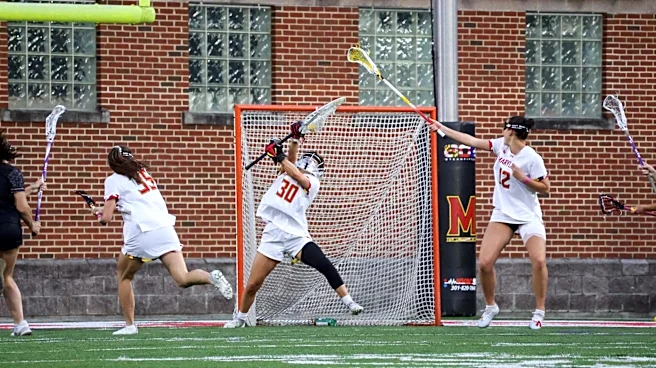
Anchored by a trio of experienced defenders in Kennedy Major, Maddy Sterling and Neve O’Ferrall, Maryland executed its patented man-to-man concept to perfection. It allowed just 10.1 goals per game, with its stout defense the backbone in many gritty battles.
The Terps carried that momentum entering the heart of Big Ten play, easily handling USC as Kori Edmondson and Keeley Block combined for seven of Maryland’s 13 goals. But in their next game against Johns Hopkins, a critical crack appeared.
Maryland struggled to put its opponents away. It led the Blue Jays, 15-7, entering the final quarter of the contest but was outscored 5-0 in the final 15 minutes. Still, the Terps escaped with a win.
Maryland solidified itself as the final unbeaten team in the nation in a physical, 14-13 win over Penn State. Despite again being outscored in the final frame, the Terps had downed their fifth ranked opponent.
“I don’t care where you’re ranked. I don’t care what you’ve done,” Reese said after beating the Nittany Lions. “I care that Maryland shows up to play…trying to be better than we were last game.”
Then, Maryland retained its top ranking with a dominant Senior Day win over Rutgers. The Terps scored 18 goals, and eight players scored multiple times.
“It just shows how lethal we are from top to bottom,” Edmondson said after the win. “We’re super deep. And I think that just shows overall where we are as a team. We can lean on anyone.”
However, that win proved to be the high point of Maryland’s season. Its lingering issues returned.
The Terps suffered their first loss of the season, 11-10, against eventual national champions Northwestern. Maryland led at the half but crumbled late, conceding four goals and committing five costly turnovers in the fourth quarter to seal its fate.
Its next contest was a more complete collapse. The Terps were demolished by Michigan, 15-4, and tied their fewest goals in a game since 1982. The Wolverines decimated Maryland’s defense while key Terps were flustered on the other end, committing 11 more turnovers than their opponents.
“We walked off the field after Michigan, and I was like, ‘What team was that?’” Reese said. “Michigan played an amazing game, and we did not.”
Reese had less than 48 hours to center her team and prepare for a regular-season finale against Ohio State. She succeeded, as the Terps beat the Buckeyes and secured second place heading into the conference tournament.
In that tournament, Maryland played three games, each separated by a single goal.
A quick rematch against Ohio State ended in a 10-9 win for the Terps, who fended off a late comeback from the Buckeyes. Maryland then overcame Johns Hopkins in overtime, with Block delivering the deciding blow in a 15-14 slugfest.
After two narrow wins went their way, the Terps fell to the Wildcats in the tournament final for the second year in a row. Despite coming back from a four-goal deficit to force overtime, Maryland lost its seventh straight contest against Northwestern.
The contentious tournament appeared to give the overwhelmed Terps some much-needed direction heading into the NCAA tournament, where they held the No. 3 seed. And after a week of recuperation, Reese once again rallied her team around her “1-0” mindset.
After a first-round bye, Maryland had another Big Ten rematch in the second round, this time against Rutgers. A six-goal first quarter was all the Terps needed, cruising past Rutgers to face former Maryland coach Cindy Timchal and her Navy squad in the quarterfinals.
That game saw the Terps again battle through adversity, winning 14-10 after scoring five times in the fourth quarter. Heading into Evanston, Maryland finally looked like a complete team.
However, its first semifinal appearance in four years was decided early in the contest, as the Terps’ weaknesses were revealed by a powerful North Carolina squad. Maryland was completely overpowered on both sides of the ball, turning the ball over 15 times and scoring just twice in the final 28 minutes of the 16-6 defeat.
The Tar Heels won the shooting battle, 37-23, capping off Maryland’s first season being outshot by its opponents in the last decade.
While Maryland’s inconsistencies in possessions and shooting killed its title hopes, its players’ passion and cohesion were simply undeniable. Reese will have plenty of work to do to bridge on-field issues, but may struggle even more to replicate the genuine connections built among her players as 11 key pieces — including Edmondson, Block, Shanahan and Jordyn Lipkin — depart this offseason.
“I think the sign of a great team… is just how special these guys really are to each other, how much they genuinely love each other,” Reese said. “They love Maryland, they love lacrosse, and that’s what makes this team really great.”