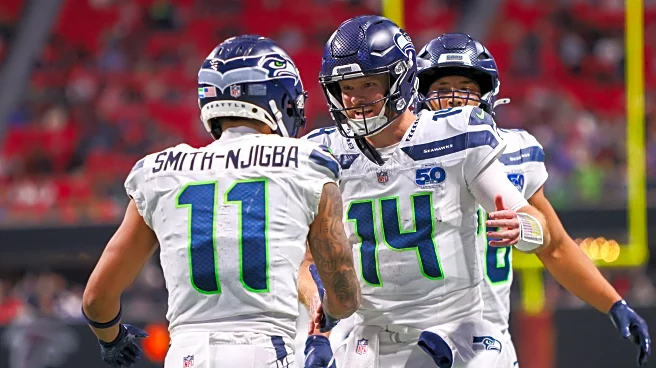

The Seattle Seahawks looked like two completely different teams within the same game against the Atlanta Falcons. The first half brought back all the recent concerns on offense, producing only six points
and little rhythm. But after halftime, the defense elevated its level even further and the offense finally found its most consistent stretch in weeks.
While the six-point first half remains a major red flag — especially against stronger opponents who won’t let you climb back into games — credit is due to Klint Kubiak and Sam Darnold for the second-half adjustments.
All data used in this article was taken from PFF.
The Bad
The only consistency in Seattle’s offensive line is inconsistency
Seattle’s offensive line is young and full of potential. Names like Charles Cross, Abe Lucas and Grey Zabel form what should be a solid long-term unit. Yet the group regularly fails to operate as one — lacking cohesion, timing, and communication. Even though the sack numbers look acceptable, this line could be doing far more.
One example: the double-team. It’s supposed to give the OL a numbers advantage, but Seattle constantly mistimes these combos. After the initial contact, one blocker must climb to the second level based on the play design and defensive alignment. That’s not happening.
Olu Oluwatimi — who didn’t capitalize on his opportunity as the temporary starter — was late off the snap and lacked the explosion to compensate. His double-team with Zabel fails because while the guard correctly climbs to block #17, the center can’t handle #93 alone. Ken Walker receives the ball with a defender already in the backfield.
On the opposite side, things aren’t much cleaner. Abe Lucas and Anthony Bradford attempt a double-team with zero synchronization. Lucas moves to pick up LB #0, which is correct, but Bradford abandons the block to stare at the opposite side of the formation and ultimately blocks no one. To make matters worse, Nick Kallerup can’t seal the edge, leaving Walker nowhere to go.
(Side note: RB coach Kennedy Polamalu will step away from the team for the rest of the season. It’ll be interesting to see the impact on the run game.)
Oluwatimi actually has leverage against #93 on one snap, but again fails to generate the explosion needed to sustain it. On the right side, Lucas wastes too much time on #17, allowing #55 to crash untouched into the backfield. With no push to the left side, Walker is forced to cut back — directly into two unblocked defenders.
Then comes the blitz. Atlanta sends #55, and while Zabel appears to check the linebacker pre-snap, he decides to help Charles Cross when the LT loses inside leverage. By the time Zabel redirects, it’s too late. Walker whiffs in pass protection and Darnold needs run to escape.
On another breakdown, Cross follows #17 inside even though a blitzer is coming off the edge. Zabel sees #55 coming free and tries to salvage the play. As #17 executes a stunt, Cross passes him off to Oluwatimi — but neither ends up blocking anyone, leading to an easy sack.
Sam Darnold’s concerning first half
The Seahawks’ offense hasn’t looked the same in recent weeks, and Darnold is a major part of that decline. Turnovers, missed throws (uncharacteristic compared to earlier in the season), and poor decisions under pressure continue to appear.
Let’s start with accuracy.
Seattle comes out in a jumbo package near the goal line, with Josh Jones as an extra OL and no wide receivers. Everything hints at a run. AJ Barner runs a fantastic route, faking inside and breaking outside with plenty of space. Darnold has no pressure and a large window — and still doesn’t even give Barner a chance at the ball.
Another missed touchdown: Darnold has been nearly automatic on bootlegs to his left, but not this time. Even against two defenders, JSN creates a sliver of separation, and in earlier games this likely becomes six points.
The worst miss may have been a simple throw to JSN with no pressure. The WR was wide open, but the ball sailed, putting Seattle into a tough 3rd-down — one they eventually converted.
Decision-making hasn’t been clean either. On one snap, the TE is smothered in coverage, and instead of throwing it away or using his legs, Darnold forces an unnecessary pass — the exact pattern behind many of his turnovers.
Even when Cross loses badly on a snap near Seattle’s own end zone, Darnold’s lack of urgency is alarming. The Seahawks already gave up a safety to Houston this season and nearly repeated it here. Darnold had a lane to escape to the right.
When he does run, the results are good. He escapes interior pressure, creates space, and even pulls off some magic — maneuvering through a collapsing pocket and finding an open target.
This is the version Seattle needs: a poised Darnold who steps up in the pocket, keeps his eyes downfield even as the LB closes in, and threads a touchdown to JSN.
The Good
Klint Kubiak looks more comfortable steering the offense
In recent years, Seattle’s offensive issues often stemmed from a lack of adjustments or coherent planning. While Kubiak isn’t free from criticism, he’s shown notable growth in recent games. The second-half rebound against Atlanta is encouraging evidence.
NFL offenses must manipulate defenses. Sometimes a play’s purpose isn’t its yardage, but the idea it plants in the defense’s mind.
Seattle calls an Insert C, bringing an additional blocker into the C-gap to muddy the Falcons’ reads. The play doesn’t gain much… but sets up what comes next.
Seattle comes out in the exact same personnel and alignment. Cooper Kupp motions into the same C-gap. Atlanta expects another run. Instead, it’s play-action and the linebackers bite hard. The motion delays the DB, JSN’s route creates traffic, and Kupp breaks free for the touchdown.
Another great call: the TE’s movement into the backfield pulls a safety into the box. Shaheed’s vertical route forces the deep safety to hold. Darnold reads defender #3, who loses track of JSN. Shaheed’s spacing opens the window, and JSN scores.
Kupp occupies the flat defender on the opposite side, while JSN draws two deep defenders. This time Rashid Shaheed is the one who takes advantage of the void and rips off a chunk gain.
Rashid Shaheed finally breaks out
Seattle made two impactful trade-deadline moves in recent years — Leonard Williams and Ernest Jones — both pivotal to the defense. Shaheed arrived with high expectations, but unfortunately during the worst stretch of the Seahawks’ offensive season.
The chemistry with Darnold is still developing. Back-shoulder throws aren’t Shaheed’s strong suit, but even then the execution could be better.
Against Atlanta dropping ten (!) into coverage, Shaheed runs an excellent route, threatening vertically before snapping off his break to get the Seahawks into field-goal range.
His motion creates natural separation, and combined with his speed, it generates an easy pitch-and-catch — though again, the throw isn’t where Shaheed expects it.
When the CB plays off to respect his speed, Shaheed punishes it with quick-out routes.
And finally: his first touchdown — a 100-yard return. Pure speed. Great double-team in the middle and #52 essentially pulling to create a new running lane.
Final Thoughts
Today’s article focused heavily on the offense, but the defense deserves plenty of credit. They kept Seattle alive while the offense struggled early. Bijan Robinson finished with 86 yards, but Seattle held him to 4.3 yards per carry — his fifth-worst mark of the season. Given how talented he is, and how committed Atlanta remained to the run even while trailing, that’s a win.
There’s work ahead — especially with Jonathan Taylor on deck — but the defensive progress continues to shine.
Seattle now sits at ten wins with four games left. The Seahawks aren’t just fighting for a playoff spot or the NFC West tittle — they fully control their path to the NFC’s No. 1 seed and a first-round bye. Call me pessimistic, but even believing this team would make the playoffs, I never imagined they’d be legitimately competing for the top seed.
Go ‘Hawks!