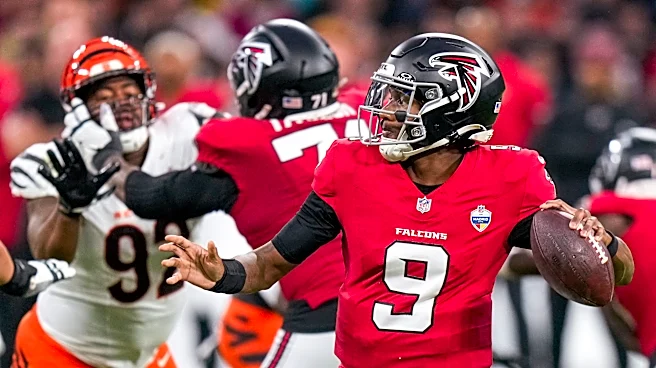


The 2026 Atlanta Falcons have a 3-7 record, a 1-5 home record, a -57 point differential, a -0.14 offensive EPA per play… and because they reside in the NFC South, they are actually one good run away from competing for the division.
But if they are going to find that good run, they’ll need to fix whatever the heck has happened to quarterback Michael Penix Jr. of late. Penix returned to the field in Week 3 after recovering from the partially torn ACL he suffered in November 2025, and things went rather
well for a while.
Weeks 3-7, to be exact. After that, everything fell apart.
It’s unexpected, to say the least. After a Week 7 performance against the San Francisco 49ers in which he completed 25 of 34 passes for 213 yards, three touchdowns, no interceptions, a passer rating of 118.9, and an EPA per pass of +0.26 — and was named NFC Offensive Player of the Week for his trouble in a 29-20 Falcons win — Penix fell off in ways nobody could have imagined.
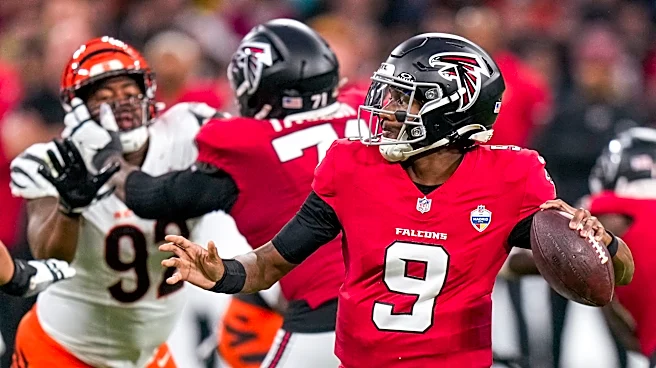
The first bad trip came in Atlanta’s 16-0 Week 8 loss to the Tampa Bay Buccaneers. Both teams were playing in monsoon conditions, but that doesn’t excuse what was Penix’s worst game as a professional quarterback. He completed 8 of 24 passes for 125 yards, no touchdowns, four interceptions, a passer rating of 12.0, and an EPA per pass of -1.09. And then, in losses to the Cincinnati Bengals and the Kansas City Chiefs in Weeks 9 and 10, Penix combined for 43 completions on 74 attempts for 448 yards, one touchdown, two interceptions, a passer rating of 69.0, and an EPA per pass of -0.34.
Okay, so… what happened? First, let’s go back to that 49ers win and see what Penix was doing right. He was throwing accurately within the timing of the routes, he was going through his progressions, he was using play-action like a boss, he was rolling out to great effect, and he looked calm and ready no matter the circumstances. This is the Penix we expected, right?
“We knew with this defense, they don’t really give up too many explosives,” Penix said after the 49ers game. “They do a good job with that. So for us, I just had to be smart and find my checkdowns, find the guys that [were] open, and obviously deliver a good ball for them. So, that’s all it was about. Just making sure we didn’t make any mistakes. Just go out there and play our brand of football.”
Quick game was a big part of the plan. Penix completed 16 of 20 passes with 2.5 seconds or less in the pocket for 144 yards, two touchdowns, and a passer rating of 130.0. Head coach Kevin Stefanski and offensive coordinator Tommy Rees gave him the answers to the test with a lot of defined first reads, and that gave Penix the confidence he needed.
Now, fast-forward to Week 8 against the Bucs. It wasn’t just the weather that held Penix back — Tampa Bay head coach Todd Bowles and his staff did an absolutely marvelous job of changing the picture from pre- to post-snap, and Penix never really got the hang of it. Linebacker Alex Anzalone grabbed two of Penix’s four picks with these disguised looks, where Penix was expecting Anzalone to be in one place… and Anzalone was in another place when Penix decided to throw the ball.
The Bucs also flipped their safeties from single-high to two-high post-snap and vice versa, and they capped Penix’s underneath reads. Total clampdown. This is what you would expect from a defense that currently ranks first in DVOA.
“Yeah, the first one was a good play,” Penix said postgame of Anzalone’s two interceptions. “My back was to him, I turned around, threw the ball and he just dropped underneath Drake [London]. The second one, that’s a good play again – there are no excuses. I’ve got to protect the ball. They didn’t do anything special.”
These things are indeed nothing special in today’s NFL, but if you can’t live in the world of coverage switches and simulated pressures, the NFL is going to spit you out and move along. The Bucs blitzed at a 36% rate and only generated pressure 24% of the time. Which tells you that the plan was more about confusing Penix with spacing, as opposed to just going after him all the time. Penix threw three of his interceptions from a clean pocket.
What’s to learn from this? Penix needs a quicker second-reaction plan when defenders switch and drop post-snap.
Atlanta’s 34-17 loss to the Bengals in Week 9 saw a better Penix — hey, it couldn’t be much worse. He completed 20 of 31 passes for 162 yards, one touchdown, one interception, a passer rating of 74.9, and an EPA per pass of -0.1. Cincinnati’s defense did a great job of plastering Penix’s targets in space, and he responded the right way: When the defense gives you holes in the middle of the field, take off and run. Penix did so three times on scrambles for 50 yards. It wasn’t enough to keep up with Joe Burrow playing at his usual nuclear level, but it did provide a bit of a spark.
“I felt good out there,” he said of using his legs when other options weren’t available. “Whenever I found a lane, I was able to scramble and get a couple first downs. I get that a lot about me not really scrambling much. Today that’s what I felt like we needed in those situations, so I took advantage of it.”
What’s to learn from this? Penix needs to use his mobility more often when the need arises. Tethering him to the pocket doesn’t always work.
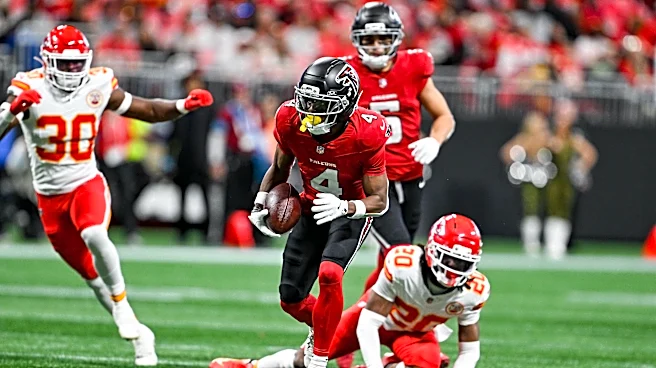
Then, there was the Week 10 disaster against the Chiefs. Game script put this in Penix’s hands, as Kansas City had a 28-3 (sorry) fourth-quarter lead — the Falcons were never really in this one. Penix completed 23 of 43 passes in the 35-13 loss for 286 yards, no touchdowns, one interception, a passer rating of 64.7, and an EPA per pass of -0.5.
As the pass-heavy necessities became clear, Penix had some issues. And those issues were not helped by the route concepts. Penix has a tendency to speed up his process when things go sideways, and that was the case in this game. He missed first-read flat routes, he threw off-time and off-target too often, and he generally didn’t seem in sync.
What Penix has from a route combination perspective is pretty rudimentary. There’s a lot of four verts, some simple two-man crossers, and a lot of iso routes where one pattern doesn’t help another. If you compare the Stefanski/Rees passing game to what Ben Johnson, Sean McVay, and Kyle Shanahan put on the field, there’s a cohesiveness to their offenses that the Falcons simply do not have, and Penix would benefit from the designed openings you get from those types of offenses. Stefanski has moved Rees from the booth to the field, and he’s getting more and more questions from the media about a possible coordinator change.
“I think it’s just very important that you pull everything apart in a bye week when you look at it,” Stefanski said on Nov. 17, as the bye week began. “You get under the hood, and you find out areas that need our attention. Now you do that every week. I think the misnomer is that you wait till the bye week to do self-scout; you’re doing it every week. But with the amount of time that you have, and you’re not game planning for the next week, you can really put a fresh set of eyes on it, if you will, and look at areas that we can be better because just the truth is, we have to be better in multiple areas. And the first part of that is identifying those areas.”
What’s to learn from this? Kevin Stefanski and Tommy Rees need to give Penix more favorable route concepts.
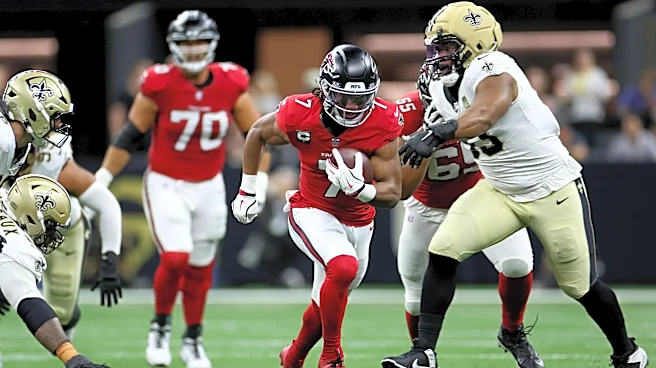
Ideally, Michael Penix Jr. would be in an offense where he is able to see routes opening through the down. He would be able to benefit the most from play-action and boot-action concepts. He would be able to benefit from a run game that prevents opposing defenses from dropping seven into coverage. We can talk all we want about the greatness of Bijan Robinson, but the Falcons have faced stacked boxes this season on just 23% of their offensive snaps, one of the league’s lowest rates. The best young quarterbacks become the best young quarterbacks in part because they live and thrive in ecosystems that maximize their attributes and minimize their liabilities.
That, of course, sounds a lot easier than it is when things are off. But the Falcons need to figure out what Penix’s best ecosystem is, and they need to do it now. Because a lost season is on the horizon, and Penix has to face Brian Flores’ insane Minnesota Vikings defense in Week 12. Coming out of that game with a 3-8 record would mark the end of the season in a competitive sense.
Coaches can turn things around during bye weeks. The Falcons’ coaches have no choice.