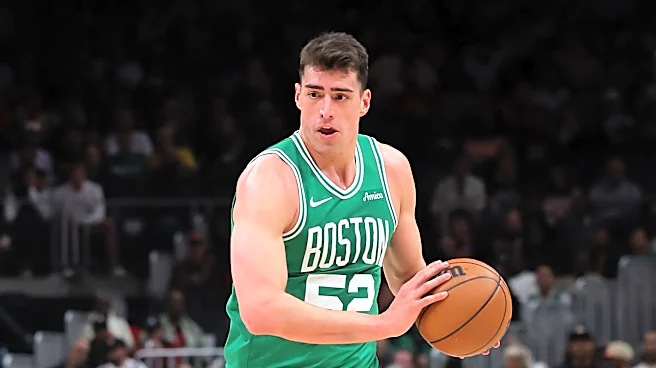







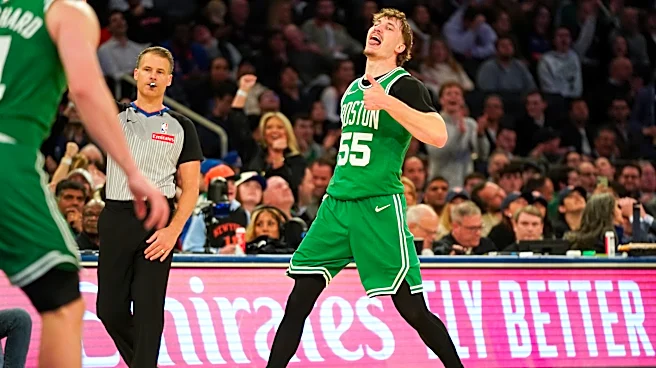

The Boston Celtics took a chance on Luka Garza after he spent most of his career on the bench for the Minnesota Timberwolves. Boston had a serious lack of depth at the center position with a tight budget and a mostly uninspiring free agent pool to pull from. Garza was still unproven at the NBA level after four years in the league, and likely didn’t generate much buzz, but managed to earn the attention of Brad Stevens.
There was a mutual fit between the two parties – Garza was looking for a chance
to have a meaningful role, and Boston was looking for a cheap way to add to their frontcourt. The expectations were low, so anything Luka was able to bring would be a positive.
Garza didn’t have a very special season by any numerical metrics compared to league standards, but he achieved career-highs in literally every major statistical category. He averaged 8.1 points, 4.1 rebounds, 1 assist, 0.4 steals, and 0.4 blocks, while having 57.7/43.3/65.7 shooting splits – all career highs. All this was done in 16.2 minutes per game, and 69 games played. The numbers probably won’t jump out, but they indicate that Luka was capable of playing a role, and playing it well, so long as he got the opportunity.
It was incredibly important for Garza to be playable for Boston this year. He wasn’t going to be the starter, but the Celtics needed solid minutes that they could rely on behind Neemias Queta, which Luka was able to provide. Even Neemi wasn’t a guaranteed starter, and had to prove himself in that role, which made Garza’s success even more critical, though Neemi did end up proving himself as well.
Luka had several electric moments throughout the season, hitting big threes in close games, battling for rebound after rebound, and even a timely block here and there. His game-winning three over the Orlando Magic in the final game of the season will live on in Celtics lore for a long time. More than anything, he impacted the game through his mindset and energy. In a season where you’re expecting role players to step up, it makes a massive difference.

Though, while the regular season can be considered a relative success for Luka, the playoffs were a different story. It was not entirely his fault – the rotations looked much different with Jayson Tatum and Nikola Vucevic back – but Luka was entirely unremarkable. He played in all seven of the Celtics playoff games against the Philadelphia 76ers, but only 8.4 minutes per game. Joe Mazzulla tightened his lineups and deferred to Vuc as the first big off the bench.
The Celtics frontcourt often found themselves in foul trouble, though, which forced the team to utilize more depth. Between that and garbage time, that’s where Luka saw most of his playing time. It makes it much harder to gauge his reliability. Compound that with the fact that he was primarily matched up with Joel Embiid, one of the most dominant physically imposing big men of the modern era (when healthy), and it was a recipe for disaster. Garza often saw himself played off the court, a stark difference from where he was in the regular season when the stakes were much lower.
Between seven games, Garza played around 60 total minutes. In that time, he averaged 4.4 points, 1.7 rebounds, and 0.9 assists on 50/30.8/87.5 shooting splits. Ultimately, he lost almost all of the value he showed over the course of the year. Maybe Boston wasn’t expecting to make it to the post-season at the start of the year, but having an extra body who becomes near-unplayable when it matters isn’t ideal.
Vuc was likely expected to take Garza’s spot in the rotation regardless given their histories, but either way, it became pretty clear that Luka can’t be more than a number three in that situation as things stand. That’s not to say he doesn’t still have value – personally I found him to be one of, if not the most fun story of the year. His endless hustle, his heart and dedication, and his pure grit made him incredibly easy to root for. On top of that, I really enjoyed seeing his father hyping him up and supporting the team at every turn.
All in all, Luka exceeded expectations. He had a much bigger impact in Boston than Minnesota, but didn’t ultimately prove to make enough of a jump to move up in tier as a player. It was a good move by Boston to bring him in, and he may have earned a spot for next season too. He has one more guaranteed year on his deal – it’s just a matter of how dependent on in him Boston is willing to be. Given the playoff results, I would expect him to move down a slot in the rotation.