
It’s the end of another NFL regular season, and the New York Giants are once again in upheaval. A tradition unlike any other. The team plummeted once again to the nether regions of the NFL standings…but
not far enough to secure the top pick in next year’s draft. The head coach that many fans wanted gone was fired…but not the general manager that many wanted to get the boot as well. Maybe most importantly, ownership family ties that permeate the front office remain in place.
Meet the new boss, same as the old boss, indeed. Giants fans won’t get fooled again. Except that we will. We always do.
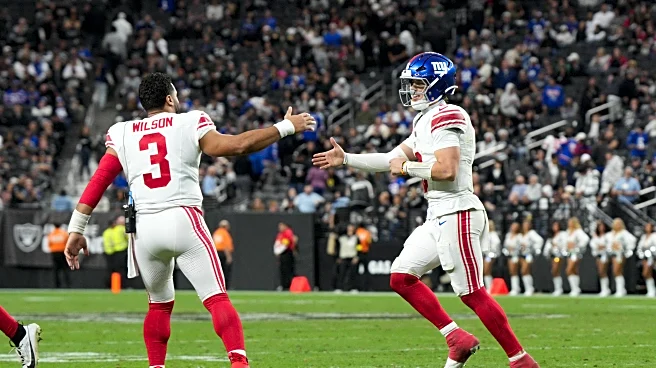
The one thing that justifies optimism this offseason, though, more than any in recent memory, is that the Giants seem to have found their quarterback, and that’s the hardest thing to do in football. Personally, I didn’t see it coming. Jaxson Dart wasn’t that high on my list entering the draft, other than the fact that he’d had lots of college experience, which is a plus. He started to change my mind the first time he stepped on the field in an exhibition game, and it just snowballed from there. Dart was a main reason for each of the Giants’ four victories this season, and he wasn’t the reason for most of the losses.
Dare we hope for a bright future based on Dart’s rookie performance?
Kevin Cole of the blog Unexpected Points has taken a look at that. There is no perfect measure of NFL player performance, maybe especially for QBs, whose merits are endlessly debated by fans and experts alike. One way modern analytics people get around this is to plot independent metrics against each other, which captures some of the uncertainty in the endeavor but also shows that each metric has some value.
Cole went back to the rookie season of every NFL quarterback in the past 20 years who played at least 300 downs in which the player either dropped back to pass or made a designed run. Here are the results. The plot below contains no information from the 2025 season for QBs who weren’t rookies this year, it only looks at each player’s rookie season. It’s up to the reader to judge things based on what we know about how a given veteran QB turned out:

The plot shows a totally objective metric, expected points added per play, plotted against the subjective Pro Football Focus grade. The three rookie qualifying quarterbacks are circled in red. The dashed lines are averages for all QBs. No metric is foolproof, hence the scatter in the diagram, but the strong positive correlation tells us that the analytics folks aren’t just making things up.
Dart falls into the upper right quadrant, evidence that he did indeed have a good rookie season. So does Tyler Shough of the Saints; Cam Ward of the Titans had a rougher go of it in Year 1. Whether Dart’s position is evidence that he’s going to have a great career depends on what you think of the company he’s keeping in that quadrant. He’s got some good company there – Cam Newton and Andrew Luck in almost the exact same spot, and elsewhere in the quadrant, Joe Burrow, C.J. Stroud, Drake Maye, Bo Nix, Dak Prescott, Justin Herbert, Matt Ryan, Jayden Daniels, and Russell Wilson (who some may have forgotten was an elite QB his first decade in the NFL). Also right near Dart on the diagram is Jameis Winston, who passed for over 4,000 yards each of his first two seasons. If Winston had ever been able to get the INTs under control he’d have been on a Hall of Fame track.
Also in that quadrant, though, are players like Kenny Pickett and Mac Jones, who haven’t gone on to such illustrious careers. Funny thing about that – coaching matters. Mac Jones would probably agree. He was arguably the best of that mostly disappointing 2021 quarterback class as a rookie. Then Bill Belichick gave him Matt Patricia and Joe Judge to work with. Jones finally wound up with Kyle Shanahan in San Francisco, and he’s had a resurgence this season even though he’s second string to Brock Purdy, another example of what good QB coaching can do.
The lower left quadrant is mostly populated by forgettable quarterbacks, but it also contains Matthew Stafford. People forget that Stafford was awful as a rookie: 13 TDs and 20 INTs. He cleaned that up and became elite, but he has really thrived since being traded to the Rams and being coached by Sean McVay.
All of that is to say that Dart’s future looks promising…but things could go south depending on who’s coaching him next year. Say what you will about Brian Daboll and Mike Kafka, but they have to get some credit for Dart being able to hit the ground running as a rookie. There’s a lot of talk right now about what type of head coach the Giants need to hire. We hear a lot about “leader of men,” installing discipline, etc. – and those are definitely needed given reports of what’s been going on in the Giants’ clubhouse.
But the other thing the Giants need is one person, whether it be the head coach or the offensive coordinator, who will be effective in continuing to develop Dart. That means making him a better passer and keeping his tendency to run in check…not totally, but somewhat. Dart’s relatively high EPA per play in 2025 in the chart above is a bit misleading. To see why, here are ESPN’s QBR rankings. QBR is based on EPA, but with modifications for quality of defense faced. Dart finished 18th among all quarterbacks in QBR in 2025 – a nice showing for a rookie, but not spectacular. The nice thing about the QBR table is that they break it down to show the individual contributions to EPA from passing, running, sacks, and penalties. Here are the top 10 QBs ranked by EPA from running the ball:

Dart was fourth among all quarterbacks in EPA from runs, and he’s in some great company. The problem is that his EPA from passes was only 24.9, far behind all the other running QBs and only 26th overall in the NFL. Part of that is due to the fact that his only elite receiver played less than half a game with him before being injured for the year. Another part is that Dart only started 12 games; scale his number to 17 games and it becomes 35.3, similar to Lamar Jackson’s but still well behind the other QBs on the list. It could be worse. Take e.g. Josh Allen, who is smack in the middle of Cole’s diagram. Allen was mostly bad as a rookie QB, so I was surprised not to see him in the lower left quadrant. The reason is that, like Dart, Allen had a great run EPA as a rookie (24.1). His pass EPA as a rookie, though, was -1.8. Dart is a polished veteran by comparison.
Dart still needs development as a passer to join the elite ranks of NFL quarterbacks. He looks like he has all the qualities a QB needs to get there, but as a rookie he never exceeded 300 yards passing in a game and only exceeded 250 once, while throwing for under 200 yards six times. A potential elite WR2 is an absolute priority for this off-season, but Dart needs work on his accuracy as well. Consider this diagram from Patton Analytics:
It’s no surprise that Dart sits in the top five of passing yards lost to receiver drops. He also sits, though, in the top 10 in missed yards (from uncatchable passes thrown to open receivers). He’s similar to Caleb Williams, Jordan Love, Patrick Mahomes, and C.J. Stroud in that regard, but quarterbacks like Sam Darnold, Drake Maye, and both 49ers QBs show that something much better is possible. In his final year in college Dart finished sixth in completion % among regularly starting QBs (69%), so we know he has it in him to be more accurate.
Thus, while the focus in the coming weeks is going to be the head coach hire, the hire that follows for offensive coordinator may be as or more important in determining whether the Giants maximize Jaxson Dart’s potential. That’s especially true if the Giants hire a “CEO-type” head coach who is going to leave Dart’s development to someone else.
In that sense, I’d prefer the new boss (of Dart) to be the same as the old boss – someone who is as skilled as Daboll and Kakfa were in making Dart one of the most intriguing young quarterbacks in the NFL as soon as he took the field. Who? Well, Davis Webb is already interviewing for head coaching positions, but if he doesn’t get one, offensive coordinator of the Giants sounds good to me. It would be a half-step up from his current passing game coordinator position in Denver, but if he’s given play calling duties it would be more than that for him…and it would give the Giants a nice return on investment from their third-round draft pick in 2017.