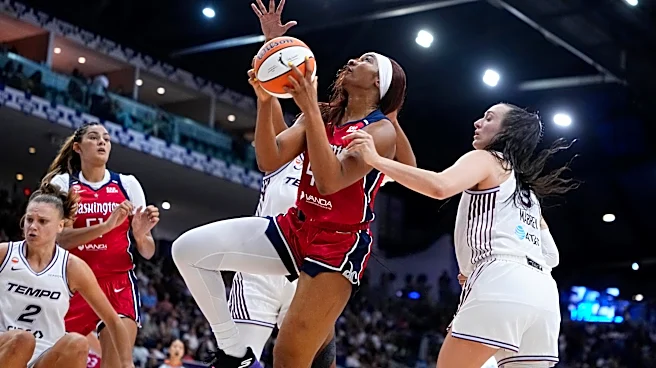








The Toronto Tempo might be the most appropriately named WNBA team.
For an organization that experienced some questioning of their branding decisions, they’ve built a team that embodies their moniker.
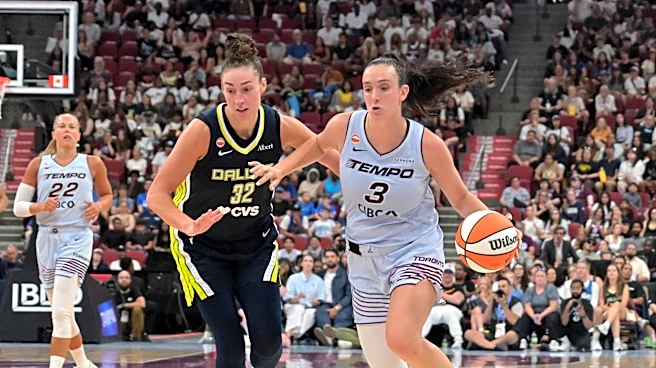
The Tempo like to play with tempo.
However, intentionally or not, they might have leaned too far into that identity. Toronto’s tempo has come with some tempestuousness, and no, we’re not just referring to Marina Mabrey’s crashouts.
WNBA analyst Dan Falkenheim recently released his midseason offensive and
defensive efficiency calculations for all 15 teams, ranking their points per play in halfcourt, scramble and transition situations.
For Toronto, the halfcourt, on both sides of the ball, stands out as an area of trouble, and one evident in their recent performances.
A widely-accepted basketball truth is that the game slows down as the intensity ramps up. As the minutes tick away in a closely-contested fourth quarter, the game increasingly becomes a halfcourt game. Defenses are set and dialed in, and, in turn, offenses must execute.
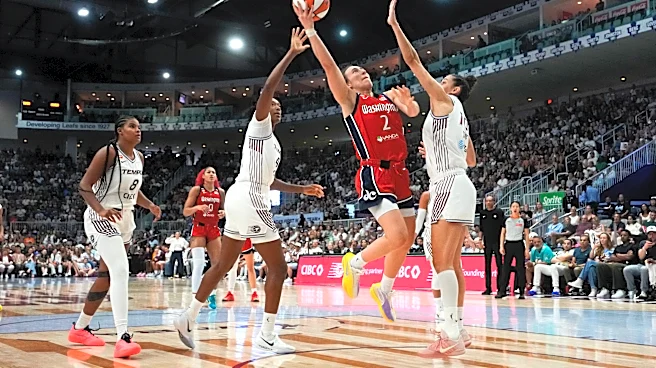
The Tempo, especially of late, have not been good in fourth quarters.
The last time Toronto won a fourth quarter was June 22 against the Atlanta Dream, their opponent on Friday night (7:30 p.m. ET, ION). Although the Tempo won the fourth by nine points, the margin already was out of hand, as the Dream cruised to a win.
Since then, Toronto has lost seven-consecutive fourth quarters by a total margin of 60 points. That averages out to about a -8.6 fourth-quarter scoring differential—a number makes the Tempo’s 2-5 mark over this stretch seem somewhat encouraging.
A look at Toronto’s halfcourt offensive and defensive efficiencies (or inefficiencies) can help explain their late-game collapses.
Per Falkenheim, the Tempo have the ninth-ranked halfcourt offense, generating 0.91 points per play. That’s not terrible. But, this team absolutely cooks in other situations. Toronto has the most efficient transition offense, producing 1.19 points per play. Their scramble offense, situations when an offense secures an offensive rebound and attacks quickly without resetting, ranks third in the league with 1.21 points per play.

Together, transition and scramble offense only account for 22 percent of the Tempo’s offensive situations. And although we don’t have the data, I would bet a significant portion of that 22 percent occurs earlier in games. For the season, the Tempo have a positive net rating in the first quarter, and a negative one in all other quarters.
The bigger issue for Toronto, however, might be the other end of the floor.
Toronto is not a good defense.
They sit at 13th in defensive rating with a mark of 112.0. They have managed to muster an average defensive effort in transition situations, allowing 1.01 points per possession. But, in scramble and halfcourt situations, they’re mired at the bottom of the league, permitting opponents to score 1.14 points per play in scrambles, which is 14th overall, and 0.95 in the halfcourt, good for dead last.

On both side of the ball in the halfcourt, where the majority of the game is played—and especially where the majority of the game is played in late, close contests—the Tempo are at their worst.
The Tempo, instead, want tempo. They thrive in the faster-paced, run-and-gun, up-and-down chaos. When consistent organization and execution is required, things get murky and messy. Wins becomes losses. Close games become blowouts.
Injuries, certainly, have exacerbated Toronto’s late-game and halfcourt troubles.
Most simply, player absences increase the burden on available players. Required to play more minutes, they’re likely more physically and mentally spent in late-game situations. Replacing injured players with often inferior players can also make it difficult to hold leads or remain in contact during games. According to Lucas Seehafer’s WNBA Injury Tracker at The IX Sports, Tempo players have combined for 15 injuries, resulting in 63 missed games; both of those numbers are above the league average.
More specifically, the Tempo are missing two of their better, if not best, halfcourt offensive creators in Brittney Sykes (foot) and Kiki Rice (ankle).
As Toronto’s could-have-been second All-Star, Sykes not only would ease Mabrey’s overall offensive obligations, but she is a particularly effective halfcourt offensive operator. A foul-drawing demon, Sykes is adept of wringing points out of seemingly lost possession by getting to the line, a skill that tends to be even more valuable in late-game situations.
Even though she has only 10 career games to her name, making it a bit dangerous to draw too many conclusions from such a small sample size, Rice was looking like an additive halfcourt offensive player, thanks to her own driving and foul-drawing talents, as well as an almost 40-percent 3-point shot.
Sykes and Rice also are Toronto’s two best perimeter defenders, capable of providing resistance that, at least somewhat, could stabilize the team’s shakiness on that end of the floor.
While the Tempo could see the return of Temi Fagbénlé (concussion protocol) on Friday, Rice and Sykes remain out, although both are starting to progress towards a post-All-Star return, with Rice participating in portions of a recent practice and Sykes doing solo work.
Without them, can Toronto find a way to change their Tempo and reverse their recent fortunes?
Atlanta might the wrong opponent.
Halfcourt offense also has been a glaring problem for the Dream, one they hope will be alleviated by the return of Brionna Jones, who is questionable to make her season debut on Friday (knee).
However, for all their halfcourt offensive struggles, Atlanta has enjoyed outlier offensive success against Toronto this season, first scoring a 25-point win up North before earning a not-as-close-as-the-final-score win in the South.
Atlanta’s defense also has been at it’s best in scramble and transition situations, meaning they are effective at limiting the offensive situations Toronto prefers.
And if this game, unlike the prior two, is close down the stretch, the Dream are a much safer bet. Atlanta owns the best fourth-quarter scoring margin in the WNBA, having outscored opponents by 80 points across 24 fourth quarters.
But, all hope is not lost for Toronto.
Atlanta’s fourth-quarter production has been trending in the wrong direction. After outscoring opponents by an average of 8.7 points per game in fourth quarters in May, the Dream are being outscored by 4.2 points per fourth quarter in July.
What do you expect to happen in Toronto on Friday night?
Can the home team avoid another collapse and earn their second win of the season over a current playoff team? Are the Tempo just due for some late-game luck? Or, does Atlanta have Toronto’s number?