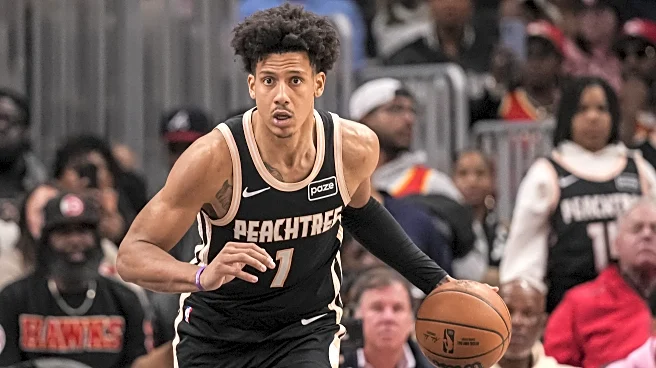



The Atlanta Hawks are red-hot as the NBA’s regular season winds down, having gone 15-2 since the All-Star break (14-1 in their last 15 games), soaring all the way up fifth place in the Eastern Conference standings in the process.
No, they haven’t faced the most arduous schedule, and the gap between tanking and non-tanking teams has been quite pronounced as of late, but even so, Atlanta has outscored their opponents by a whopping 230 points over this 15-game span – something only Oklahoma City and Charlotte
have done this season.

Now, with just nine games remaining, every fixture on the schedule carries a little extra significance as the Hawks jostle for postseason positioning in the East’s crowded middle tier – with just two games separating fifth from tenth.
Could this be the year Atlanta finally escapes the Play-In Tournament?
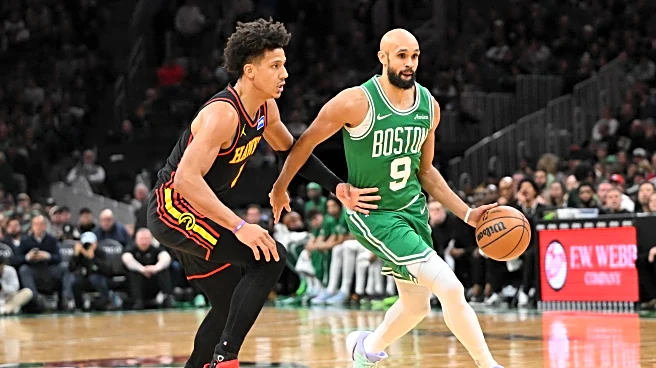
It won’t be easy*, but with the confidence that this team is playing with at the moment, it’s a real possibility. Make sure your seatbelt is fastened for what’s going to be a thrilling finish to the regular season. We’ll see if the Hawks can keep the momentum going against Boston tonight.
*Atlanta faces the sixth-toughest remaining schedule in the league
Ahead of the home stretch, let’s take a look at a few of the numbers behind Atlanta’s impressive form over the past few weeks.
Hitting the glass, and winning the possession battle
As one would expect given their lofty winning percentage and point differential over the past few weeks, the Hawks have been excellent on both sides of the ball since the All-Star break, with a big part of their success being their focus on winning the possession battle from night to night.
Looking at the team’s turnover margin, while forcing turnovers has been a priority all season long*, the Hawks have been extra-disruptive as of late – ranking third in defensive turnover rate (16.6%) and first (!) in points off turnovers (23.9 ppg) since the All-Star break, boasting the league’s fourth widest turnover margin over this span.
*Atlanta ranked eighth in defensive turnover rate (15.4%), and sixth in points off turnovers (19.8 ppg) prior to the All-Star break

In addition to winning the turnover battle, perhaps the most startling difference in the team’s post-All Star break form has been the improvement we’ve seen from them on the boards.
Prior to the All-Star break, rebounding was a weakness for Atlanta as they ranked just 27th in offensive rebounding percentage (27.3%) and 21st in defensive rebounding percentage (68.9%). From night to night, the second chance points margin was typically something they would have to overcome in order to win.
Since the All-Star break however, things have changed. The Hawks have ranked fourth in both offensive rebounding percentage (34.2%) and defensive rebounding percentage (74.0%), winning the second chance points battle by an average of 5.9 points per game in the process – the third widest rebounding margin and the second widest second chance points margin in the league over this span.
As noted in the intro, the Hawks have faced more ‘poodles’ than ‘predators’ over the past few weeks, a reality that’s hard to ignore when trying to figure out how exactly the team has pulled off this implausible shift in identity.
Through taking a look at the individual player rebounding numbers from before and after the break, you can tell who has been putting in a little more work on the boards as of late.


Jalen Johnson* and Onyeka Okongwu have continued to crash the glass at an impressive rate, while Dyson Daniels** and Zaccharie Risacher have both seen their rebounding numbers soar since the All-Star break – pulling down 11.2 and 11.4 rebounds per 100 possessions respectively. Jock Landale has been a steady force, particularly on the offensive glass. Meanwhile, Mouhamed Gueye and Jonathan Kuminga have both been outstanding in this area.
*Johnson is ranked 12th in rebounds per 100 possessions on the season (min. 41 games played)
**Daniels ranks eighth amongst guards in offensive rebounds per 100 possessions since the All-Star break

It’s been a staggering turnaround on the glass for Atlanta over the past few weeks, and while their recent games against Houston and Detroit have shown* that there is still room for improvement, the progress that they have made in this area over the course of the season has been very encouraging – and it’s a credit to the organization for addressing an area of need that they probably didn’t see coming prior to the season.
*Detroit and Houston are two of the best rebounding teams in the league, but even so, both teams posted 30% offensive rebounding percentages against Atlanta in their matchups over the past week. Against Houston, Atlanta really struggled on the offensive glass, grabbing just 19% of the available offensive rebounds and scoring just seven second chance points.
Checking in on the perimeter shooting
Beyond the boards, Atlanta’s recent success has also been reflected in the quality of looks they’ve been generating — and conceding — from beyond the arc.
On the whole since the All-Star break, the Hawks rank in the middle of the pack in three-point accuracy (35.9%) and volume (43.3% 3-point attempt rate), and are just inside the top ten in opponent three-point accuracy (34.3%) and volume (40.4%). But do the ‘closest defender’ numbers reveal any hidden truths?


In the first plot, focusing on the offensive shooting numbers, it’s encouraging to see that the Hawks have been generating a solid amount of ‘open’ looks from the perimeter, ranking ninth in ‘open’ three-point frequency while converting these looks at a healthy 37.9% clip. They also don’t appear to be outliers in terms of their frequency or accuracy on ‘contested’ and ‘semi-contested’ three-point attempts.
On the defensive end, the Hawks have done a really great job closing out on shooters in recent weeks, as evidenced by their opponents taking the third-fewest rate of ‘open’ threes and the fifth-highest rate of ‘contested’ threes since the All-Star break. While they are getting a little unlucky in terms of their opponent’s conversion rate on ‘semi-contested’ threes*, opponents have shot a league-low 15.7% (11-for-70) on ‘contested’ threes against them so it somewhat evens out.
*35.2%, eighth-highest opponent accuracy on this shot type since the All-Star break
Looking at the individual player’s numbers over this stretch, Nickeil Alexander-Walker has been on a shooting tear since the break, shooting 45.5% from deep on 7.6 attempts per game (more on NAW below). Additionally, I’m happy to report that ‘post-ASB Risacher’ is back, with the second-year Frenchman shooting 42.9% on 7.4 three-point attempts per 100 possessions after shooting just 35.2% on 8.1 attempts per 100 possessions prior to the break. Jonathan Kuminga (12-for-25) and Mouhamed Gueye (7-for-18) have also shot it well from the perimeter lately – albeit on limited volume.
What makes ‘NAW’ special?
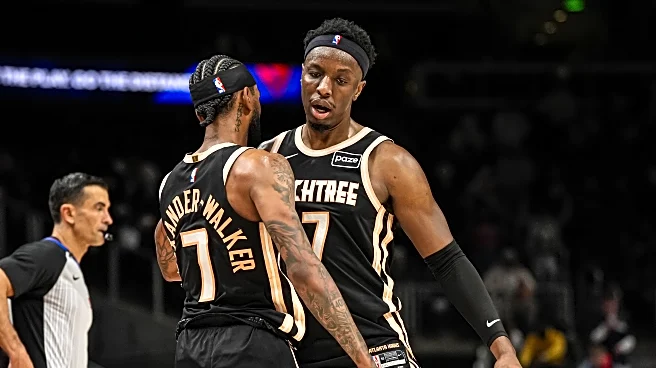
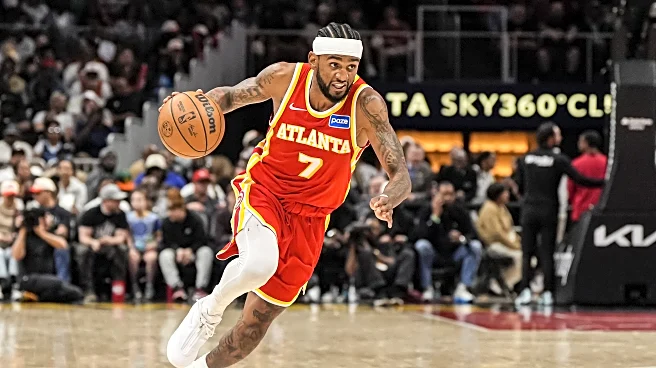
It’s been an incredible debut season for Nickeil Alexander-Walker, who has seen his numbers rise alongside his playing time in Atlanta, without sacrificing any of the efficiency or attention to detail that made him such a valuable role player in Minnesota last season.
NAW has put together quite a compelling case for this season’s Most Improved Player award, with per-game averages of 20.4 points, 3.7 assists and 1.3 steals while shooting 39% from deep and 90% from the free throw line. While he does a lot of things well, one area of his game that’s really impressed me this season has been his transition finishing ability.
This is a skill that was perhaps under-utilized* on a Minnesota team that ranked 25th in pace last season, however now that he’s playing for an Atlanta team that keeps one foot on the gas pedal at all times (ranked fourth in pace this season), we’ve seen him blossom into one of the league’s most efficient high volume transition finishers, ranking 13th in transition scoring possessions per game (4.8) and in the 74th percentile in efficiency (1.25 points per possession (PPP))
*NAW was quite efficient in transition last season (1.21 PPP), though he averaged just 1.7 transition scoring possessions per game.

NAW gets it done both inside and outside the arc in transition. Check out this composed finish in the lane against Miami from a few weeks ago.
From the Dallas game earlier this month, the Hawks force a turnover, and NAW is immediately off to the races, finishing off the possession with a dunk.
Against Detroit on Wednesday night, he showed off the shooting range with a couple of transition triples.
As a team, the Hawks have improved from 21st in transition efficiency (1.11 PPP) last season to 12th in transition efficiency (1.15 PPP) this season, and Alexander-Walker has been a big part of that improvement.
Another area of NAW’s game that’s really impressed this season has been his catch-and-shoot three-point shooting proficiency. Similar to his transition scoring, he was quite efficient on these looks last season, shooting a stellar 42.5% on 3.6 attempts per game for Minnesota. Now this season, he’s been able to maintain his efficiency while significantly increasing his volume of attempts, shooting 41.6% on 5.9 attempts per game in Atlanta – one of the very best marks in the league.

Lastly, as the awards races heat up towards the end of the season, it’s worth pointing out that Alexander-Walker has been pushing hard to make his case for the ‘MIP’ award*, as he is currently in the midst of one of the most efficient scoring months in the NBA – averaging 23.3 points per game on a ridiculous 74.6% true shooting percentage.
*Alexander-Walker currently has the second shortest odds (Fanduel) to win the Most Improved Player award this season
I plotted the players averaging 20 or more points per game in March, and as you can see below, Alexander-Walker has been the league’s most efficient 20-point scorer this month – beyond impressive for a player that averaged just 7.5 field goal attempts per game last season.

It’s been a darn near flawless first season in Atlanta for Nickeil Alexander-Walker and the cherry on top is that he is under contract for the next two seasons at just around 8.7% of the team’s salary cap (great value for a starter) with a player option for 2028-29.
As his improvement from last season to this one shows, Alexander-Walker might be entering his prime at 27 years old, but he is a player that continues to add to his game year after year. I’m glad he’s a Hawk, and I am excited to watch how he develops over the next few seasons.