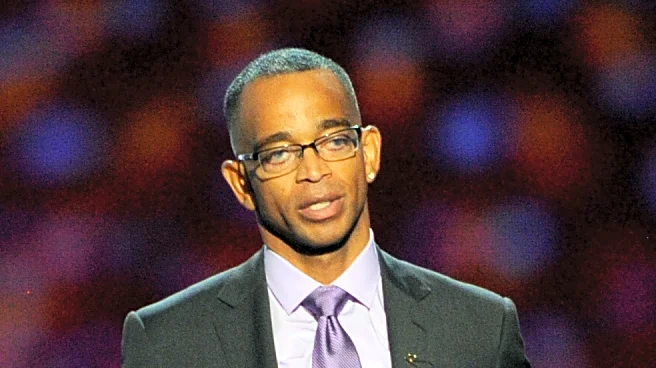




I never met Stuart Scott.
I really wish I had. I’m sure a lot of folks that got to enjoy him on ESPN wish they had. He hit ESPN at just the right time for me. I had just started high school when ESPN2 launched and he took a spot on their airwaves, but it wasn’t until my senior year that he really entered my life by anchoring SportsCenter. On my screen was this energetic anchor who not only had fun with the highlights, but he was also a proud Tar Heel.
Look, back in 1996, we didn’t have phones and the
Internet required a modem that would disconnect the moment someone else picked up the landline phone. Video? You were lucky if you would get a few seconds of grainy footage, and it was only when I got to UNC that I had access to speeds fast enough to play that. If you wanted sports highlights you had to watch SportsCenter. The real gem? Unlike today ESPN just…ran the same SportsCenter that they showed at 1 AM all the way until about noon. If some sort of breaking news happened they could always cover it, or put something on the Bottom Line, but really every morning before school I would wake up and get Stuart Scott going over the highlights.
Sports anchors were not supposed to really let you know they rooted for a team in particular. Even at the “fun” place of ESPN, most of the anchors came across so jaded to some extent about sports in general that while the highlights were fun, they didn’t seem like fans. With Stuart that changed, as he made it very clear he was from UNC.
Needless to say, every NBA player that would score would get a little “Tar Heel!” as he sunk a basket, and anytime that 96-97 Carolina team — Dean Smith’s last — would get a big win, it was so enjoyable to hear Scott call the highlights with a little extra pep that let you know he was personally happy at the result.
That same year, I got into Carolina myself. All throughout my time there — when I lived in dorms that had cable, mind you — I would still make sure to catch Scott calling highlights after big Carolina wins. By the time I graduated, he was a bonafide star — so much so that my class asked him to speak at UNC for the 2001 commencement.
Over time, he would host Late Night with Roy, and a whole new round of students got to experience his passion and joy for Carolina in person. Even after he was diagnosed with cancer, he still made those appearances, and it was a shock when he couldn’t. I was genuinely upset when I couldn’t make it to Chapel Hill to be at one of these Late Night with Roy’s in person.
A few years later, when his death was announced, I spent the morning glued to my TV watching people pour their heart out for a man that touched so many lives.
The ESPN 30 for 30: “Boo-yah: A Portrait of Stuart Scott” takes you through all of these, and somehow manages to do an amazing job of connecting you with the man who has been gone from us for over a decade now. What’s funny is that if you read Scott’s book, Everyday I Fight, most of the information wasn’t new. Hearing him and his family say it with archival footage put a different spin on it, though, and by the end tears were rolling down my face.
The reason this information wasn’t new to me was that I read Everyday I Fight in December of 2018 — two months into my own cancer journey. By that point, I had gone through several rounds of chemo and I was staring at a milestone birthday with a tumor in my body and taking poison to get rid of it. I knew of Scott’s journey through his 2015 ESPY speech, but seeing the words and reading it put a completely different spin on it.
There’s a part of the book where he says that members of the Cancer Club have this connection that no one else does. I thought after losing my own mother to the disease in 2010 I had an idea, but I really didn’t until I was going through it. The toll it takes on your body and the face you have to present to the world. I documented my road back in 2018 not to be some sort of inspiration — because I’m not — but frankly because I didn’t want to have to say the same thing over and over again. When you have cancer, you’re…the person with cancer. There are always questions, there’s the weight of having to put on a smiling face for the people worried about you while sometimes all you want to do is curl up under a blanket and succumb to the weakness. These are the things that people in the Cancer Club know. Reading Scott’s frank account of the things he went through — that we didn’t know as members of the public — hit home to me at that moment. The way he kept fighting was the kick in the rear I needed to keep going.
What the 30 for 30 does, though, is give you the side that members of the Cancer Club also know — the caregivers and the family. My wife had to put up with so much while I was sitting in an infusion chair then leaving with a bag dangling from my side with a slow drip chemo implanted in my chest port. Friends were amazing, but if you want to know pain — real pain — look at the pain of the people who were in Scott’s life during his fight, and the people who took care of him. Over a decade later, that pain is still etched on their faces. It’s not just the loss, it’s seeing that loss up close and having to deal with the scars that they knew they had to endure.
It’s just so funny to me that between Scott proudly embracing being a Tar Heel to speaking at my commencement, to his death from a disease that would ultimately find its way to me — his life ended up so intertwined with mine despite never meeting. I understand why Rich Eisen said he can’t bring himself to watch this documentary. If you’ve gone through the fight, it’s probably going to be a hard watch, too.
That said, it’s a must-watch. There have been plenty of alumni to have walked the brick at Carolina, but Scott may have been one of the most unique and his story is something that everyone should soak in. If you have full access to the ESPN app either through their Unlimited subscription or through your television provider, make sure you take some time to sit back and watch it. I promise you any sort of annoyances you’re dealing with in your life will pale in comparison to the story woven in this work. As we quickly approach eleven years since Scott left us, this 30 for 30 does an outstanding job of outlining his legacy. Hopefully that means it’ll never be forgotten.