
In the winter/offseason of 2006-07, the prized pitcher on the market was Daisuke Matsuzaka. The 26-year-old was posted by the NPB’s Seibu Lions after a decorated career with them that included a 2004 Japan
Series championship and a star turn in the inaugural 2006 World Baseball Classic, where he was MVP. Many teams were interested in Matsuzaka, including the Yankees. When the pitcher instead went to the rival Boston Red Sox, that felt a gut punch in the moment, although Matsuzaka didn’t necessarily live up to all the hype after a championship in his debut season.
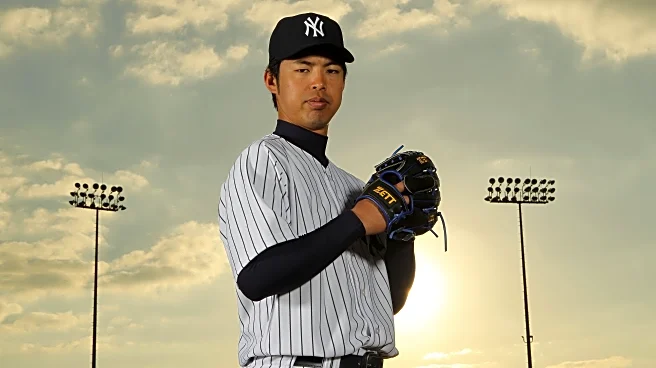
The Yankees decided to pivot and pursue another NPB starter. While he wasn’t as high-profile an arm as Matsuzaka, the Yankee career of Kei Igawa goes down as one of the most mentioned failures of the franchise in recent memory.
Kei Igawa
Signing Date: December 27, 2006
Contract: Five years, $20 million (plus a $26 million posting fee)
Having posted an 18-strikeout game in high school, Igawa was selected by the Hanshin Tigers in the second round of the NPB draft in 1997. While he showed potential, his early years were marred by wildness, including setting a record for wild pitches in the NPB’s minor league. However, his parent club weren’t going anywhere good in the standings, and gave Igawa a chance with the NPB’s Tigers in 1999, when he was just 19 years old.
Their seasons in the doldrums allowed the Tigers to let Igawa work through his issues, and eventually led to a breakout season in 2001, another good one the following year, and a dominant one in 2003. In the 2003 season, Igawa won both the NPB equivalent of the Cy Young and also the Central League MVP, having posted a 20-5 record with a 2.80 ERA and 179 strikeouts.

Igawa helped the Tigers to the Japan Series, although they fell to the Fukuoka Daiei Hawks in seven games, failing to break the “Curse of the Colonel.”
ERA-wise, Igawa took a step back the next two years, although he continued to strike out an impressive amount of batters. In addition to that, he helped the Tigers return to the Japan Series in 2005, where they fell short again. He bounced back in 2006, putting up a 2.97 ERA in 209 innings, while he put up his best season to that point in regards to limiting hits.
After the 2006 campaign, the Tigers agreed to post Igawa to let him pursue a career over in MLB. While he wasn’t the attention-grabbing name that Matsuzaka was, the Yankees and other teams saw him as a potential MLB-level pitcher. In the end, the Yankees won the right to negotiate with him, successfully bidding $26,000,194 as a posting fee. The “194” was to represent his NPB-leading strikeout total in 2006. After that, they came to terms with the player himself on a five-year, $20 million deal.
The Yankees didn’t have outsized expectations for their new pitcher. General manager Brian Cashman said they expected him to be a solid, back of the rotation arm. Unfortunately, Igawa wasn’t even that.

Igawa made his MLB debut on April 7, 2007, getting the ball for the Yankees’ fourth game of the season. He gave up a home run to the Orioles’ Nick Markakis in the first inning, and things didn’t get better from there. In five innings, he allowed seven runs on eight hits and three walks (they needed an amazing A-Rod-powered comeback in the ninth to win it). He was better in his next game, and then got his first career MLB win on April 18th. On April 28th, Igawa had to come in during the first inning in relief of an injured Jeff Karstens and threw six scoreless innings in a win over the Red Sox.
That ended up pretty much being the high point for Igawa’s debut season, though. In May, the Yankees sent him down to the minor leagues, hoping he could work through some mechanical flaws there. The Steinbrenners even overruled Cashman to hold onto him, nixing a potential midsummer waiver claim trade with the Padres. He would return to the big leagues in June and then again in September, but his overall season numbers were unsightly. In 67.2 innings across 14 games, Igawac coughed up 15 homers with a 6.25 ERA (73 ERA+) and a 6.37 FIP.
In 2008, Igawa failed to make the Yankees’ roster out of spring training. While injuries eventually led to his return to the majors, his 2008 ended up ever worse than his 2007, statistically. He only appeared in four innings for the Yankees in 2008, but his ERA ended up over 10, as he managed to allowed 13 hits over those 10 innings before finally being removed from the 40-man roster in July. Unfortunately for Igawa, he was also just OK at Triple-A that year, and he never got a chance to try and lower those numbers.
In fact, Igawa never got a chance to lower any of his career numbers—like his foreboding 6.66 career ERA—ever again. While he remained under contract with the Yankees for another three seasons (even continuing to live in Manhattan), the Yankees would never call him back up to the big leagues. In fairness, they made quite a number of improvements ahead of 2009, regardless of whether Igawa could pitch at the big league level or not. However, with an ERA over four at Triple-A in two of his remaining three years in the Yankees’ system shows that Igawa probably couldn’t have pitched in The Show.
In a 2011 interview with the New York Times, Cashman did not mince words in an assessment of the Igawa contract:
“It was a disaster. We failed.”
While Igawa stated a preference to remain in the U.S. after his Yankees’ deal expired—not a surprise, as he had turned down buyout opportunities in ’08 and ’09 that would have allowed him to return to Japan earlier—that chance never came. He eventually gave up the ghost, signed with the Orix Buffaloes, and played three more seasons in NPB.
Not that I find it likely that Igawa could’ve success anywhere, but Igawa’s signing really did feel like a kneejerk response to Matsuzaka going to Boston. After his contract expired, Igawa gave an interview where at an early meeting after his signing, Cashman and Joe Torre asked Igawa what his best pitch was. That feels like something that you should know before signing a guy. It’s not as if the contract was a massive one that hamstrung the Yankees, but it certainly was an annoying one.
See more of the “50 Most Notable Yankees Free Agent Signings in 50 Years” series here.