

The A’s know they have very limited ways to improve their starting rotation given the limitations their current home field, recent records, and still modest payroll create. They also know they won’t compete for anything until they vastly improve their pitching.
This dilemma gives the new front office one tempting but dangerous choice: to dip into their pool of talented position players in order to land a quality SP. This, of course, weakens the lineup and while at a glance the lineup looks “pretty
good” in fact their away splits reflect that when not in a hitter’s paradise this group performed poorly, literally last in all of MLB in BA, OBP and OPS.
Some of this can be attributed to how many scrubs they wound up starting in place of injured players, but even when the full group was on the field they were about league average. So it’s unclear how wise it would be to subtract a key player from this group and some of it depends on how confident you are about the would-be replacement.
Here’s a breakdown of the A’s options as I see it, listed in alphabetical order.
Henry Bolte
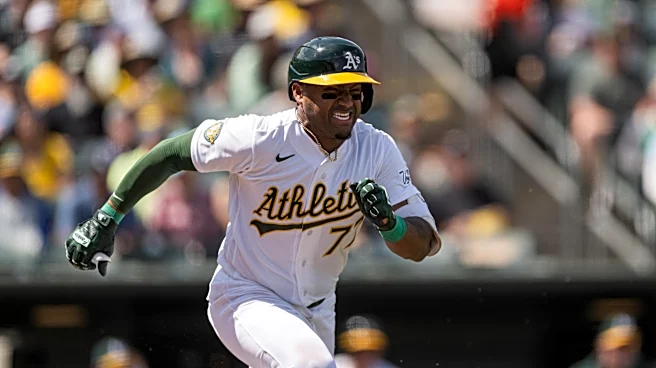
Butler and Gelof have demonstrated how quickly a player can vacillate between “untouchable” and “afterthought” but it’s hard to imagine the A’s dealing Bolte and getting better when they have such difficulty attracting stars and could have one under their fingertips.
Bolte proved to be a true center-fielder, putting up impressive metrics in his rookie season (+5 DRS/+5 OAA) and his hitting appears to have only scratched the surface — and yet his BA and OBP were excellent at .277 and .359. Bolte is also just 23 with 6 years of contract control left.
To trade Bolte would mean losing the only CFer they have who can hit a lick and the only true lead off hitter they have. Now would you trade that for an actual “ace”? Maybe so, but with still only 119 big league games under his belt Bolte is unlikely to bring back an ace. He would, however, garner quite a sizable return — and leave the A’s with a sizable gap in the outfield.
Lawrence Butler
Butler is the most enigmatic of the group having been arguably the worst player in MLB the first half of 2026 but turning it on to approximate the brilliance of 2nd half 2024 after the All-Star break (he batted .280/.357/.496, 130 wRC+).
As a result it’s honestly hard to assess what his trade value is. His contract, which has 5 years and $12M left on it, along with a $4M buyout, creates some liability and yet if he’s performing well it’s a very team friendly deal.
Still the contract, along with the huge swings in performance, lower Butler’s trade value considerably and so he’s not likely to return the A’s a quality SP in any deal. As a result he’s probably the wrong guy to move until he has a strong start to 2027 and rebuilds his value as being truly a 130 wRC+ type of hitter.
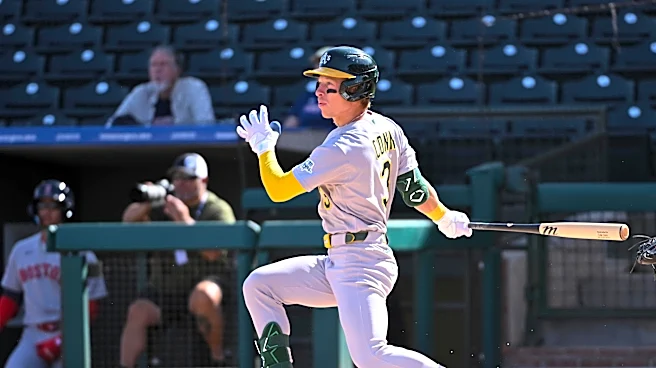
As far as replacements go, if you trade Butler he’s most likely being replaced soon by the up and coming Devin Taylor, who could well match Butler’s hitting and doesn’t have a huge bar to reach to match Butler’s fielding. So that part might be tempting if the A’s believe Taylor is close to being ready for the big leagues.
Zack Gelof
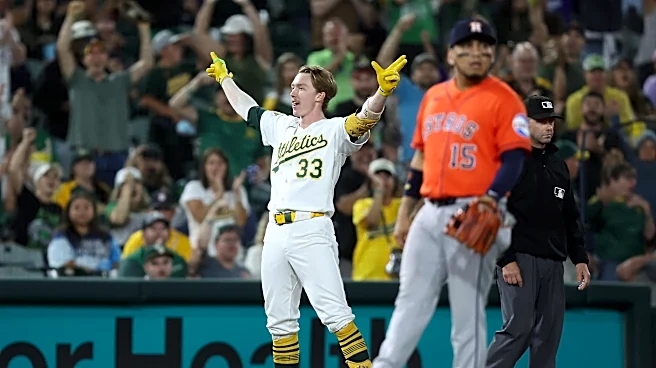
Gelof gets a fair amount of play in trade rumors, partly because one MLBTR writer predicted he would be the Yankees starting 3Bman in 2027 (just a throwaway line of a guess) and mostly because so many on AN had written him off he was “good as gone” in a lot of people’s minds anyway.
What has emerged about Gelof is that he can excel defensively at multiple positions. He is a plus defender at 2B who acquitted himself very well at 3B, the position he was playing when the A’s drafted him. He also looked very solid in CF, so much so that if the A’s were to trade Bolte, Gelof would be a natural replacement for an every day gig. He was also good in LF when he wasn’t being attacked by vicious wires.
At the plate Gelof seemed to finally cure what ailed him. He’ll always strike out a bit but his .256/.322/.475 line was very comparable to his burst-onto-the-scene rookie season (.267/.337/.504). And his 24.6% K rate was the lowest of his career.
Because of his positional versatility and because his excellent defense means his bat doesn’t have to be spectacular for him to be a positive contributor, one can imagine teams are willing to give up a fair bit to acquire Gelof.
How much would the A’s miss Gelof if they used him to get a quality SP? Some of that depends on health because if you aren’t losing infielders and outfielders left and right you can probably do without a Gelof better than if you constantly need to slot a player in somewhere without missing a beat — something Gelof allows you to do because he has mastered so many positions.
His replacement would likely be Joshua Kuroda-Grauer in an every day role and Denzel Clarke forced to be the primary CFer if Bolte goes down. At some point, of course, Leo De Vries is expected to join the big leagues but his timeline was severely impacted by his shoulder surgery.
So with only Gelof, Wilson, Kuroda-Grauer currently in the 2B-SS-3B mix, the A’s infield really isn’t so deep as to be able to absorb a big loss until De Vries arrives.
Shea Langeliers
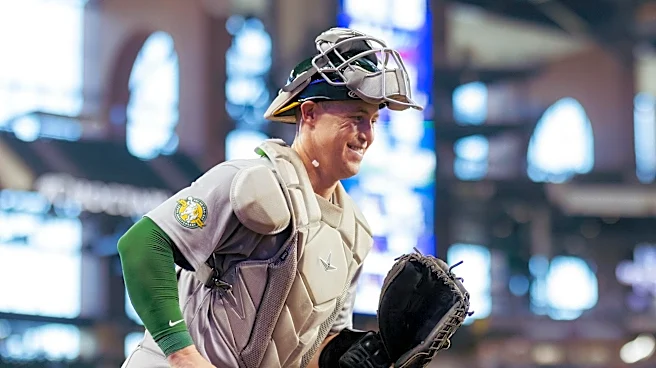
Langeliers’ name probably comes up the most here, possibly in part because his name has come up repeatedly in rumor mill/reporting sites like MLBTR. One of the obvious pluses is that Langeliers, considered one of the top overall catchers in the AL, would command a significant return with 2 full years still remaining on his contract.
The knee injury put a wrench in things. If the A’s were considering dealing him at last year’s trading deadline, those conversations were tabled when Shea went under the knife. He returned in September running like he never left so his trade value likely isn’t diminished by fears that he hasn’t returned to 100% health.
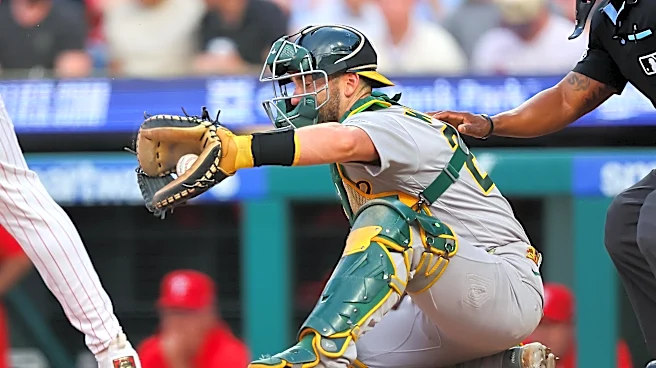
The biggest problem for the A’s is that they simply don’t have a replacement for a primary catcher, not now and not for a while. Cole Conn and Davis Diaz are both interesting and alliterative, but both profile not really as primary starting catchers so much as versatile part-time catchers. Conn is closer but to deal Langeliers is to accept a huge drop at the catcher position for the known future.
Langeliers is also not without fundamental flaws that could mitigate a ginormous return. While Shea is well regarded around the league, his blocking is well below average and though he was torrid in April and July, very good in May, he was also terrible in June and September.
That September line (.250/.294/.292) could be some cause for concern as he came back from a knee injury to slug just .292. But likely any team pursuing Langeliers would be prepared to give up the kind of quality SP (or SP prospect) the A’s are seeking. It’s just a matter of whether it’s worth it to weaken the catcher position so much.
Brent Rooker
Rooker is one of the A’s biggest clubhouse leaders and for that reason alone he is likely not being moved anytime soon. But he also may not have the kind of trade value he had after his spectacular 2024 season. Since then he has had an “ok” 2025, a disastrous start to 2026, and a season ending surgery.
Just as importantly, Rooker is a DH who plays the outfield like my Aunt Bertha plays the bass guitar. Keep in mind that my Aunt Bertha can’t even get her arms around the instrument and you’ll understand how bad Rooker is in the OF.
Teams are going to be rightly hesitant to presume Rooker’s bat will revert back to his 2024 prowess and he has no positional value. As a result he has more value to the A’s than he has trade value to other clubs. With his contract, recent performance, and recent injury, I very much doubt any team will dangle the kind of pitching the A’s covet.
Tyler Soderstrom
Soderstrom is a somewhat natural choice because he has generally performed when on field, Taylor waits in the wings to replace a corner outfielder, and with a fair contract (6 years/$80M left) that has team control through at least 2032 his trade value should be high.
A big unknown, though, and one which could impact his trade value, is his outfield defense. Soderstrom was a gold glove finalist in his first year playing LF, but dropped considerably in 2026, from +10 DRS to +3 DRS and from +5 OAA to -8 OAA.
If the hip impingement is thought to be the sole cause and if Soderstrom is deemed to be 100% healthy going into 2027, perhaps teams will view him like a gold glove finalist. But the questions currently remain unanswered and there could be teams that want to see him perform for a couple months post-surgery before pulling the trigger on a sizable return.
There is also the reality that the A’s core is somewhat RH heavy with Rooker, Gelof, Langeliers, Bolte, Wilson, Clarke and Kuroda-Grauer all RH batters. Other than Soderstrom only Butler and Kurtz offer a LH bat. That being said, you know who else bats LH? Devin Taylor.
Jacob Wilson
Wilson is another core player often discussed on AN as a potential trade chip to acquire starting pitching. He was the starting shortstop in the 2025 All-Star game, is currently carrying an ongoing MLB record for consecutive errorless games at SS, is on a reasonable contract (6 years/$69M left plus a buyout), and probably has a lot of trade value.
Yet every day fans know that Wilson’s stubborn lack of plate discipline and limited range make him a flawed player as currently constituted. For all his talent Wilson had put up just an 83 wRC+ when he hit the IL for the season.
The idea of Wilson as a trade chip seemed more viable when Leo De Vries wowed everyone at spring training and looked like he was very much in line for a call up sometime in 2026. Then he had a finger injury followed by continued shoulder problems, had surgery on the shoulder and won’t be back even to the minors until around mid-May.
So similar to trading Gelof, moving Wilson means leaving the infield quite short-handed. The A’s do at least have a true SS in Kuroda-Grauer, but that leaves a hole somewhere on the infield at 2B or 3B. And that’s before any injuries.
How’s that for some in-depth analysis trying to be objective and not leaning in any particular direction. Reading through all this, is there one of these players you think the A’s should use as a chip to significantly bolster their rotation? Or should they stand pat with the core and add pitching in other ways?
Without question it’s a tough call for Taylor Smith and Cam Castro, with any trades needing to be made in November — or they may have to wait until March.