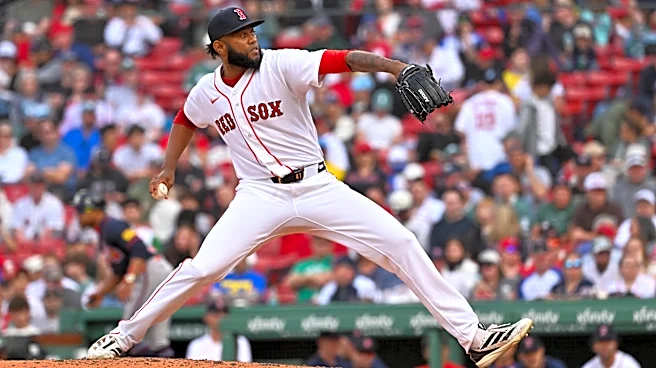








There’s no such thing as too much pitching. Pitchers inevitably get hurt. Relievers go on cold stretches. Starters tire down the stretch. The baseball season is a war of attrition, and pitchers are the main casualties. There’s a reason why teams hand out minor league deals to every pitcher with a pulse during Spring Training. For the Red Sox, one of those pitchers was Tyron Guerrero.
Coming into the season, Guerrero had last appeared in the Majors in 2019 when he posted an ERA over six with the Miami
Marlins. Since then, he’s spent time in Japan, Mexico, and the minors. His numbers didn’t jump off the page in any of those stops, but if you watch him pitch for about three pitches, you’ll know why he was given a chance back in the States — he’s huge, and he throws really, really hard.
Guerrero’s sinker averages 99.9 miles per hour. Among pitchers with at least 150 pitches thrown (an arbitrary threshold to include Guerrero), that ranks 5th in all of baseball, behind names such as Jacob Misiorowski and Mason Miller. When you figure in his 7.1 feet of extension, the perceived velocity is 101.3 mph, 3rd among 507 qualifiers. That isn’t enough to make someone stick in a major league bullpen, but it’s enough to give them a chance.
Guerrero has taken that opportunity and run with it. He allowed 4 earned runs over his first 3 appearances, ballooning his ERA to 9.82. Since then, he’s been lights out, allowing just 1 earned run over his last 9 appearances (7.2 innings). He’s struck out almost 40% of the hitters he’s faced this season and walked just one (2.1%). Last time he was in the majors, he walked over 16% of hitters while striking out 19.9%. In Japan in 2025, he walked 8.5% and struck out 21%. We’re dealing with a small sample this season, but the improvement is clear. The question is: is it for real, or is it small sample luck?
With so few appearances under his belt, it’s hard to say if Guerrero is for real, although there are some encouraging signs. The biggest of which is that he’s in the zone. His sinker’s zone rate is over 60%, the highest mark of his career. I don’t have his rates from overseas, but I’d be willing to bet the current mark is above those marks as well. His slider – his most used secondary pitch – is also above 50%. Those two pitches have posted well above average strike rates, helping him limit the walks.
Each pitch also provides whiffs. The sinker’s swinging strike rate is over 15%, while the slider’s is almost 20%. At 100 mph with movement, that mark feels sustainable. The slider, as long as it’s near the zone, should also continue to return whiffs as hitters gear up for the fastball. Seriously, how do you hit this?
That’s really all there is to the arsenal. Throw one million miles per hour and dare people to hit it. Every now and then, pull the string and drop in a slider. It’s a formula that’s worked for a long time and will continue to work as long as Guerrero is in or around the zone.
That’s all fairly uninteresting, but the Red Sox do have an interesting choice to make with Guerrero. Given his age (35) and contract, he’ll likely never hit free agency (barring a significant chance to the CBA). According to Spotrac, the righty is still pre-arbitration, meaning he has several years of team control before he hits free agency.
As I mentioned in the open, contenders always need bullpen help. Adding strikeouts to a bullpen is always an attractive proposition. Guerrero, with his premium velocity, might become a name that teams are circling ahead of this year’s deadline. But, should the Red Sox trade him? Dan Secatore described the tightrope the Red Sox need to walk at this year’s deadline yesterday. The pitching is excellent, the offense is not, but they’re not that far off from competing in a top-heavy American League. Despite a disastrous season, they’re poised to turn things around in 2027 and compete again with a few shrewd moves to bolster the lineup. Adding prospects, either to flip for other pieces or to develop into major leaguers, is never a bad idea.
At the same time, the Red Sox have not developed relief pitchers over the past several years. Aroldis Chapman and Garrett Whitlock have been staples at the back of the bullpen for a few seasons now, but Chapman is all but certain to be traded. Justin Slaten has excellent stuff, but he’s struggled with injuries and hasn’t been dominant for a long stretch. Outside of those finds, the Red Sox haven’t had any late-inning arms to rely on. With that in mind, do you hold onto Guerrero and trust him to continue his dominance, slotting into the seventh or eighth inning for 2026, or trade him now while there is some value to be had? I lean towards the former, but could see the argument either way.