

The focus around the Colorado Rockies is rightly on who will be traded before Monday afternoon and what the club might receive in return. There is also a real possibility that the final transaction list will underwhelm a fan base expecting the new front office to reshape the roster more aggressively.
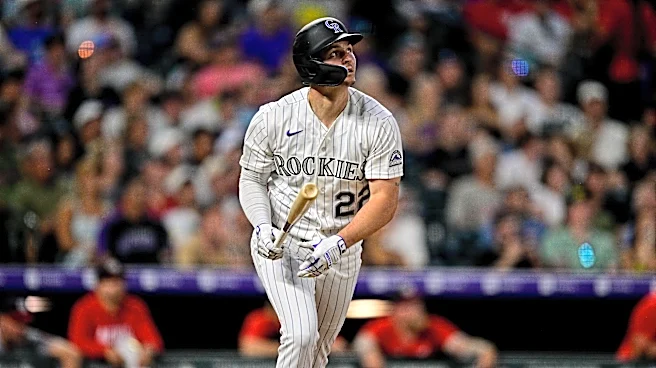
One player likely to remain when the deadline passes is Troy Johnston.
What happens after that is less obvious.
Johnston has produced enough to remain interesting, but Colorado’s roster is filling around
him. TJ Rumfield has established himself at first base. Cole Carrigg should continue receiving regular opportunities in center field, while his athleticism and arm also allow him to impact either corner. Charlie Condon is not far off at Triple-A.
The rest may depend on Jake McCarthy and Mickey Moniak.
If one or both are traded, Johnston would have a clearer route to occasional corner-outfield, designated-hitter and bench opportunities. If both remain, those openings could become scarce.
That does not mean Colorado should manufacture playing time for Johnston. He should not start ahead of Carrigg, block Condon, displace Rumfield or take opportunities away from McCarthy and Moniak if they remain in purple.
His value must exist around those players, not ahead of them.
The question is whether Johnston can produce enough to remain useful wherever the roster has room for him.
Johnston earned a longer look
Through June 30, Johnston was batting .312/.378/.435 with an .813 OPS and a 113 wRC+ in 284 plate appearances. He ranked third on the team in wRC+, trailing only Rumfield and Moniak.
Johnston was not merely surviving. For three months, he was one of Colorado’s most productive hitters.
His limited home-run power and modest defensive value prevented that production from making him a long-term lineup fixture, but it established something useful. Johnston reached base, accumulated doubles, and consistently produced competitive plate appearances.
He was particularly effective against right-handed pitching. Through July 30, Johnston had hit .317/.395/.438 in 258 plate appearances against righties, compared with .203/.238/.284 in 81 plate appearances against left-handers.
Neither sample provides a final answer, particularly the smaller number of opportunities against lefties, but the difference is large enough to shape how the Rockies should view him.
Johnston is not an everyday answer. He may be a matchup answer.
That platoon shape did not suddenly appear at Coors Field. Johnston received 121 plate appearances with the Miami Marlins late in 2025, batting .277/.331/.420 overall and producing a .787 OPS against right-handed pitching.
Across two organizations and parts of two seasons, he has shown that he can provide useful major-league at-bats against right-handers.
That production is the foundation of his value. Everything else—his remaining options, contractual control, defensive coverage and personality—only matters if the bat supports it.
July complicated the evaluation
Johnston hit .157/.246/.196 with a 13 wRC+ in 61 plate appearances during July. His season line fell to .289/.358/.399.
That does not erase three productive months, but it changes the nature of the evaluation. Johnston is no longer simply showing what he can provide. He is trying to prove that his earlier production can return.
His playing time also declined as Moniak returned, McCarthy earned additional opportunities, and Carrigg entered the lineup. That reduction made sense. Colorado had players who had earned priority.
Irregular work may have made it more difficult for Johnston to regain his timing, but it does not excuse the results.
A player trying to establish value in a flexible role must eventually demonstrate that he can contribute without receiving four plate appearances every night.
Still, Johnston’s July was more complicated than the slash line suggests.
His strikeout rate improved from 17.3% through June to 14.8% in July. His hard-hit rate climbed from 34.8% to 46.7%. He continued putting the ball in play and frequently hit it with authority.
The problem was where that contact went.
Johnston’s ground-ball rate jumped from 37.7% through June to 51.1% in July. At the same time, his line-drive rate collapsed from 28.9% to 11.1%.
His BABIP followed, falling from .374 through June to .178 in July.
Some regression from the earlier BABIP was always likely. Johnston does not possess elite speed or overwhelming exit velocity that should consistently support a mark near .400. A drop that extreme, however, cannot be explained by regression alone.
Johnston did not stop making contact, and he did not stop hitting the ball hard. He began driving far too much of that contact into the ground instead of producing the line drives and gap contact that supported his first three months.
A hard ground ball remains a ground ball.
Johnston does not necessarily need to discover more raw power. He needs to start producing line drives and gap contact again.
His options preserve flexibility
Johnston’s defensive profile is limited, but he can cover enough positions to remain useful.
The available metrics suggest he is playable at first base and left field without identifying him as an impact defender at either position. Statcast credits him with plus-one Outs Above Average at first, while his overall outfield work has been below average and right field has been less convincing.
He can also take designated-hitter at-bats.
That gives Johnston a narrow but identifiable package. The Rockies know where he can stand, which pitchers he should face and what kind of offensive contribution they are seeking.
Unlike Tyler Freeman or Edouard Julien, who have struggled to pair theoretical flexibility with adequate production, Johnston has produced enough against right-handed pitching to support a more specific assignment.
More importantly, Johnston still has three minor-league options and remains under club control.
That saves the Rockies from a binary keep-or-cut choice. Colorado can use him as a selective platoon bat when the major-league roster requires one, option him to Albuquerque when it does not and recall him when an injury or roster opening creates a need.
His options give the Rockies flexibility. They do not create an obligation to find him at-bats.
The offseason question can wait
If McCarthy and Moniak both remain beyond the deadline, Johnston may be pushed into an optionable depth role.
That is not necessarily a failure. Colorado does not need to decide today whether Johnston belongs on the 2027 active roster.
Keeping him through the deadline, evaluating him through September and carrying him next season are separate decisions. His options allow the Rockies to preserve a potentially useful player without promising playing time.
Johnston’s clubhouse presence is absolutely a positive, but “clubhouse guy” is an empty designation without adequate production.
Johnston is unlikely to be part of the next contending Rockies team, but he can still provide value as an optionable platoon bat against right-handed pitching. Whether he does will depend on the line-drive contact that disappeared in July.
If the line drives return, the Rockies may have a useful player.
If they do not, Colorado might have its answer.
On the farm
Triple-A: Albuquerque Isotopes 14, El Paso Bootmakers 8
The Albuquerque Isotopes (53-53) hit five home runs and collected 15 hits in a 14-8 victory over the El Paso Chihuahuas (44-61), who played Thursday night under their alternate “Bootmakers” identity.
Albuquerque scored four runs in the first inning and never trailed, although El Paso twice pulled within two. Zac Veen helped create separation both times. He opened the fifth by winning a seven-pitch battle and crushing a 93.7 mph sinker for his 19th home run of the season. The ball left his bat at 110.8 mph and traveled 412 feet to right-center.
After El Paso cut the lead to 6-4, Veen came through again in the sixth. He stayed on a 91.1 mph changeup in an 0-2 count and shot a 98.2 mph double into right field to score Drew Avans and Ryan Ritter. It was Veen’s 28th double of the season, and he finished 2-for-5 with a walk, two runs and three RBI, raising his season total to 75 RBI.
Nic Kent went 3-for-4 with a walk, three runs and three RBI while recording his first multi-homer game of the season. He jumped on a hanging 86.1 mph slider in the seventh and drove it 403 feet to center field at 102.9 mph for his 12th homer, then added No. 13 in the eighth.
Vimael Machín doubled home two runs in the first and hit his 11th homer in the eighth, finishing with three RBI. Adael Amador added Albuquerque’s fifth home run in the ninth, driving his eighth of the season 406 feet at 104 mph. He finished 2-for-6 with two RBI, while Ryan Ritter went 2-for-5 with a walk and scored twice.
Patrick Weigel opened the game with two hitless innings and struck out two. Parker Mushinski earned the win with 1.1 scoreless innings, and John Brebbia worked around two hits in a scoreless ninth.
Double-A: Double Header
Game One: New Hampshire Fisher Cats 3, Hartford Yard Goats 2
The Hartford Yard Goats (53-46) managed only five hits and went 0-for-5 with runners in scoring position in a 3-2, seven-inning loss to the New Hampshire Fisher Cats (47-51).
All three New Hampshire runs came on solo home runs. Carter Cunningham opened the scoring in the third, J.R. Freethy tied the game in the fourth and Dub Gleed broke the 2-2 tie with a leadoff homer in the seventh.
Jared Thomas provided all of Hartford’s offense with his first Double-A home run, a two-run shot to right-center in the third that briefly gave the Yard Goats a 2-1 lead. Thomas finished 1-for-4, while Aidan Longwell recorded his 24th double of the season.
Hartford had an opportunity to extend its lead in the fourth, loading the bases with one out. Zach Kokoska then lifted a fly ball to left, but Jack O’Dowd was thrown out at home to complete an inning-ending double play.
Michael Prosecky allowed one run across three innings, giving up four hits without a walk. Cade Denton took the loss despite striking out six and issuing no walks over four innings.
Game Two: Hartford Yard Goats 9, New Hampshire Fisher Cats 8 (9 innings)
The Hartford Yard Goats (54-45) scored twice in the bottom of the ninth to walk off the New Hampshire Fisher Cats (46-51), 9-8, and earn a split of Thursday’s doubleheader.
Hartford fell behind 4-2 before erupting for five runs in the fourth. Cole Messina cleared the bases with his 15th double of the season, and GJ Hill followed with a two-run homer to right-center, his 12th, to give the Yard Goats a 7-4 lead.
New Hampshire responded with three solo home runs over the next two innings. Dub Gleed went deep in the fifth before Cade Doughty’s sixth-inning homer tied the game at 7-7. Neither team scored in the eighth, despite Hartford putting runners at the corners with nobody out.
The Fisher Cats moved ahead on a balk in the top of the ninth, but Hartford answered. Messina walked and Hill reached on a bunt single to load the bases behind automatic runner Mike Antico. Jared Thomas brought home the tying run with a groundout, and Dyan Jorge followed with a fielder’s choice that scored Messina for the walk-off win.
Messina went 2-for-3 with a walk, three runs and three RBI. Hill finished 2-for-3 with a homer, a sacrifice bunt and three RBI, while Jorge reached twice and drove in two.
Nathan Blasick kept Hartford alive with 2.1 hitless innings, striking out three. Jarrod Cande allowed an unearned run in the ninth but earned the win when the Yard Goats rallied in the bottom half.
High-A: Spokane Indians 7, Vancouver Canadians 5 (10 innings)
The Spokane Indians (48-52) erased an early three-run deficit and scored twice in the 10th inning to defeat the Vancouver Canadians (44-56), 7-5.
Spokane trailed 3-0 before tying the game in the fifth. Kelvin Hidalgo and Clayton Gray opened the inning with consecutive hits, and a balk brought home the first run. Tommy Hopfe followed with an RBI groundout before Cameron Nelson tied the game with a two-out RBI single.
The Indians moved ahead in the sixth when Roldy Brito walked, stole second and scored on Tanner Thach’s sacrifice fly. Hopfe added an RBI single in the seventh to extend the lead to 5-3, but Vancouver scored once in the eighth and tied the game on Tucker Toman’s two-out solo homer in the ninth.
Brito delivered the decisive hit in the 10th, lining his third High-A double into left field to score automatic runner Tevin Tucker and Robert Calaz. It was Brito’s 23rd double overall after he hit 20 with Fresno. He finished 1-for-4 with a walk, a stolen base, one run and two RBI.
Hopfe drove in two runs, while Hidalgo went 2-for-4 with a run and his 16th stolen base. Gray doubled, walked and scored twice.
Ismael Luciano provided 2.1 scoreless innings with three strikeouts after Vancouver scored three runs against Isaiah Coupet. Dylan Crooks allowed the tying homer in the ninth but recovered to strike out two in a scoreless 10th and earned the win.
Single-A: Fresno Grizzlies 17, Ontario Tower Buzzers 2
The Fresno Grizzlies (56-44) drew 13 walks and scored 17 runs on 12 hits in a 17-2 rout of the Ontario Tower Buzzers (55-45).
Fresno took control immediately with a five-run first inning. The Grizzlies drew six walks and capitalized on a throwing error that allowed two runs to score before Juan Castillo, Landyn Vidourek and Ashly Andujar each drew a bases-loaded walk.
The lead remained 5-2 until Cristian Arguelles broke the game open in the sixth. With two outs, Arguelles launched his first Single-A home run, a three-run shot to center field that extended the advantage to 8-2. He finished 1-for-5 with a walk, one run and three RBI.
Fresno added five more runs in the seventh and four in the ninth. Roynier Hernandez went 2-for-4 with two walks, three runs and three RBI, while Andujar finished 2-for-5 with a walk, three runs, two RBI and his third stolen base. Castillo reached four times, going 2-for-3 with two walks, two runs and an RBI.
Vidourek drove in three runs, and Derek Bernard added two RBI and scored twice. Every hitter in Fresno’s lineup reached base, and eight of the nine scored at least once.
Bryson Van Sickle earned the win after allowing two runs on seven hits over 5.0 innings. He struck out seven without issuing a walk. Easton Marks completed the game with 4.0 scoreless innings, allowing three hits and two walks while recording his first save.
Padres Targeting 3 Outfielders at Trade Deadline, Including 2 From NL West Rival | SI.com
Could the Rockies help solve San Diego’s biggest offensive weakness? The Padres are reportedly targeting three left-handed outfielders at the deadline—including Mickey Moniak and Jake McCarthy.
Is Hunter Goodman’s defense really something to worry about? | purplerow.com
Teams may be questioning Hunter Goodman’s defense, but the numbers suggest those concerns are overstated. His framing has slipped, yet he remains adequate behind the plate—and one of baseball’s best catchers at using the ABS challenge system.
What should the Rockies do with Brenton Doyle? | purplerow.com
Brenton Doyle returned to the Rockies on Friday, but the question remains: Where does the two-time Gold Glove winner fit in an increasingly crowded outfield?
Join the conversation!
Sign up for a user account and get:
- Fewer ads
- Create community posts
- Comment on articles, community posts
- Rec comments, community posts
- New, improved notifications system!
Please keep in mind our Purple Row Community Guidelines when you’re commenting. Thanks!