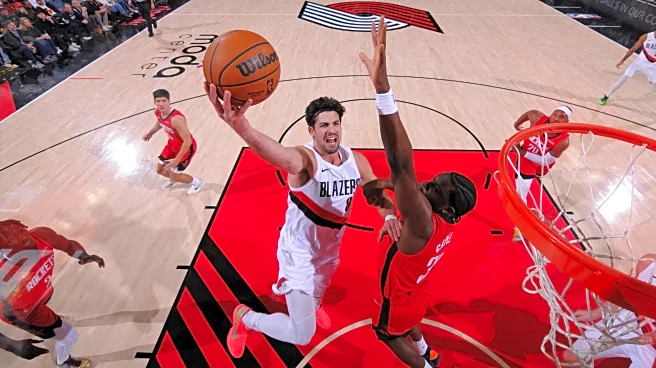


Deni Avdija’s ascension to stardom has coincided with criticism surrounding his foul-drawing. Naysayers have accused Avdija of engaging in foul-baiting, placing him in the same grifting echelon as reigning MVP Shai Gilgeous-Alexander, or long-time free throw merchant and superstar Luka Doncic.
It would be difficult to flatly deny that Avdija receives favorable treatment from the referees – both the eye test and free-throw related statistics affirm that observation. Per Cleaning the Glass, Avdija gets
fouled (or for the haters, “gets the foul called”) on 22.3% of his shot attempts, good for the 98th percentile among all forwards. Those of you with “Hater Brain Syndrome” may feel vindicated by these statistics, but the story is much deeper than that.
During Avdija’s final season with the Washington Wizards in the 2023-2024 NBA season, Avdija had already emerged as one of the league’s preeminent whistle-getters, sitting at the 97th percentile for shooting fouls drawn. Even in the prior season, Avdija was above average, representing the 74th percentile of the same statistic.
Avdija has been trending towards becoming one of the league’s best foul-drawers, even before the “superstar whistle” allegations. Now, the question becomes: is this trend consistent with playstyle? It has been a common retort to claim that Avdija’s league-leading drives-per-game result in his astronomically high free throw rate. Using statistics alone, can we prove this to be true?
To test this, I pulled the drives per game of wings and forwards who play more than 29 minutes per game, and performed a regression analysis against those players’ shooting foul drawn percentage (SFLD%). This cutoff creates a dataset with high-minute ball handlers, which allows us to test Deni’s foul-drawing acumen against other scoring threats. Keep in mind that there may be some inaccuracies in the data, given that Cleaning The Glass (the website that provides SFLD%) filters out garbage time, and the NBA stats website does not. That said, if we correlate SFLD% against drives per game for wings and forwards, we get the following visualization:

This shows a relatively stable correlation between drives per game and shooting fouls drawn. Deni’s position, though seemingly an outlier, doesn’t actually fall beyond the expected number of calls he should receive given his insane rate of drives per game. The stats tell us that drives are a predictor, but perhaps not the most effective one. This is where Avdija’s “grifting” comes into play.
(Jimmy Butler is highlighted because phew, he is a skilled at getting calls. Off-ball actions and cuts don’t count for “drives per game,” so the Warriors offense — and some elite grifting — likely account for this massive disconnect)
Avdija seeks out body contact against his opponents. This can be by way of plowing directly into his opposition, or lowering his hands and performing a rip-through like motion, among other tricks. His proclivity to seek out contact creates a great number of fouls. Now, to the haters’ credit, sometimes, the body contact Avdija creates, and receives foul calls for, could certainly be considered marginal (whatever that means, nowadays). However, the past few years have clearly demonstrated the NBA’s preference for offenses. Avdija is leveraging the attitude of the league and its officiating to create advantages, similar to Shai Gilgeous-Alexander, Luka Doncic, and other offensive juggernauts. Avdija would not be a foul-baiter if the referees did not explicitly reward his playstyle.
Don’t Hate The Player, Hate the Game
Unfortunately, the variability in the game of basketball means stats can only predict so much. Drives per game don’t represent the best correlate to foul calls, but neither does any other stat that I tested. Perhaps someone with more than an A-minus in their one and only statistics course can come in and correct the mathematics here. However, I think the truth is a lot more obvious: Avdija’s immense volume of drives and expansive bag of downhill tricks allows him to generate more fouls than the typical player. Did I mention that he is in the 100th percentile for usage rate among forwards? All of these factors contribute to a lot of free throws, but not more than should be expected given the context. Rather than channel hate and anger towards Avdija, the masses must recognize that this is the type of play that the league has incentivized for multiple seasons: Offense above all else. As long as the rules that allow offenses to continue to expand – and gradually evict defensive competitiveness – players will continue to be rewarded for barrelling head-first into defenders.
Avdija is not an outlier, rather, he has leveraged the current state of the game to his advantage. We would all be better off appreciating his exceptional talent, rather than degrading him for the league’s larger failure of minimizing defense.
Bonus Graph
We can also do a multi-variable regression analysis, comparing usage rate against our other predictors. The findings aren’t significantly more telling, though it does improve our correlation slightly.