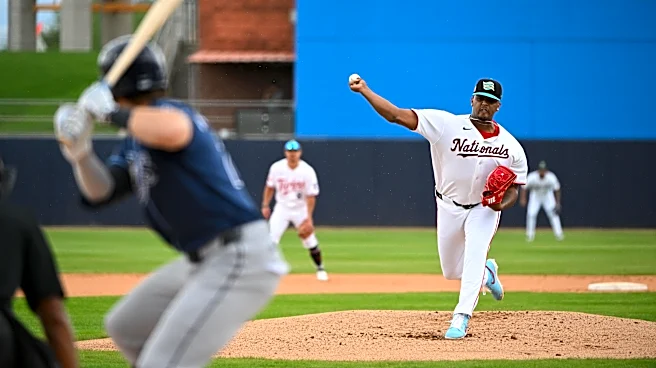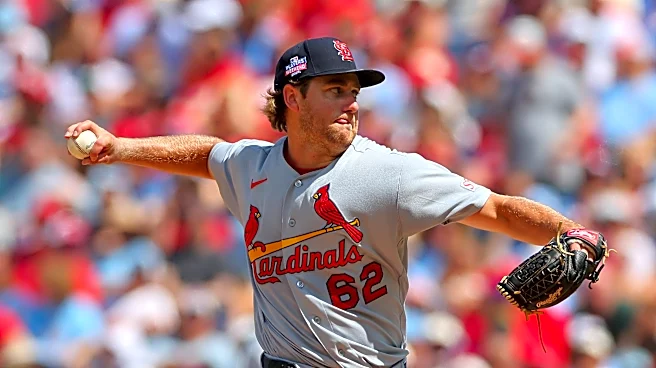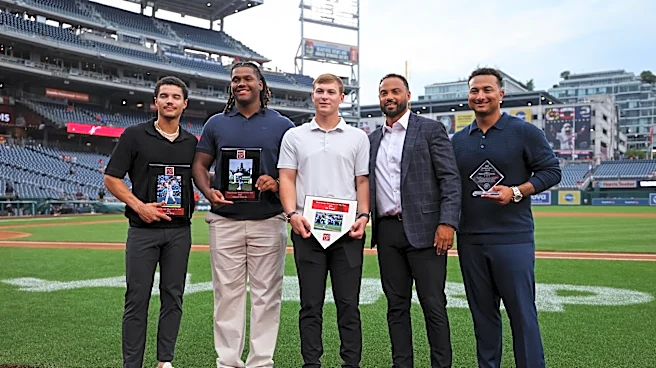



When Paul Toboni took over as Nationals President of Baseball Operations last year, one of his main goals was to build a “scouting and player development monster”. We saw plenty of development at the MLB level, but the minor leagues is where we really saw the fruits of Toboni’s labor. The Nationals farm system is the healthiest it has been in a long time.
The system may have had more blue chip talent in the 2023-2024 days, but we have never seen this kind of depth. Having a deep farm system allows
you to do a lot of different things. You can replace players easily, but you can also use that depth in trades to fill holes that way. It is a luxury the Nationals have not often had.
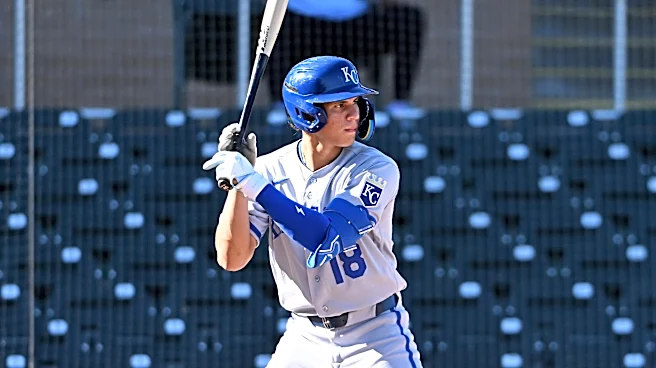
While the depth is the strength of this farm system, the Nats do have a blue chip prospect at the top. Even though he was the first overall pick in the 2025 draft, Eli Willits still exceeded expectations in his first full pro season. He hit .265 with an .869 OPS across three levels and reached Double-A as an 18 year old. Willits also slugged 14 homers despite not being known as a power hitter.
Willits established himself as a top 10 prospect in the sport this year, and should be the Nats shortstop of the future. As the son of a big leaguer, Willits has an extremely high baseball IQ, hardly ever makes errors and puts together great at bats. He also runs very well, has good bat to ball skills and is growing into average power. You can see the path to 5 WAR seasons for Willits. His game reminds me a lot of Geraldo Perdomo on the D-Backs.
However, this Nats system is a lot more than just one player. In fact, I think the most impressive part of this year at the minor league level is how many players just came out of nowhere. Several players who either weren’t on my radar or had fallen off the radar had ultra impressive seasons.
A great example of that is Maxwell Romero Jr., who had a breakout year. The 25 year old catcher was a 9th round pick in 2022, who was having an unremarkable pro career in the Nats organization. He was closer to being released than making the big leagues. The arrival of the new regime changed everything for him though.
Romero started the year in AA, where he used his power and patience to destroy the competition. Once he got to AAA, he just kept on rolling. For the season, Romero hit .253 with an .879 OPS and 23 homers. His .881 OPS in AAA was nearly identical to his .878 mark in AA.
Despite the great season, Romero is not even a top 30 prospect in the Nats system according to MLB Pipeline or Baseball America. Despite his production, Romero strikes out a ton, nearly 35% of the time on the season. There is a decent chance he does not turn into anything at the MLB level. However, before this season, he did not look anywhere near a big leaguer. Now he has a path to being a power first backup catcher.
Cayden Wallace is another one of these older prospects who broke out. Given Wallace’s previous pedigree and contact skills, I am probably higher on him. The point is that the Nats are developing a lot of bodies who deserve looks in the big leagues. Not all of them will work out, but some of them will. That is why you build depth.
Another reason to build farm depth is for trades. Whether it is this offseason, next deadline or in windows to come, the Nats now have plenty of ammunition to make trades. If the Nats are in the playoff mix in July of next year, they have the chips to make a deal and still have a healthy farm.
Honestly, I think the system could take further strides in 2027. There are a lot of players who seem to be right on the cusp of breaking out if they can fix one or two things. An example of that is Miguel Sime Jr., the Nats 4th rounder from 2025. Sime has a triple-digit fastball and a pair of nasty breaking pitches with his slider and curveball. When he is at his best, Sime is devastating.
In his first pro season, Sime did a lot of great things. He pitched to a 2.99 ERA with 130 strikeouts in 72.1 innings. Batters only hit .153 against Sime this season. However, he walked 64 batters in those 72.1 innings. He will never have great control, but if he can drop his 20% walk rate down to 12-15%, he can become a top 100 prospect. Ronny Cruz, Coy James and Landon Harmon are also good examples of prospects on the cusp of fully breaking out.
Not all of these guys will hit, but Toboni has collected such a stockpile of talent, the odds are that enough of them will. He is also not leaving this purely to chance either. The way the Nats have improved their player development system has been really impressive. Minor League results are not everything, but you can see the improvements in those results.
In 2025, the Nats had a .463 winning percentage in the minors and a -377 run differential. As of August 25th of 2026, which is the most recent data I could find, the Nats had a .520 winning percentage and a +124 run differential. On the pitching side, no organization had allowed fewer runs than the Nats. Hopefully that starts to translate at the MLB level as well.
We also got to see Paul Toboni’s first draft as the Nats POBO this year. The first player he selected was Chris Hacopian, a local kid with an elite bat. Hacopian only played 13 pro games, but we got a glimpse of his exciting offensive toolset. He has a great combination of contact skills, plate discipline and raw power. The key will be to tap into that raw power more consistently in games.
I am excited to see how this first class of Toboni recruits performs next season. We could be watching them very closely given the lockout situation. If we can only watch the minor leagues to start next year, there are certainly worse farm systems to be monitoring.
It is only year one, but we are already seeing Paul Toboni make a serious mark on this organization. I touched on some of the standouts on the farm, but there are so many others. We wrote about Seaver King’s rise the other day and there are many more exciting players in the system. Hopefully these prospects can link up with the Nats existing young nucleus and make up the foundation of the next great Washington Nationals team.